Monday, April 07, 2008

Documented Aliens

It seems to me that upbringings have themes. The parents set the theme, either explicitly or implicitly, and the children pick it up, sometimes accurately and sometimes not so accurately. When you hear people talking about their children, you can often detect a theme. The theme may be "Our family has a distinguished heritage that you must live up to," or "We are suffering because your father deserted us," or "No matter what happens, we are fortunate to be together in this lovely center of the earth," or "There are simply too damn many of us to make this thing work." Sometimes there is more than one theme. It's possible, for instance, for an upbringing to reflect at the same time "We are suffering because your father deserted us" and "There are simply too damn many of us to make this thing work."

When I was a child, I was under the impression that one of the themes of my upbringing was one of the grand American themes: "We have worked hard so that you can have the opportunities we didn't have." It's a grand theme partly because in its purest form it requires a suppression of ego: it requires people to think of their lives as taking meaning largely from being a transition to other people's lives--their children's. Thinking back on it, though, I realize that I might have misread the signals slightly. I think what was actually being presented was the immigrant subsection of that theme: "We have worked hard so that you can have the opportunity to be a real American."

Our immediate family would not have struck anybody as foreigners. Both my father's parents and my mother's parents were born in Europe, but my parents were thoroughly American and did not even speak the language of their parents. We didn't live in an immigrant neighborhood; but I suspect that a lot of people I went to school with had grandparents who came from Europe. But the Old Country -- untalked about, basically unexperienced by anyone in our immediate family --was a constant in our lives. My mother was born in West Virginia, but her parents were Polish-Catholic immigrants. Her father had one of those bone-chilling immigration stories often heard among people of that generation. Having immigrated to America from Poland to work as a coal miner, in about 1910, he died in the prime of his life in 1918 in the great influenza epidemic that swept the country, indeed, the world, following World War I.

We used to go to Atlantic City every summer when I was a boy. To some degree I associated Atlantic City with immigrants. In the late 1950s, about fifteen years after the end of World War II, Atlantic City was a vacation refuge for many holocaust survivors. The numbers stamped on the arms of survivors were always prominent in their beach attire. I remember asking my mother as a small boy on the beach about all the people with numbers stamped on their arms. "Sh," my mother would say. "They were in concentration camps." "What are concentration camps?" "Sh," my mother would repeat. I knew I had stumbled onto a forbidden subject.

My father's immigrant parents had died years before I was born. The only person one generation older than my parents who survived into my childhood was my mother's mother, who spoke English with a heavy accent. By chance, the only other old person I saw regularly when I was a boy also had an accent; the mother of my father's friends with whom we stayed each year in Atlantic City.

Only one generation removed from me, my father had grown up in an entirely different world. His was a world populated by immigrants. He had a friend, Benny Rossman whose household was a free-wheeling, lively place filled with Yiddish talk and Yiddish newspapers which, at first, neither of his parents could read. My father was one of the many people always stopping by the Rossman household, some living there for a few months if they had no work . . . always good food. My father used to drop by the Rossman's house for fried matzoth and to hear his friend Benny's father sing songs in Hebrew and Yiddish. Benny, the youngest son, was early assigned the task of asking the four traditional questions at the yearly Seder, the Passover feast, held in the Rossman house as a mark more of tradition and of generational continuity than of religious observance.

My father had an American's optimism -- the sort of quiet confidence about the future that was not always easy to find among the immigrants or first-generation Americans of that era. The people who came to this country in the great wave of immigration from Europe may have looked on America as the land of opportunity, but their experience over generations in the Old Country must have told them that they would be doing well to keep their heads above water. One part of them was waiting for their American disaster. A story is told that in one immigrant home at the close of the Passover seder, at the moment when it was traditional in Jewish homes to offer in the final prayer the phrase "Next year in Jerusalem," the father would push back from the table and say, in Yiddish, "Iber a yor nischt erger" -- "Next year no worse."

Sunday, April 06, 2008

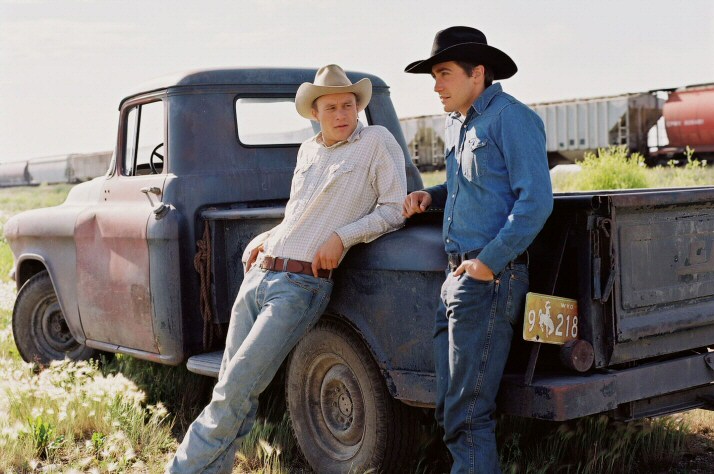
Not Quite Brokeback Mountain

This post is a parody of my nonsexual obsession with Brian Brown, the manager of my local public library.

March 7, 2006 - I didn't want it to happen. I didn't see it coming. I'm a husband. I'm a dog owner. I'm the head librarian of the Cleveland Park Neighborhood Library. I'm every reader's go-to guy. But today, while I was watching the patrons in the library, I realized, beyond a shadow of a doubt: Oh, my God, I'm in love with Gary Freedman.

March 8, 2006 - I hoped that once I'd written it down, once I could actually see the words in these most secret diary pages, my undeniable feelings would, I don't know, just somehow vanish. I mean, I've never even thought about another fellow that way, not ever--O.K., Ted Kennedy at the pool in those sopping madras trunks. But, hey, give me a break--I'm Irish Catholic. But this is different. This is oddly . . . sacred. Those liquid, burden-of-decency basset-hound eyes. That long, luscious, well-formed jaw. That cinder-block thick, brushed-chrome hair. I'm so ashamed. And I've never felt more alive.

March 11, 2006 - I couldn't keep it to myself, not one second longer. I had to tell someone I trusted absolutely, someone who I thought just might understand--Decosta. I said, "Bill, I have something to tell you. Something powerful. Something true. I'm madly, hopelessly, soul-quiveringly in love with Gary Freedman." He stared at me. Had I made a terrible mistake? And then he grasped my forearm and whispered, in that irresistibly soothing voice, "Brian--you, too?" Bill and I were clutching each other's shoulders, hopping up and down, squealing, wondering which of us he'd choose. "Oh, but you're so much smarter and tougher," Bill insisted. "But you are so friendlier," I told him, ruefully. "That's true," Bill admitted, trying not to sound smug. "Stop smiling like that," I snapped.

March 21, 2006 - I had to tell my wife, Paige. It was the right thing, the only decent thing, to do. I knew there'd be tears, and I knew she'd need Entenmann's. But I sat her down and I said, "Babe, we've had a good, long run. You made me quit shaving, you've watched me and my beard grow and mature, you've shown me what books are for. But we can't live a lie--I love Gary Freedman." She took a deep, sharp breath. Could she ever forgive me? Could she make any sort of life for herself? "That bitch," she finally hissed. "I knew it. I knew he wanted you. I'm just a librarian's wife; how am I supposed to compete with that?" Paige seethed, lunging for another box of Munchkins.

April 1, 2006 - I'm giddy, I'm like a child, like a butterfly, like a bookmobile--if only those roving librarians could share this happiness, and barrel down a highway of love! I called my folks and I told 'em, "Mom, Dad, I'm in love with Gary Freedman and nothing can stop me!" There was a brief pause, and then I heard my mother say, "I win the bet." "Are you sure about this, son?" my dad asked. "Remember when you were in love with that Barbara Eden person?" "But I found out she wasn't a real genie," I protested. "Gary, though--he's pure magic!" Mom sighed heavily, the way she did after she found out my pension plan had vested. "Are you going to do the right thing?" my dad demanded. "Are you gonna marry him?" "Of course!" I all but sang. "I'm going to join the Log-Cabin Republicans, and vote for David Catania in the next election, just for the two of us! Nobody else! I want it to be special."

April 2, 2006 - I've figured it all out--we'll be co-equal partners. Whenever we have to make a decision, like whether to buy the New York Times best-seller or the Los Angeles Times best-seller, I'll just gaze across the breakfast table and ask, "Honey, what do you think?" And he'll twinkle impishly--I'll teach him how--and he'll say, "Sweetheart, you know best." "No, you," I'll insist, roguishly. "Stop it," he'll pretend to bark, his eyes telling a different story. And then we'll take turns reading the Sunday-edition book reviews, and if one of us disagrees we'll just cock a thumb at the other guy and chirp, "Barnes and Noble!"

April 3, 2006 - There's only one thing left to do, the final step on my escalator to ecstasy: I'm going to tell him. I've got his top secret, ultra-personal cell-phone number, and I've planned it out. If someone else answers, I'll be really polite. I'll just say, "Could I please speak to Gary? And, remember, whatever happens, you'll still have access to Gary's cell phone." And then he'll get on the line and I'll say playfully, "Guess who this is!" And after he tries "Will Ferrell?" or "Whoopi?" I'll blurt, "No, Silliness! It's Brian Brown!" And he'll ask, "How do I know it's really you?" And I'll say, joyfully and honestly looking the phone straight in the eye, "Because--I love you!" And he'll gasp and then, the words aching with emotion, he'll plead, "Don't say something like that. Not unless you really mean it." "Of course I mean it," I'll declare. "I've never meant anything so much in my entire life! This morning Decosta asked me if I was high on painkillers!" "Oh, Brian," he'll coo. "I've hoped . . . I've dreamed . . . but I've never dared to imagine that you might feel this way, too! Can we head to your house and pretend to clear out the garage together?" "Name the date!" I'll crow. It's going to be so incredible; he's gonna make me the happiest guy since--well, all I can say is, this is so University of Maryland! I'm picking up the phone, I'm dialing, it's ringing, he's answering! Wish me all the lovingest luck in the world, here I go!

And yes, Brian's wife is, in fact, named Paige. The head librarian is married to a woman named Paige. You can't make up stuff like that. Oh, and David Catania--he's the gay Republican member of the D.C. City Council. His domestic partner is named Brian. You can't make that up, either.

Wednesday, April 02, 2008

The Supplicants at the Arch: A Parable

In the shade of a high sandstone arch, a troop of watchmen guard the main point of entry into the city's Imperial Plaza, a heavily fortified area west of the Great River, from which the officials of the New Order govern. The arch was built a few years ago by the Emperor, now dead, in imitation of ancient gates that once protected the city from foreign invaders. The people of the city now call it the Gate of Supplication.

Early each morning, before the sun grows dangerous, crowds of people gather at the Gate of Supplication. Some are job seekers, while others are protesters carrying banners. Demonstrators bring their causes here and sometimes turn into rioters. People hand out lists naming family members executed by the Old Order or carry letters addressed to the chief officials that govern the city. With the Old Order overthrown, most of the people don't know where to take their grievances and petitions, where to unload the burden of their personal histories. So, like supplicants to the Caliph of ancient Constantinople, they bring them directly to the Gate of Supplication. But few people have the credentials to enter the Imperial Plaza, and there are few, if any, watchmen with the necessary credentials to allow access to the Gate. The people stand on one side of coils of wire, gesturing and trying to explain why they must get in; on the other side stand armed watchmen, doing twelve-hour shifts of checkpoint duty, keeping them out.

One day in July, a tiny woman in a salmon-colored veil stepped out of the crowd and thrust a handwritten letter at one of the watchmen. She was a schoolteacher, about thirty, with glasses and thick white face powder and an expression so pointedly solemn that she might have been a mime performing grief. Her letter, which was eighteen pages long, requested an audience with the chief officials of the New Order. It contained a great deal of detailed advice on the need to govern the city with justice and mercy. She was having trouble sleeping, she said, and had all but stopped eating.

A man with a cane hobbled from the line. His left hand, wrapped in a bandage, was missing the thumb. He explained to the teacher that he had been paralyzed in a terrible accident while attempting to flee the city, and that at some point he had lost the piece of paper entitling him to hospital care. Now that the officials of the New Order were in charge, he felt emboldened to ask for another copy--and so he had come to the Gate of Supplication. The man, unshaven and wretched-looking, began to cry. The teacher told him not to be sad, to trust in God, and to speak with the watchmen at the checkpoint. He shuffled back in line.

"Please, sir, can you help me?" the teacher continued. "I must work with the New Order, because my psychology is demolished. Not just me. All the people. Psychological demolition."

The woman did not have the necessary credentials, and was turned away by the one watchman present at the scene who had the necessary credentials to permit access to The Imperial Plaza.

Wednesday, March 26, 2008

The Dinner Party

20 May 2009

Dear Mr Freedman,

Thank you for putting me onto your ingenious piece. It's quite an assemblage! It's a problem publishing things, but perhaps the NY Wagner Society has a website which can post it or at least link to it.
Best wishes

Paul Lawrence Rose
Professor of History
The Pennsylvania State University

Dear Mr Freedman


Many thanks for sending me The Dinner Party, which I enjoyed very much indeed. It is highly original (as far as I know) and very cleverly put together. I'm sorry to say that it's not quite right for us, however, and I hope you will be able to get it published elsewhere.


with all good wishes


Barry Millington

Editor, The Wagner Journal

Saturday, September 1, 2007


The text of "The Dinner Party" can be found at the following site:

Monday, March 17, 2008

Like a Genie in a Bottle

My personality is a collection of errant genies evaporating into and materializing, helter skelter, from a bottle. One genie, one fragment of my personality, is a poet drafting his verses out of things most people cast aside. He has a withdrawn and private nature. Another genie is very sensitive; like porcelain, he is easy to crack. He appears fragile to those who don't know him too well; but woe to whoever offends him. Paradoxically, another genie is good old plastic; he won't crack no matter what you do with him. Then there is the comedian: shy by nature, but at times excitable. He is able to lose his inhibitions at times and has a tone of voice that gently mocks and questions not just others but himself as well. Another genie is outrageous and outspoken, relishing the shock value of his actions and comments, and often clashing with others. His disarming smiles never look like smiles; they appear more like preludes to an irrepressible and nervous hilarity. He is the wild one. Another genie is the calmest among us, and seems to recede and fade into a pale register. He can manipulate an unsuspecting victim into bending his will. And yet another genie vacillates between his desire for independence and his need for approval, who lacks the perseverance to finish whatever he starts.

The genies do not comprise a total personality. There are vacant portions of my personality, whose absences are more real than their presences. I am like a figure in a photograph, slightly out of focus, blurred, somehow distant. It's as if I am partly hidden behind something -- another person, a tree, peering out, like an imp intruding roguishly on a scene I have not been invited to. I appear absent-minded, frowning, as if unaware that I am being photographed. The genies of my personality are like the Cheshire cat, appearing and disappearing at unexpected turns.

The truth is I can't describe myself -- the I of my being: I am my own definition. One can only say that I am I. If you get to know me, you will slowly see each of the genies appear in turn. Gradually, each one gains an outline and a shape, becoming his own inimitable self.

My room is our sanctuary, our self-contained universe, mocking the reality of the city that sprawls outside the door. I feel the presence of the world only through the disembodied noises emanating from outside my window, or through the occasional laughter and footsteps in the corridor beyond my door.

I need you, my readers, to imagine us, for we won't really exist if you don't. Against the tyranny of time and reality, imagine us the way we sometimes don't dare to imagine ourselves: in our most private and secret moments, in the most extraordinarily ordinary instances of life, listening to music, reading a book, walking down a shady street.

Saturday, March 15, 2008

Cezanne at the National Gallery of Art

I went to see the exhibit "Cezanne in Provence" at the National Gallery in Washington. There is a show-within-the-show that arrives midway through the oils in the exhibit. In two rooms are 29 sheets of paper, each lightly touched. Their thoughtful, pale beauty -- tender and alerting -- refreshes the exhibit the way a demitasse of iced sorbet interrupts the feast.

Twenty-nine watercolors by Paul Cezanne (1839-1906). He did the finest late in life. You seldom get to see so many. They're different from his canvasses, especially the early ones, whose thick and oily paint he spread like butter with his palette knife.

Cezanne's late watercolors aren't thick with color. They're largely white paper. That whiteness is, of course, the light source of these images, which appear, when you first see them, to be made of heart of light.

This is how he did them: With a bright sheet set before him, he would look at Provence. Sunbaked rock and tree, greenery and mountain. And while looking at the landscape he would touch the paper gently in two ways -- rhythmically, with a graphite pencil, and wetly, with a brush. His dripping brush left wet marks that, once they had dried, would leave stained into the paper tinted see-through veils in closely sequenced colors as thin as Chinese tea.

Lesser water color painters use their pencil for drawing the outlines of things, and for shading them, and their colors for coloring in. Not Cezanne. He didn't want flat, uninflected, Japanese-print colors. "Without volume," he insisted, "there are only cartoons." He didn't want outlines either. He called the tempting inclination to "circumscribe the contours with a black line" a "fault that must be fought at all costs." He had something else in mind.

Deconstructing beauty is usually a chump's game, but Cezanne's late watercolors seem to call for deconstruction, for the painter had a system, and he asks your eye to track it. You can count every separate pencil stroke. You can count each colored blotch.

Watercolors die. Many of Cezanne's, exposed too long to sunlight, have faded irretrievably. Those chosen for the show by curator Philip Conisbee are exceptionally bright. He could not have selected sheets much richer than these.

Thursday, March 13, 2008

Long Day's Journey Into Night: A Monologue

There's something that people need to ponder about me which actually opens them up to the whole arc of writing. What does it cost to be an artist? What did it cost me to be Gary Freedman? What being Gary Freedman cost Gary Freedman was a normal relationship with a mother, it cost me a normal relationship with a father, cost me a happy marriage that never took place. It cost me children I never had. It cost me the friends I never had because I didn't know how. I had never learned that. Now you say, that happens to a lot of people. It does. But not everybody can write about it. Not everybody is really willing to look deep within themselves and see what's going on. Not everybody is able to invest energy into writing about the question, "What am I doing?"

But I am capable of that: writing about my life and those I have known. And that's hard. It is hard to take a pencil and say: This is me in the deepest part of my gut. And this was my mother, and this was my father, and this was all the people who were close to me. And they all in some respect were strivers and failures. That's not an easy thing to say. And what it cost them--artists--what it cost me, I am not sure our artists are truly appreciated and recompensed for their effort.

A long journey into the unknown, into night, we shall eventually fold into it. That is a journey where I put myself. I have put my family on the stage, so to speak, in an effort to try to understand. Now that could be described as a cruel thing. Because I expose everybody. Honesty and truth are hard. Truth is clean but it's hard. And I have spoken the truth about those closest to me.

In my life I was not given the grace, the opportunity, to work things through with my sister, with my mother, with my father. Is that not the case with so many of us? In the here and now. In the tyranny of the moment. The tragedy of time. We so often can't finish things. Art finishes the things that life leaves unfinished.

To a remarkable degree my whole life has gone into the making of my project, as if the truth it conveys and feelings it lays bare were almost more than I could endure in life. Haunted from the start by memories of my past, my whole life has been a kind of seeking flight, a restless search for meaning and identity, reality and truth. At once an escape from and a search for the gorgons of my past and the oblivion I feel at the center of my soul.

"You're the most conceited man I've ever known," a friend once remarked of my habit of continually looking at myself in mirrors. "No," I replied, "I'm just trying to make sure I'm still here."

It was a great mistake my being born a man. I would have been much more successful as a seagull, or a fish. As it is I will always be a stranger who never feels at home. A person who doesn't really want what others want, and who is not really wanted, who can never really belong. Who must always be a little in love with death.

My life has been a turmoil and I spent my life trying to understand something of that turmoil. And I see the turmoil in others. I see the torture in people because I feel it in myself. I feel that in myself--the pulling apart, I was being pulled apart by the questions that I introduced into my life.

These are the age old questions, I suppose, of life itself. Who am I? And where do I come from? And do I have a part in my own fate? Am I simply a checker on the board, being moved around? Do I belong to anything, to anyone? To whom do I belong? To God, who seems to be abandoning me?

I am someone who has suffered terribly as a result of my complete fealty to a vision of the truth, to a notion that there's a depth, that there's a profundity, that there's great complexes and abysses of meaning underneath the surface of life, and that our job as artists and as people is to dig, and to go deep, or to dive, as Melville kept saying, deeper and deeper and deeper. And that it hurts, and that the more deeply you dive you're at more risk of being dismantled or crushed. But that's what your job is. You don't flinch from it. In me I see this absolute God-ordained mission, which is to keep searching, even if in the process you discover that there is no God. It's a terrifying sort of mandate. But it also, I think, should be the mandate of all artists, and, in a way, of all people.

Wednesday, March 12, 2008

The Summerwind's Wild Chase

Sir Goosefoot, Lady Pimpernel,
Now quickly duck,
because the summer wind's wild chase is coming.
Hesitant the midges fly,
from the reed-lined grove,
the wind engraved the water's silvery disc.
It's worse to come, than you ever imagined;
Ho! Eerie sounds waft over from the beeches!
It's St. Johns dragon with his red fiery tongue,
and the black meadow dew, a shadow bleak and dead!
What a surge and swaying!
What a hustle and ringing!
Into the ears of the corn slashes the foul-mooded wind,
so the cornfield whispers and trembles.
With its long legs the spin fiddles,
and torn away is, what she busily wove.
Tinkling the dew comes down from the hills,
Stars shoot and vanish at the blink of an eye;
Fleetingly the moth rustles through the hedge-rows,
the frogs jump to watery shelter.
Quiet! What may be the wind's wish?
If the withered leaf it turns,
it searches for those gone too early:
spring's blue-white blossomy seams,
the earth's fleeting summer-dreams --
they are long gone to dust!
But up to the tree-tops
It goes to loftier spaces,
Because up there, as intricate as dreams
it thinks the blossoms to be!
And with wondrous sounds
in their leafy crowns
it again greets
the slender beauties.
Look! Now that's over too.
Over lofty steeps it twirls on free
to the lake's blinking mirror,
and there in the wave's neverending dance,
in the star's pale reflection
it peacefully rocks to sleep.
How quickly the quiet came!
Ah, how light and bright it was!
Oh, rise from the blossom tiny lady-bird,
And ask your beautiful wife to make a lively dance in the sunshine.
Already the waves dance at the cliff's edge,
already the snail glides through the grass,
now the birds of the wood rise,
dew shakes off the blossom from its wavy hair
and looks out for the sun.
Rise, rise, you flowers to bliss!

Tuesday, March 04, 2008

The Song of the Thames Daughters

The river sweats
Oil and tar
The barges drift
With the turning tide
Red sails
Wide
To leeward, swing on the heavy spar.
The barges wash
Drifting logs
Down Greenwich reach
Past the Isle of Dogs.
Weialala leia
Wallala leialala

Elizabeth and Leicester
Beating oars
The stern was formed
A gilded shell
Red and gold
The brisk swell
Rippled both shores
Southwest wind
Carried down stream
The peal of bells
White towers
Weialala leia
Wallala leialala

Saturday, March 01, 2008

The Dismal Science

I stick my finger into existence -- it smells of nothing. Where am I? What is this thing called the world? Who is it who has lured me into the thing, and now leaves me here? Who am I? How did I come into the world? Why was I not consulted?

That's Kierkegaard. Soren Kierkegaard, one of the fathers of existentialism. He was not a lot of fun at parties; I can tell you that. Human life is not designed for pleasure, Kierkegaard tells us, yet in the time given to each of us for our own existence, we strive for happiness in order to escape anxiety and the deep, hopeless depression which is despair. But there is no escape -- no matter how pleasurable and comfortable we make our lives in order to hide from the truth. For the truth is, Kierkegaard insists, that all of us live in anxiety and despair. This is the universal human condition. We suffer from anxiety even when we are not aware of it, and even when there is nothing to fear, nothing in the objective world to feel anxious about. This is because at bottom, says Kierkegaard, our anxiety is not objective at all, it is subjective anxiety -- it is the universal fear of something that is nothing, it is the fear of the nothingness of human existence.

Wow! And they call economics the dismal science!!

Friday, February 29, 2008

Dupont Circle

What makes me feel that I have the right to live this life I live, and then to write about it?

I am where I want to be, where I have always wanted to be. I might have longed for temporary sojourns in one or another of the great capitals of the world, but Washington, DC is the place I've always wanted to call home.

When I think of writing about this, the models of literature serve me. The images of city life in the books I love are created by people whom I can think of as being much like me, and they describe my life. They are created by people who breathe air. The light they see the world through is the same light that illuminates me and my surroundings. They suffer through cold and wet, and yearn for sun and warmth. Their food is agreeable. The city teaches them of loneliness and alienation or the misfortunes of their neighbors. The city also provides a home.

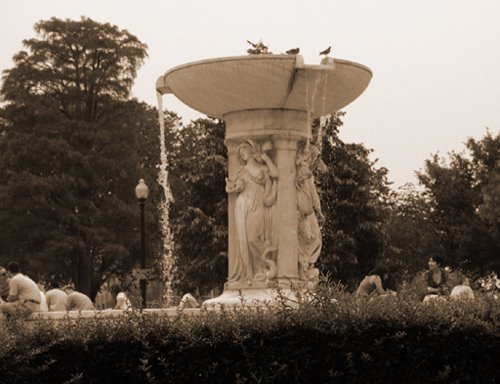
From 1988 to late 1991 I worked at a large Washington law firm whose offices in downtown were a stone's throw from Dupont Circle. In warm weather I used to buy lunch at one of the many take-out restaurants in the neighborhood and head to Dupont Circle to settle on one of the inner row of benches. The fountain in the center of Dupont Circle resembles a flying saucer, held aloft by two Greek women in flowing robes and one scantily clad Greek man blowing on a conch shell. Water pours from the saucer in a silky curtain into the basin below.

My theory that Dupont Circle is a paradise in the heart of the city and the nation goes this way: In Dupont Circle poor meets rich, old meets young, gay meets straight, native meets new arrival, and the peoples, styles, and languages all squish together to form America. Love begins here during morning rush hour with a glance. At midday, political and religious evangelists stop passersby with a few words, a petition, a holy book. In the afternoon, solo figures pursue venture capital and real estate deals using tiny phones. In the evening, dogs approach or snub one another. People find good food nearby, designer and regular ice cream, coffee simple or embellished, newsstands, movie theaters with smallish screens.

But what conclusively distinguishes Dupont Circle from its Parisian ancestors and Washington cousins are the dozen bookstores within a few minutes' walk. Bookstores enough to gladden any newly published author's heart. Bookstores chain and independent, specialty and general; large stores inventoried via satellite and corporate projection, small stores inventoried according to individual whim. Bookstores filled with thrillers and self-help books that sell like hotcakes, and bookstores obstinately maintaining law, philosophy, literature, and social history collections. Stores where books are as surprised to find themselves rubbing up against each other as the people who crisscross great Dupont Circle itself, queer theory thrust into briefcase alongside military biography, genetics text squeezed into the same well-worn backpack with epistolary love story.

Dupont Circle, despite commercialization, gentrification, and Metro-station domination, is still perfect.

Thursday, February 28, 2008

The English Patient

I sense a shift in the weather. There is another gust of wind, a buckle of noise in the air, and the tall trees in the park just beyond my window sway. I hear the first drops of rain on the window pane.

I lie on my couch, on a sheet, naked: my body exposed to the mild breeze from the window which is opened slightly on this warm day in early spring. I turn my head slowly to the book I hold awkwardly in my left hand. I had purchased the book second hand at a book shop near Dupont Circle. My gaze turns to my body, beginning at my feet and ankles, then to my legs, then to the penis sleeping like a sea horse. I lie on my back, my head on a pillow, looking up at the ceiling. I take a bite of a plum that I hold in my right hand. I withdraw the stone and pass the flesh of the fruit into my mouth. My mind is focused on the book I am reading and the well of memory that I plunge into from time to time.

My memory slips from level to level like a hawk. It is late afternoon. My hands play with a piece of sheet, the back of my fingers caressing it. I stand up naked and walk across the room to the kitchen, where I wash my hand.

I return to the couch. I am not tired enough to sleep. I read from the book. A candle flickers over the page, barely revealing the pictures that decorate the walls. I swallow the words of the book like water. It is still raining. I smell the liquid in the air. The rustle of things. Tree branches and dead leaves. The banging of a tin can whose deep pitch reveals it is full of water.

I lie and read the book under the waver of light. I glance now and then at the wall of books across from me. For years I had fallen upon books as the only door out of the prison cell that is my life. They have become half of my world.

The book is perched on my lap. I realize that for more than five minutes I have been looking at the porousness of the paper, the crease at the corner of page 17 which someone had folded over as a mark. I brush my hand over its skin. A scurry in my mind like a moth at the window. A table sits next to the couch. Earlier I had ceremoniously poured myself a small beaker of wine and set it on the table and now I lift a glass to my lips and sip away further into the book I am reading. The book has gaps of plot like sections of a road washed out by storms, missing incidents as if plaster on the ceiling had pealed away.

My past, my memories are much like that. Some phases of my life cannot be entered because the rubble of memory, fragments of lived experience, have crowded in on each other leaving many periods inert and lost to reminiscence. I am not concerned about the gaps in plot, either in the book or in my life. I simply continue to read. I hear the sound of a bird and I look up from the book again. My eyes come to rest on the high wall of books, then the walls.

I glance back at the book. Some of the pages are joined together in a stiff wave. I feel like Crusoe finding a drowned book that had washed up and dried itself on the shore. The English Patient. As in all of the best books, there is the important page with the list of illustrations, a line of text for each of them.

I enter the story knowing I will emerge from it feeling I had been immersed in the lives of others, in plots that stretched back more than sixty years, my body full of sentences and moments, as if awaking from sleep with a heaviness caused by unremembered dreams.

The candle goes out. I light a match in the dark room and move it onto the wick of the candle. Light lifts itself onto my shoulders. I breathe in the smell of sulfur. I imagine I also breath in light.

I pick up a notebook that lies on the small table beside the couch. It is a book that I have had with me for many years -- a copy of The Histories by Herodotus that I have added to, cutting and gluing in pages from other books or writing in my own observations -- so they all are cradled within the text of Herodotus. I begin to read my small gnarled handwriting, and set as aside The English Patient.

Wednesday, February 27, 2008

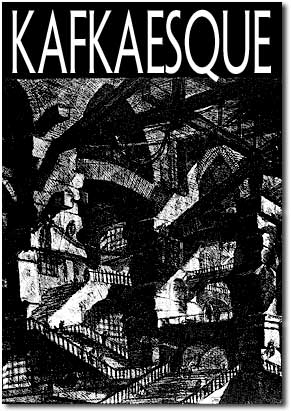
A Kafkaesque Endeavor

I recently met with my job counselor at the District of Columbia's Rehabilitation Services Administration. The Rehabilitation Services Administration places disabled workers, like myself, in employment. My case has been wending its way through the bureaucracy since August 2005.

The meeting with the job counselor caused me little concern, almost to my own surprise. I sought to explain this to myself on the grounds that, judging by my previous experiences, dealing with the bureaucracy's authorities was very simple for me. On one hand, this was due to their having issued for my affairs, apparently once and for all, a definite ruling as to my future employment as a paralegal that was outwardly very much in my favor, and on the other, to the admirable consistency of the agency which was, one suspected, especially perfect on occasions when it appeared to be missing. Sometimes when thinking of such matters I almost concluded that my situation was quite satisfactory, though I always told myself quickly after such fits of satisfaction that this is precisely where the danger lay. Dealing directly with the authorities wasn't all that difficult, for no matter how well organized they were, they only had to work with distant and invisible causes on behalf of remote and invisible clients, whereas I was fighting for something vitally close, for myself, and what's more of my own free will: namely, securing a position with a local law firm.

But what if my case were to be permanently or semi-permanently stalled in the bureaucracy? If this went on, if I weren't always on guard, I might one day, despite the friendly attitude of the authorities, despite my meticulous fulfillment of my exaggeratedly light official duties, be deceived by the favor seemingly granted me and lead the rest of my life so imprudently that I would fall to pieces, and the authorities, gentle and friendly as ever, would have to come, as though against their will but actually at the behest of some official ordinance in the District of Columbia Code of which I knew little, in order to clear me out of the way. And what did that actually amount to here, the other part of my life?

Indeed my case had more cause for worry than I was able or willing to admit to myself.

Tuesday, February 26, 2008

An Analytic Hour

My writing has saved my life. What one comes away with is my total isolation, my fear of people, my panic over closeness, and that's why my real life is so chaotic and my writing is so much more controlled and stable.


It's amazing to me, you know? The interesting thing apart from the obvious sexual guilt that I've always felt is that nothing has changed in my life since I was young. It's years later. I had a shrink then and now I still see a shrink. It's years later, six shrinks later. I'm innumerable jobs down the line. I got fired from my last two jobs. And I still can't get my life in order.

I still fantasize about whores. It's ideal. You pay them, and they come to the house and you don't have to discuss Proust or films or . . .

I don't know what's happening to me. I just have not grown up and I feel . . . I see other guys my age. I think of fucking every woman I meet. I meet a woman in the bank or on the bus. I think: What's she look like naked? Can I fuck her? This is crazy. I see guys I know that are lawyers and doctors with families and houses. They're not so . . . Did the President of the United States, President Clinton, want to fuck every woman he met? Bad example. I don't know. Take Raoul Wallenberg. Did he want to bang every cocktail waitress in Europe? Probably not.

I was so immature in college. I couldn't buckle down. I almost got thrown out of college. I was not interested in college. I wanted to be a writer. Writing was all I cared about. I did not care about the real world. I cared only about the world of fiction.

Now, for the first time in my life I have writer's block. This, to me, is unheard of. I start these short stories and I can't finish them. I finished the novel I was working on for eleven years. So that's done. And I can't settle into something new, a new project. I find I'm taking more pills and medicine and . . .

My last shrink said I expect the world to adjust to the distortion I've become. I don't expect anything. I'm going through something. For the first time in my life I can't seem to write. It's not coming. And for me all l have in life is my imagination.

I'm sorry, our time is up.

Monday, February 25, 2008

Cleveland Park

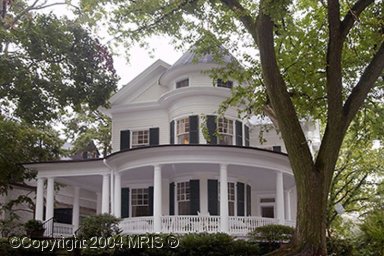
I live in the Cleveland Park section of Washington, which spreads throughout the northern part of the District of Columbia. The neighborhood first attracted residents because it was the high ground -- blessed relief from the swampy heat of Washington summers. In fact, Cleveland Park got its name from President Grover Cleveland, who bought a country "cottage" in the area in 1886. Similar "cottages," with their wraparound porches built to catch the cool breezes, still line the streets of Cleveland Park. I have lived in this neighborhood for about 23 years -- almost as long as I lived in my hometown of Philadelphia. I know each block, each apartment building. There has been little building here on upper Connecticut Avenue in the last decades, and I have the illusion of having put down roots here. There is a synagogue in the neighborhood, Adas Israel, a large conservative congregation to which many illustrious Jews belong. They know me in some of the stores but not in any of the restaurants. I never eat out. I am a minimalist. I haven't been to the movies since 1992, though the neighborhood theater, The Uptown, features first-run movies. Movie premieres that take place in Washington always happen at the Uptown. In the late 1990s former President Clinton attended a movie premiere at The Uptown. I stayed away from the theater that night. My presence near the President of the United States would make the Secret Service apprehensive. I have, in fact, been investigated by the U.S. Secret Service as a potential threat to the President. But we won't go into that.

Even the pigeons of Cleveland Park know me; the moment I come out with a bag of feed, they begin to fly toward me from blocks away. It is an area that stretches from Cathedral Avenue on the south to Tilden Street on the north and west from Wisconsin Avenue to Rock Creek Park on the east. Although readers unfamiliar with Washington will not know these street names. The stretch of Connecticut Avenue, where I live, that passes through Cleveland Park is lined mostly with apartment houses and condominiums. But the side streets are lined with beautiful old homes, many of them built in the late nineteenth-century. One steps into another world when one walks along the side streets of Cleveland Park, an old and gracious world. Almost every day after lunch, I go to the neighborhood library, built in 1953, the year I was born. There's been talk that the library may be torn down and replaced with a modern structure. I hope not. The library, though antiquated, has its own charm. The library is the home of my ambitions and illusions. It is at the library where, in fantasy, I meet with Shakespeare and Dickens and negotiate foreign policy with Napoleon. Though I never eat out, I imagine that the library is a kind of cafeteria where one converses with old friends and gets one's fill of food for the soul.

Sunday, February 24, 2008

Pleasure versus Fortitude

by Suzanne Jacobson

Suffering stems from desire, but the entire premise of modern life is built upon want. Want for a better future, want for a career, want for material goods. The Tao masters suggest to just be, the Nike copywriters to just do. Is there a middle ground to be found among extremes?

Surrendering one's life in pursuit of fulfilling a want is not necessarily self-centered. We, as humans, are irrelevant. The only thing we have to offer is that which will supercede our lives. Love left in our loved one's hearts is irrelevant because they too, will die.

This is not advocating for self-centeredness, this is an acknowledgement of what Americans will never admit — our lives mean nothing; unless we abet in a cultural evolution. Such an evolution is the only way to live forever.

That notion could be construed as nihilistic, but if one takes the equal and opposite stance, the sacrifice could be freeing.

Could. Because should one submerge the self in pursuit of something greater than themselves, then the self is lost and so is any chance for enjoyment. Yes, perhaps there are beers to be drunk after a long day of building something outlasting the evaporating human spirit, but then a life lived without regard to evaporating life, the human spirit forgets its chance to prosper. Without proper indulgence, there is no energy left to build that which lasts forever. But with too much indulgence, the goal is forgotten in the midst of enjoyment, an enjoyment that can be more detrimental than if it never existed. Because enjoyment can be distracting.

Few people have the temperament or desire for such a path. 'Why?' they say. Life is fleeting and should be enjoyed. And that is 100 percent true.

So what if you find yourself on a path with little enjoyment, but it is the only way you can conceivably begin to build something that lasts beyond death? What if pursuing the one thing you enjoy means forgoing opportunities for pleasure. Does this mean that the path is wrong? Does this mean one should return to the path of pleasure and forget that of service? When we, in America, have such freedom and such opportunity to sit at a desk for eight hours a day and cash a paycheck every other Friday with no outpouring of self or sacrifice, why would one pursue the other path?

Is it ego-ism that would allow one to preposterously perceive notions of contributing something useful to society? And then there are those that seem to do exactly what it is what you want, but effortlessly. Does this mean you are not meant to act in the capacity you see as your destiny?

But then if destiny is a choice, is the only choice between pleasure and work? And perhaps pleasure will come at a later date, after trees are cleared for an easier passage. But somehow, the further I travel along this road, the further I become from what I want to be. Perhaps this is untrue in ways cloudy from proximity, but that I cannot see yet.

Wednesday, February 20, 2008

The Emperor's Garden

Frustration, whether occasioned by loss or the result of unfulfilled aims, is difficult to bear. Substitute satisfactions will always be sought to mitigate the pain of loss or to soothe the grief of disappointed ambitions.


It is said of Napoleon, for example, that in exile on St. Helena, he took to gardening, attacking its problemswith martial courage and discipline. Historians note that he conscripted his entire colony to join in the enterprise of digging, carting, planting, watering, and weeding. Napoleon is said to have consumed with delight the fresh vegetables that the well-watered garden produced.

Perhaps, for Napoleon, gardening provided a substitute satisfaction, a replacement for a lost empire. I have no doubt that for my aunt, gardening was a substitute for something she never had -- children.

For thwarted dictators, regardless of hue or shade -- those who have lost an empire, or those whose desire for an empire has been frustrated -- gardening provides a sublimated fulfillment of a childish wish to dominate. The garden is a world that accepts the authority of its master without question -- a world in which vigilant cultivation, a sort of horticultural discipline meted out by the gardener-as-master to his slave empire, the garden, generally assures the realization of the ideals of rigid compliance and luxuriant perfection.

Invoking Nietzsche, and a little German philology as well, we learn that "slavery is, as it seems, both in the cruder and in the more subtle sense, the indispensable means of spiritual discipline (zucht) and cultivation (zuchtung), too."

My aunt inhabited a psychological world in which the concepts of cultivation (i.e, zuchtung, in the form of compulsive pruning and weeding -- really horticultural castration) and discipline (zucht) merged; a world in which the distinction between the cultivation of plants and the disciplining of children was blurred so that reasonable pedagogic limitations on the feasibility -- not to mention desirability -- of molding absolute perfection and compliance in children were incomprehensible to her. Failure of the child to respond to cultivation would be perceived by my aunt as the thwarting of the will of the gardener, and would suggest the need for pruning -- i.e., castration -- the preferred means of dealing with weeds, overgrown plants, and obstreperous children (and troublesome males of all ages, for that matter). My aunt's motto: "If it offends the subtler taste, prune it!"

The gardener despises weeds and recalcitrant plants ("nature's rank and gross") just as the dictator abhors political dissidents; nonconformity with the established norm -- really the narcissistic ideal -- is highly threatening for both the dictator and the earnest gardener.

The presence of weeds in another person's garden -- and my aunt never failed to notice the weeds in other people's gardens -- was always an occasion for stern condemnation of both the gardener and his lax methods of cultivation. One could expect, also, a lecture on the inferiority of the species of plant, tree, and shrub found in other people's gardens, as well as a critique regarding the placement and arrangement. "That tree is too close to the house," my aunt often said, pointing to her neighbor's dwelling, "a storm might cause it to topple and damage the property." Her neighbors were obvious miscreants.