http://dailstrug.blogspot.com/2010/08/creativity-example-of-homospatial.html
The Wagner-Wesendonk situation has been called a triangle by those who forget Minna. It was actually an impossible piece of geometry . . .
Robert W. Gutman, Richard Wagner: the Man, His Mind, and His Music.
. . . far removed from everyday reality—
Robert Osserman, Poetry of the Universe: A Mathematical Exploration of the Cosmos.
The Wesendonck saga began in earnest in 1857, the year that saw the publication of Gustave Flaubert's Madame Bovary. The husband in the case gets little mention, though it was Otto Wesendonck . . .
Martin Gregor-Dellin, Richard Wagner: His Life, His Work, His Century.
. . . a wealthy retired merchant, . . .
Victor Hugo, Les Miserables.
. . . who owned the houses, threw the parties, and footed the bills for everything.
Martin Gregor-Dellin, Richard Wagner: His Life, His Work, His Century.
It seemed that as his leisure increased with his growing fortune he made use of it to . . .
Victor Hugo, Les Miserables.
. . . patronize struggling genius.
Wilkie Collins, A Rogue’s Life.
Wagner . . .
Charles Darwin, Origin of Species.
. . . who lived as . . .
Charles Dickens, Bleak House.
. . . a semipermanent guest . . .
Peter Radetsky, The Invisible Invaders: The Story of the Emerging Age of Viruses.
. . . on the estate . . .
Charles Darwin, Origin of Species.
. . . of Otto and his wife . . .
Ernest Newman, The Life of Richard Wagner.
. . . found his host . . .
Edgar Rice Burroughs, The Outlaw of Torn.
. . . tiresome, as he concedes in his memoirs, in a passage whose obliquity does nothing to disguise the brazen presumption of his conduct. "I had often noticed," he says, "that Wesendonck, in his honest, unrefined way, felt disturbed by my making myself at home in his house. In many matters, such as heating, lighting, and the hours appointed for meals, I was deferred to in a way that seemed to encroach on his rights as master of the house."
Martin Gregor-Dellin, Richard Wagner: His Life, His Work, His Century.
But then, . . .
Emile Zola, The Debacle.
—looking back—
K.R. Eissler, Talent and Genius.
. . . Wagner’s . . .
Bryan Magee, Aspects of Wagner.
. . . relations with . . .
Wilkie Collins, The Evil Genius.
. . . his benefactors . . .
Charles Dickens, Oliver Twist.
. . . had always . . .
Wilkie Collins, The Evil Genius.
. . . betrayed . . .
Richard Wagner, Tristan und Isolde.
. . . excessive rivalry, insatiable ambition, ingratitude—and acting out, so as to humiliate those to whom he was indebted.
K.R. Eissler, Talent and Genius.
Between November 1857 and May 1858 Wagner set five of Mathilde Wesendonk's poems to music.
John Deathridge and Carl Dahlhaus, The New Grove Wagner.
The music mirrors the mystical nature of the poems, each of which deals with the themes of life slowly fading away and of eternal rest.
Brooks Peters, September Songs.
Well, in the end there came what the French call un denouement—what we in forcible modern English would call a smash,—and it happened thus.
John Strange Winter, Koosje: A Study of Dutch Life.
His first wife . . .
Thomas Hardy, Desperate Remedies.
. . . Minna's interception of a . . .
John Deathridge and Carl Dahlhaus, The New Grove Wagner.
. . . love-letter . . .
Thomas Hardy, Desperate Remedies.
. . . addressed to Mathilde (one of the few and most wildly interpreted documents to have escaped the grasp of Wagner's heirs) precipitated on 7 April 1858 a catastrophe that eventually led to his departure . . .
John Deathridge and Carl Dahlhaus, The New Grove Wagner.
. . . for Italy—
Johann Wolfgang von Goethe, The Flight to Italy: Diary and Selected Letters (explanatory notes).
Yes—for a holiday, for a long holiday . . .
Thomas Hardy, Tess of the D’Urbervilles.
. . . altogether alone . . .
Thomas Hardy, Life’s Little Ironies.
. . . in Venice.
Johann Wolfgang von Goethe, The Flight to Italy: Diary and Selected Letters (Diary entry, October 5, 1786).
Ah, Venice! What a glorious city!
Thomas Mann, Death in Venice.
There, there would I go with you, O my beloved!
Johann Wolfgang von Goethe, Wilhelm Meister.
. . . (as he recorded in his journal) . . .
Booth Tarkington, His Own People.
If that cannot be, I would not dwell where you are, but rather be alone in that world into which I now go forth.
Johann Wolfgang von Goethe, Letter to Charlotte von Stein.
O Mathilde!
Alexandre Dumas, The Count of Monte Cristo.
Take my entire soul as a morning salutation!
Richard Wagner, Letter to Mathilde Wesendonk (April 7, 1858).
His letters were returned to him unopened: but he and Mathilde each kept a diary which was read by the other at a later date. Wagner’s diary, kept in the form of letters to Mathilde, gives us an incomparable picture of his inner life during his Venice sojourn.
Ernest Newman, The Life of Richard Wagner.
Leaving behind the growing frustrations of . . .
Johann Wolfgang von Goethe, The Flight to Italy: Diary and Selected Letters (editor’s note).
. . . creative . . .
K.R. Eissler, Goethe: A Psychoanalytic Study 1775-1786.
. . . work, a difficult love-affair, and lack of time to write, he discovers himself again . . .
Johann Wolfgang von Goethe, The Flight to Italy: Diary and Selected Letters (editor’s note).
. . . in the wondrous island city . . .
Johann Wolfgang von Goethe, The Flight to Italy: Diary and Selected Letters (Diary entry, September 28, 1786).
. . ..as a sensuous being and an artist.
Johann Wolfgang von Goethe, The Flight to Italy: Diary and Selected Letters (editor’s note).
On his arrival in . . .
Anthony Trollope, The Prime Minister.
. . . Venice, the Serenissima of all Serenissime—
Erica Jong, Serenissima: A Novel of Venice.
. . . Wagner had, . . .
Ernest Newman, The Life of Richard Wagner.
. . . to begin with, not a glimmer of an idea for a new composition.
Michael Steinberg, Mahler’s “Symphony of a Thousand.”
Writing to Mathilde . . .
Martin Gregor-Dellin, Richard Wagner: His Life, His Work, His Century.
. . . Richard confessed . . .
Charles Dickens, Bleak House.
. . . he was “haunted by the spectre of failing inspiration.” By his own account, he went to his studio, a tiny . . .
Michael Steinberg, Mahler’s “Symphony of a Thousand.”
. . . chamber . . .
William Shakespeare, Romeo and Juliet.
. . . at the Hotel . . .
Thomas Mann, Death in Venice.
. . . on that first day . . .
Henry James, The Chaperon.
. . . in Venice . . .
Leonard Bernstein, The Unanswered Question.
“with the firm resolution of idling the holiday away (I needed to so much that year) and recruiting my strength. On the threshold of my old workshop . . .
Michael Steinberg, Mahler’s “Symphony of a Thousand.”
. . . Tristan und Isolde . . .
Richard Wagner, Letter to Hector Berlioz.
. . . took hold of me and shook me and drove me on for the next eight weeks until my greatest work was done.”
Michael Steinberg, Mahler’s “Symphony of a Thousand.”
—Oh, how lovely it is to love! And only now do I know what it is! Pain has lost its power and death its thorn. Tristan speaks truth: I am immortal, for how could Tristan’s love die?
Gustav Mahler, Letter to Alma Mahler (1910).
The inter-relationship of themes and particles of themes throughout . . .
Michael Kennedy, Gustav Mahler: Symphony no. 8 in E-flat.
. . . Tristan . . .
James Joyce, Finnegan’s Wake.
. . . is intricate and organic; and . . .
Michael Kennedy, Gustav Mahler: Symphony no. 8 in E-flat.
. . . the entire work. . .
Herman Melville, Typee: A Romance of the South Sea.
. . . elaborate and massive as it is, is a recognizable sonata-form structure.
Michael Kennedy, Gustav Mahler: Symphony no. 8 in E-flat.
It required more than vision and audacity—
Ronald W. Clark, Einstein: The Life and Times.
This, Tristan, . . .
Richard Wagner, Tristan und Isolde.
. . . this extraordinary work . . .
Wilkie Collins, A Rogue’s Life.
. . . demanded also the quality of intuition, a feel for . . .
Ronald W. Clark, Einstein: The Life and Times.
. . . the Poetry of Earth . . .
Leonard Bernstein, The Unanswered Question (quoting Keats).
. . . a feel for nature as indefinable as a poet’s sense of words or the artist’s knowledge of what his last dab of materialistic paint can unlock in the human mind.
Ronald W. Clark, Einstein: The Life and Times.
Wagner’s . . .
Martin Gregor-Dellin, Richard Wagner: His Life, His Work, His Century.
. . . interior monologue in . . .
Bryan Magee, Aspects of Wagner.
. . . Tristan . . .
James Joyce, Finnegan’s Wake.
. . . dark, dense, profound . . .
Janet Malcolm, Psychoanalysis: The Impossible Profession.
—an experiment in density, really, as Venice is an experiment in water—
Adam Gopnik, The City and the Pillars: The Long Walk Home.
. . . embodied the composer’s . . .
BBC Online—Proms, Ludwig van Beethoven.
. . . paradoxical preoccupation with . . .
Christopher Knight, Peering Beyond the Edge.
. . . enchantment and . . .
Vladimir Nabakov, Speak, Memory: An Autobiography Revisited.
. . . oblivion, . . .
Hermann Hesse, Siddhartha.
. . .during his weeks and months in Venice.
Martin Gregor-Dellin, Richard Wagner: His Life, His Work, His Century.
This inner life is not the words nor even the plot as conceived by . . .
George and Portia Kernodle, Invitation to the Theatre.
. . . Wagner . . .
Margaret Brenman-Gibson, Clifford Odets: American Playwright.
. . . the playwright, but a dynamic sequence, constantly surging in rhythmic waves from the beginning to the end.
George and Portia Kernodle, Invitation to the Theatre.
This “birth of the modern” was an explosion of energy.
Martin Gregor-Dellin, Richard Wagner: His Life, His Work, His Century.
For the past several months, since the middle of April, he has dreamed many dreams about time . . .
Alan Lightman, Einstein’s Dreams.
. . . a new dimension of time, quite different from anything before in music. It is a time which no longer ticks by, or even dances or saunters by: it proceeds imperceptibly, as the moon moves, or as leaves change their color.
Leonard Bernstein, The Unanswered Question.
His dreams have worn him out, exhausted him so that he sometimes cannot tell whether he is awake or asleep. But the dreaming is finished.
Alan Lightman, Einstein’s Dreams.
My sleep . . .
Richard Wagner, Siegfried.
. . . says Wagner, . . .
Leonard Bernstein, The Unanswered Question.
. . . is dreaming, my dream is searching, my search . . .
Richard Wagner, Siegfried.
. . . he says is . . .
Ivan S. Turgenev, Virgin Soil.
. . . for weapons of knowledge.
Richard Wagner, Siegfried.
Thought that can merge wholly into feeling, feeling that can merge wholly into thought—these are the artist’s highest joy. And our solitary felt in himself at this moment power to command and wield a thought that thrilled with emotion, an emotion as precise and concentrated as thought: namely, that nature herself shivers with ecstasy when the mind bows down in homage before beauty. He felt a sudden desire to write.
Thomas Mann, Death in Venice.
He mused awhile, sat down at the table, and wrote down the following lines in his sacred copy-book, without a single correction:
Ivan S. Turgenev, Virgin Soil.
My task is done, my song hath ceased,
my theme
Has died into an echo; it is fit
The spell should break of this protracted dream.
George Gordon, Lord Byron, Childe Harold’s Pilgrimage.
On the afternoon of August 6, . . .
Martin Gregor-Dellin, Richard Wagner: His Life, His Work, His Century.
Or, maybe, . . .
Albert Camus, The Stranger.
. . . it was the 5th . . .
Alexandre Dumas, The Count of Monte Cristo.
. . . I can’t be sure. . . .
Albert Camus, The Stranger.
. . . Wagner summoned . . .
Martin Gregor-Dellin, Richard Wagner: The His Life, His Work, His Century.
. . . a young musician . . .
Hugo Wolf, Letter to His Parents.
. . . to his hotel room and invited him to look through the score of Tristan. It was almost finished.
Martin Gregor-Dellin, Richard Wagner: His Life, His Work, His Century.
All . . .
Albert Camus, The Plague.
. . . the visitor . . .
H.G. Wells, The Stolen Bacillus.
. . . gathered was that the work . . .
Albert Camus, The Plague.
. . . Wagner . . .
Charles Darwin, Origin of Species.
. . . was engaged on ran to a great many pages, and he was at almost excruciating pains to bring it to perfection.
Albert Camus, The Plague.
“Eh? What’s that?”
Albert Camus, The Stranger.
. . . where are you?
Richard Wagner, Tristan und Isolde.
. . . bar 28 . . .
Ernest Newman, The Life of Richard Wagner.
Can one imagine F sharp and G sharp accompanied by a chord in A minor!
The Beethoven Companion (quoting A. Oulibicheff, Beethoven, ses critiques et ses glossateurs, Paris, 1857).
He was bending over the manuscript.
Albert Camus, The Plague.
What key are we in?
Leonard Bernstein, The Unanswered Question.
. . . no sphinx ever imagined such a riddle . . .
The Beethoven Companion (quoting The Harmonicon, London, August 1823).
. . . it seems to elude analysis . . .
Hector Berlioz, A Critical Study of Beethoven’s Nine Symphonies.
“Well?”
Albert Camus, The Stranger.
A minor?
Leonard Bernstein, The Unanswered Question.
“More or less.”
Albert Camus, The Plague.
‘Ah! Now I see,’ said the visitor.
H.G. Wells, The Stolen Bacillus.
“It’s my opening phrase, and . . .
Albert Camus, The Plague.
. . . it gave me . . .
Arthur Conan Doyle, The Parasite.
. . . trouble, no end of trouble.”
Albert Camus, The Plague.
The theme floats serenely . . .
Philip T. Barford, Beethoven’s Last Sonata.
. . . says Wagner, . . .
Leonard Bernstein, The Unanswered Question.
. . . like a planet in the void, a star born in the emptiness of that motionless moment which gives the clue to the whole work.
Philip T. Barford, Beethoven’s Last Sonata.
At half-past four . . .
Martin Gregor-Dellin, Richard Wagner: His Life, His Work, His Century.
. . . in front of this audience, . . .
Johann Wolfgang von Goethe, The Flight to Italy: Diary and Selected Letters.
. . . Wagner . . .
Anthony Storr, Solitude: A Return to the Self.
. . . wrote in the final bars.
Martin Gregor-Dellin, Richard Wagner: His Life, His Work, His Century.
That was all.
Elia W. Peattie, The Piano Next Door.
No agony and no ecstasy.
Judith Rossner, August.
Verily it is well for the world that it sees only the beauty of the completed work . . .
Thomas Mann, Death in Venice.
. . . the fair copy . . .
The New Cassell’s German Dictionary (entry for the German word “Rein”).
. . . of the completed work and not its origins nor the conditions whence it sprang; since knowledge of the artist’s inspiration might often but confuse and alarm and so prevent the full effect of its excellence.
Thomas Mann, Death in Venice.
But Tristan’s completion seemed bleakly disenchanting compared to the elation that had gripped . . .
Martin Gregor-Dellin, Richard Wagner: His Life, His Work, His Century.
. . . the composer . . .
Alexandre Dumas, The Count of Monte Cristo.
. . . while at work on it. Only then did he become conscious of the void that faced him on awakening from a long dream filled with music.
Martin Gregor-Dellin, Richard Wagner: His Life, His Work, His Century.
It was . . .
K.R. Eissler, Talent and Genius.
. . . on the same Canale Grande where Wagner was to die 25 years later he realized that . . .
Klaas A. Posthuma, Wagner’s “Tristan und Isolde”.
. . . the relationship between . . .
K.R. Eissler, Talent and Genius.
. . . the “wagoner” and his “mudheeldy wheesindonk ”. . .
Bryan Magee, Aspects of Wagner quoting James Joyce, Finnegan’s Wake.
. . . was all over; Venice became “the tomb of their love”.
Klaas A. Posthuma, Wagner’s “Tristan und Isolde”.
Was liffe worth leaving? Nej!
James Joyce, Finnegan’s Wake.
There . . .
Thomas Mann, Death in Venice.
. . . in Venice, . . .
Marcel Proust, Remembrance of Things Past.
. . . it became perfectly clear to Wagner that Mathilde did not for one moment intend to play Isolde to his Tristan.
Klaas A. Posthuma, Wagner’s “Tristan und Isolde”.
What . . .
Ernest Newman, The Life of Richard Wagner.
. . . milady’s . . .
James Joyce, Finnegan’s Wake.
. . . real feelings for him were we have practically no means of knowing at present.
Ernest Newman, The Life of Richard Wagner.
—I have formed in my own mind the following reconstruction . . .
Sigmund Freud, Dora: An Analysis of a Case of Hysteria.
She imagined various versions of the final dramatic split-up, and discovered herself weeping bitterly in the midst of her engrossed imagining of the scene. She remarked how characteristic this was of her, that she was shedding those real tears with such intense feeling in a self-conjured-up situation that existed, as yet, only in her imagination. She predicted, quite correctly, that 'when that time came' she would feel nothing at all. Indeed, the actual ending of her affair came in a rather prosaic, dull way without comedy or tragedy. When it had finally ended, she was relatively quiet and serene for some weeks. Then retrospective dramatization began. She relived in imagination a past situation which had never been more than imagined. But retrospectively, the past imaginary situation had become the real one.
R.D. Laing, The Self and Others.
Let it be said that the whole matter of the relations of Wagner and Mathilde is wrapped in an obscurity that is at present utterly impenetrable. Those of his letters to her that have already been published . . .
Ernest Newman, The Life of Richard Wagner.
. . . she was, in principle, opposed to publishing the letters . . .
J. Moussaieff Masson, Final Analysis.
. . . are only a selection made by the lady herself in her old age, with a natural insistence on the most ideal aspects of their relationship.
Ernest Newman, The Life of Richard Wagner.
Mathilde was no Emma Bovary.
Martin Gregor-Dellin, Richard Wagner: His Life, His Work, His Century.
—or was she?
Computer Forensics, Case Histories: Blackmail in the Chat Room.
The truth is:
Mathilde Wesendonck, Letter to W. Ashton Ellis.
She seems to have had few individual strivings or goals beyond providing for her husband and respecting his wishes. Her progeny never really belonged to her. She loved in them images of their father. She never interceded for them.
Jean-Paul Sartre, L’Idiot de la Famille.
She had moments of revulsion against her own meekness. . . . Sometimes she was surprised by the horrible possibilities that she imagined; and yet . . .
Gustave Flaubert, Madame Bovary.
She lacked the courage to desert her husband and children and dare all for Wagner's sake. . . . And so Wagner had to leave. . . . The loss would have broken another man.
Robert L. Jacobs, Wagner.
Would you believe it? All of Wagner's heroines, without exception, as soon as they are stripped of their heroic skin, become almost indistinguishable from Madame Bovary!
Friedrich Nietzsche, The Case of Wagner.
There is no need to explain the autobiographical element in the relationship Tristan—Isolde—King Marke . . .
Hans Gal, Richard Wagner.
. . . the identification between Mathilde and Isolde, Wagner and Tristan, Wesendonk and Mark cannot be successful . . .
Hans Mayer, Portrait of Wagner.
. . . and it is sheer idle speculation whether Wagner's passion was released by the artistic concept which was filling his innermost being, or whether to that passion must be ascribed the direct cause of the composition of Tristan.
Hans Gal, Richard Wagner.
I believe that we are here face to face with the outstanding characteristic of great tragedy—that it is the equivalent both of a historical record of real events and, at the same time, of a dream.
K.R. Eissler, Discourse on Hamlet and HAMLET.
I am not sufficiently well-read to know whether this fact has already been remarked upon; possibly, indeed, some writer on aesthetics has discovered that this state . . . is a necessary condition when a work of art is to achieve its greatest effects. . . .
Let us consider Shakespeare's masterpiece, Hamlet, a play now over three centuries old.
Sigmund Freud, The Moses of Michelangelo.
Was Shakespeare expressing his own conflicts by having Hamlet act as he does in the tragedy? This question is of a different order of relevance. It is theoretically conceivable that a poet could create such personages without deriving the stuff for them from his own life history. Instead, the stuff of his personages could be derived mainly from his observations of others about him. Since it is known, however, that the process of observation also depends on the observer's unconscious, one feels inclined to assume, in this instance too, that the poet's own unconscious has been deeply involved.
K.R. Eissler, Discourse on Hamlet and HAMLET.
The author directs his attention to the unconscious in his own mind, he listens to its possible developments and lends them artistic expression instead of suppressing them by conscious criticism. Thus he experiences from himself what we learn from others—the laws which the activities of this unconscious must obey.
Sigmund Freud, Jensen's Gradiva.
I have always sought not to put anything of myself into my works and yet I did put in a great deal.
Gustave Flaubert, Letter to Louise Colet.
One of the memorable moments in Madame Bovary is the scene where the heroine seeks help from the village priest. Guilt-ridden, distraught, miserably depressed, the adulterous Emma—heading toward eventual suicide—stumblingly tries to prod the abbe into helping her find a way out of her misery.
William Styron, Darkness Visible: A Memoir of Madness.
Emma’s disillusionment and its reconstructions are very similar to the
chronic pessimism so characteristic of Flaubert. It was his profound
belief that happiness is a myth and that attachments bring nothing but
pain; one day they must all be relinquished or they will become
draining. The outcome of such philosophy of life was to lead to a
withdrawal, similar to Emma’s, into his inner world.
Francis D. Baudry, On The Problem of Inference in Applied Psychoanalysis: Flaubert’s Madame Bovary.
Solipsism is suggested by the fact that reality for . . .
Bryan Magee, Aspects of Wagner.
. . . Flaubert . . .
Cosima Wagner’s Diaries (editor’s note).
. . . is always to be found in the psyche, not the external world. Inner
emotion is so overwhelmingly experienced that everything else,
including other people, has only a shadowy existence on its periphery.
Bryan Magee, Aspects of Wagner.
Hence, the inability to reach happiness through external reality and
involvement with others is Emma’s main problem, as it is Flaubert’s. In
this instance, then, when Flaubert was describing this aspect of Emma,
he was really writing about himself.
Francis D. Baudry, On The Problem of Inference in Applied Psychoanalysis: Flaubert’s Madame Bovary.
Until the onslaught of my own illness and its denouement, I never gave much thought to my work in terms of its connection with the subconscious—an area of investigation belonging to literary detectives. But after I had returned to health and was able to reflect on the past in the light of my ordeal, I began to see clearly how depression had clung close to the outer edges of my life for many years. Suicide has been a persistent theme in my books—three of my major characters killed themselves.
William Styron, Darkness Visible: A Memoir of Madness.
To Mathilde . . .
Robert W. Gutman, Richard Wagner: The Man, His Mind, and His Music.
. . . Wagner . . .
The Diary of Richard Wagner 1865-1882 – The Brown Book.
. . . observed, "My poetic conceptions have always been so far ahead of my experiences that I can only consider these conceptions as determining and ordering my moral development."
Robert W. Gutman, Richard Wagner: The Man, His Mind, and His Music.
Indeed, from a certain point of view (a very doubtful one), one may say that nothing can happen in a man's life without its acquiring the meaning or function of a wish fulfillment.
K.R. Eissler, Talent and Genius.
One goes astray in trying to interpret an artist's life by his work, for it is exceptional to find one a counterpart of the other. It is more likely that an artist's work will express the opposite of his life—the things he did not experience.
Romain Rolland, Wagner: A Note on Siegfried and Tristan.
The idea of Tristan and Isolde was in fact conceived not by a man in love but by someone conscious of his lack of love. As early as December 1854 Wagner had written to Franz Liszt: . . .
Hans Mayer, Portrait of Wagner: An Illustrated Biography.
. . . to the devout Abbe Liszt, whose apartment in the Vatican had been steps from the Sistine Chapel . . .
Robert W. Gutman, Richard Wagner: The Man, His Mind, and His Music.
"Since in my life I have never enjoyed the real good fortune of love, I want to set up a monument to this most beautiful of all dreams, a monument in which from start to finish this love might for once be satiated: in my head I have planned a Tristan and Isolde, the simplest but most full-blooded musical conception; it is with the 'black flag' that waves at the end that I want then to cover myself, in order to—die."
Hans Mayer, Portrait of Wagner: An Illustrated Biography.
Was he contemplating suicide?
Martin Gregor-Dellin, Richard Wagner: His Life, His Work, His Century.
Wagner . . .
Johann Wolfgang von Goethe, Faust (Part II).
. . . could readily imagine that he, like . . .
Arthur B. Reeve, The Poisoned Pen.
. . . Tristan was foredoomed to sorrow from the moment of his birth:
Ernest Newman, The Wagner Operas.
. . . doomed, since childhood, to live a miserable and unfortunate life that could all too easily lead to suicide, whatever the particular external circumstances of his later life might have been.
K.R. Eissler, Talent and Genius.
He tried to occupy his mind with books; but his soul was gangrened with bitterness against the world, which, in his opinion, had cruelly denied him the simple right to live.
Ernest Newman, The Life of Richard Wagner.
My nights are often sleepless; I get out of bed wretched and exhausted, with the thought of a long day before me which will not bring me a single joy. The society of others tortures me, and I avoid it only to torture myself. Everything I do fills me with . . .
Romain Rolland, Wagner: A Note on Siegfried and Tristan quoting Wagner.
. . . this terrible yearning in my heart . . .
Richard Wagner, Tristan und Isolde.
I awake with horror in the morning,
And bitter tears well up in me
When I must face each day that in its course
Cannot fulfill a single wish, not one!
Johann Wolfgang von Goethe, Faust.
Ay me! Sad hours seem long.
William Shakespeare, Romeo and Juliet.
At midnight
I awoke
And looked up at the sky.
Not a star in the galaxy
smiled at me
at midnight.
At midnight
my thought went
out to the limits of darkness.
There was no thought of light
to bring me comfort
at midnight.
Gustav Mahler and Friedrich Ruckert, Excerpt from the Song "Um Mitternacht."
What if her eyes . . .
William Shakespeare, Romeo and Juliet.
. . . Mathilde’s . . .
Martin Gregor Dellin, Richard Wagner: His Life, His Work, His Century.
. . . eyes were there, they in her head?
The brightness of her cheek would shame those stars
As daylight doth a lamp; her eyes in heaven
Would through the airy region stream so bright
That birds would sing and think it were not night.
William Shakespeare, Romeo and Juliet.
O God, send peace and heavenly shining
On the dark desert of my heart.
Gustav Mahler, Symphony no. 8 in E-flat (quoting Goethe, Faust (Part II) (Final Scene).
This is how Wagner wrote . . .
Romain Rolland, Wagner: A Note on Siegfried and Tristan.
. . . in the diary he kept for Mathilde in Venice
Martin Gregor Dellin, Richard Wagner: His Life, His Work, His Century.
In the same way Michelangelo wrote to his father in 1509: "I am in agony. . . . I am wasting my time to no purpose. Heaven help me!"
Romain Rolland, Wagner: A Note on Siegfried and Tristan.
'Verily, verily . . .'
Clifford Odets, Communication to William Gibson.
". . . to put up with living one has to be dead!"
Cosima Wagner's Diaries (Monday, October 9, 1882).
Yet the very hopelessness of it all kindled a mystic hope in him. Only where there are graves, as Nietzsche says, are there resurrections.
Ernest Newman, The Life of Richard Wagner.
When he prayed, "Dear God, help me!" he was praying to himself, beseeching himself to have fortitude, to be invincible of body and spirit, to have the stamina and will to create mightily in a vision of a more heroic world.
Irving Stone, The Agony and the Ecstasy: A Novel of Michelangelo.
He did not . . .
Thomas Hardy, Life’s Little Ironies.
. . . after all commit suicide . . .
K.R. Eissler, Talent and Genius.
. . . tho thoughts . . .
Henry Van Dyke, Ships and Havens.
. . . of self-destruction were never far away.
William Manchester, The Last Lion: Winston Spencer Churchill; Visions of Glory: 1874-1932.
Sometimes . . .
Johann Wolfgang von Goethe, Faust.
—sometimes mysteriously so—
Sigmund Freud, Moses and Monotheism.
. . . death is never quite a welcome guest.
Johann Wolfgang von Goethe, Faust.
Writing to Mathilde . . .
Martin Gregor-Dellin, Richard Wagner: His Life, His Work, His Century.
Wagner
The Diary of Richard Wagner 1865-1882 – The Brown Book.
. . . confessed:
Martin Gregor-Dellin, Richard Wagner: His Life, His Work, His Century.
Among a considerable collection of weapons I possessed a handsome, well-polished dagger. This I laid every night by my bed, and before extinguishing the candle I tried whether I could succeed in plunging the sharp point a couple of inches deep into my heart. Since I could never succeed in this, I at last laughed myself out of the notion, threw off all hypochondriacal fancies, and resolved to live.
Johann Wolfgang von Goethe, Fiction and Truth.
Perhaps fate intervened this time on the side of right.
Brooks Peters, September Songs.
Wherever he went, conflicts speedily evolved; and he always seemed to achieve victory at first, only to hurt himself subsequently. He was forever achieving a new rise—until this drive toward self-destruction set the mortal wound. Yet even that final disaster . . .
K.R. Eissler, Talent and Genius.
. . . and subsequent . . .
Thomas Hardy, Desperate Remedies.
. . . Flight to Italy . . .
Johann Wolfgang von Goethe, The Flight to Italy: Diary and Selected Letters.
. . . was followed by an elevation, in the form of . . .
K.R. Eissler, Talent and Genius.
. . . a new trust in his perceptions and emotions and in his power to convey them
T.J. Reed, Introduction to Goethe, The Flight to Italy: Diary and Selected Letters.
He is a prototype of Ambiguous Man, compulsively engineering his own destruction, and simultaneously flying on into the future.
Leonard Bernstein, The Unanswered Question.
It was more biblical than Shakespearean—the story of a man who sinned, suffered, died, and rose again.
Leonard Garment, Crazy Rhythm.
____________________________
Friday, August 01, 2008


Thursday, July 31, 2008
The Obituary
 When they write my obituary. Tomorrow. Or the next day. It will say, "Gary Freedman is survived by an apartment full of shit." I'm surprised I haven't been buried alive. I have to struggle to keep a path clear between couch and toilet, toilet and table, table and front door. If I want to get from the toilet to the front door, I have to go by way of the table. I like to imagine the couch as home plate, the toilet as first, the table as second, the front door as third: should the doorbell ring while I am lying on the couch, I have to round the toilet and the table in order to arrive at the door. If it happens to be Stanley Schmulewitz, I let him in without a word and then jog back to the couch, the roar of the invisible crowd ringing in my ears. Stanley Schmulewitz, who has lived in the building for the past thirty-six years, is president of the tenants association.
I often wonder who will be the last person to see me alive. If I had to bet, I'd bet on Pius Cookson, the building engineer. Pius Cookson has been the engineer for at least the last sixteen years. He lives with his family down the hall from my apartment. I pass him in the hall a few times a week, entering or exiting his apartment. Twice a year, once in the spring and once in the fall, Pius Cookson enters my apartment to change the filter in the heating/cooling unit. Whenever he comes, I make a big production of the affair. After all, it happens only twice a year and I get few visitors. He stands at the door holding the filter while I wonder if this is the night I'll finish off my daily spaghetti, climb into bed, and have a heart attack in my sleep.
I try to make a point of being seen. Often when I'm out I'll buy a juice, even if I'm not thirsty. If the store s crowded, I'll sometimes go so far as to drop my change all over the floor, the nickels and dimes skidding in every direction. I'll go into the Athlete's Foot and say, "What do you have in sneakers?" The clerk will look me over like the poor schmuck that I am and direct me to the one pair of Rockports they carry, something in spanking white. "Nah," I'll say, "I have those already," and then I'll make my way over to the Reeboks and pick out something that doesn't even resemble a shoe, a waterproof bootie, maybe, and ask for it in size 11. The kid will look again, more carefully. "Size 11," I'll repeat, holding his gaze while I clutch the webbed shoe. He'll shake his head and go to the back for them, and by the time he returns I'm peeling off my socks. I'll roll my pant legs up and look down at those decrepit things my feet, and an awkward minute will pass until it becomes clear that I'm waiting for him to slip the booties onto them. I never actually buy. All I want is not to die on a day when I went unseen.
A few months ago, I saw an ad in the paper. It said, "NEEDED: NUDE MODEL FOR DRAWING CLASS. $15 AN HOUR." It seemed too good to be true. To have so much looked at, by so many. I called the following Tuesday. I tried to describe myself, she wasn't interested. "Anything will do," she said.
The days passed slowly. I told Stanley Schmulewitz about it, but he misunderstood. He thought I was signing up for a drawing class in order to see nude girls. He didn't want to be corrected. "Their breasts?" he asked. "They show their boobs?" I shrugged. "And down there?"
After Maxine Krieger on the fourth floor died of a massive stroke and it took three days for anyone to find her, Stanley Schmulewitz and I got into the habit of checking on each other. We'd make little excuses--"I ran out of toilet paper," I'd say when Stanley Schmulewitz opened his door. A day would pass. There would be a knock on my door. "I lost my TV Guide," he'd explain, and I'd go and find him mine, even though I new his was right where it always was, on his couch. Once, he came down on a Sunday afternoon. "I need a cup of flour," he said. It was clumsy, but I couldn't help myself. "You don't know how to cook," I said. There was a moment of silence. Stanley Schmulewitz looked me in the eye. "What do you know," he said. "I'm baking a cake."
Tuesday, July 29, 2008
Sunday, July 20, 2008
The Roommate from Hell
I had a college dorm roommate with a narcissistic personality disorder, I think. He had two girlfriends--an on-campus girlfriend and an at-home girlfriend. Neither knew about each other, of course. I went looking through his things (I know you're not supposed to, but I'm an asshole myself) one day and I found his little black book. Page after page of girls names and telephone numbers. He was incapable of a deep, mature emotional relationship with women, so it's no surprise that we could never establish any rapport. He had one male friend that I knew about. He was a jock. When the two of them got together all they ever talked about was the girls they did.
He demanded to have the room to himself all evening about four nights a week or more so he could have sex with his on-campus girlfriend. I got the room to myself every two weeks when he went home on weekends to have sex with his at-home girlfriend.
He once put a used condom in my bed. Nice touch.
He used to object to my smoking cigarettes, and would open the window when I lit up. But he smoked a pipe.
He stole a glass sugar dispenser from the dining hall. One day I accidentally broke the sugar dispenser. He told me I had to get him more sugar. Not being a psychopath, I went to a grocery store to buy him a box of sugar cubes. I gave them to him and he was angry. "I wanted you to replace the sugar dispenser you broke with another one just like it from the dining hall." He wanted me to steal for him. Then a few days later he was apologetic and said he had gotten used to the sugar cubes and even found them to be superior to the glass sugar dispenser.
When the weather got cold (this was at Penn State in the mountains of central Pennsylvania) he bought a bottle of cherry vodka. He took a shot every morning to keep him warm on his way to class. That was his breakfast.
One time he asked me if I wanted to play chess. I said "sure." He had bought a little plastic chess set. I'm a miserable chess player, but he was worse. When it became clear to him that he wasn't going to win the game, he said: "I'm not playing this game anymore." No sense of fair play.
One Friday afternoon he told me he wanted the dorm room for the entire night because he wanted to sleep with his girlfriend. I had to find a friend who had a spare bed to let me sleep in all night.
One time I was alone in the dorm room, and decided to take a shower. I went to the bathroom to take a shower. And by the time I had gotten back to the room, the door was locked. My roommate was back and having sex with his girlfriend. I had to wait outside in the hall with a towel wrapped around my naked ass till he finished.
Anybody know what happened to Robert Brennan from Doylestown, Pennsylvania--an accountancy major who graduated from Penn State in May 1974?
He demanded to have the room to himself all evening about four nights a week or more so he could have sex with his on-campus girlfriend. I got the room to myself every two weeks when he went home on weekends to have sex with his at-home girlfriend.
He once put a used condom in my bed. Nice touch.
He used to object to my smoking cigarettes, and would open the window when I lit up. But he smoked a pipe.
He stole a glass sugar dispenser from the dining hall. One day I accidentally broke the sugar dispenser. He told me I had to get him more sugar. Not being a psychopath, I went to a grocery store to buy him a box of sugar cubes. I gave them to him and he was angry. "I wanted you to replace the sugar dispenser you broke with another one just like it from the dining hall." He wanted me to steal for him. Then a few days later he was apologetic and said he had gotten used to the sugar cubes and even found them to be superior to the glass sugar dispenser.
When the weather got cold (this was at Penn State in the mountains of central Pennsylvania) he bought a bottle of cherry vodka. He took a shot every morning to keep him warm on his way to class. That was his breakfast.
One time he asked me if I wanted to play chess. I said "sure." He had bought a little plastic chess set. I'm a miserable chess player, but he was worse. When it became clear to him that he wasn't going to win the game, he said: "I'm not playing this game anymore." No sense of fair play.
One Friday afternoon he told me he wanted the dorm room for the entire night because he wanted to sleep with his girlfriend. I had to find a friend who had a spare bed to let me sleep in all night.
One time I was alone in the dorm room, and decided to take a shower. I went to the bathroom to take a shower. And by the time I had gotten back to the room, the door was locked. My roommate was back and having sex with his girlfriend. I had to wait outside in the hall with a towel wrapped around my naked ass till he finished.
Anybody know what happened to Robert Brennan from Doylestown, Pennsylvania--an accountancy major who graduated from Penn State in May 1974?
Thursday, July 10, 2008
Friendship
Contrary to what the radical feminists tell us, men and women are fundamentally different, not only physically, but also psychologically. That is the reason for the well known observation that men are from Mars, while women are from Venus.
If you love reading 19th Century literature and personal correspondence from that time, you would notice that men who lived at the time, developed very deep friendships with each other, that are not common today. It is true that men from that era did not hug as much as men do today, and it is known that men were much less lachrymose than in this wimpy age. But friendships between men, nevertheless, had a very strong emotional content, and in reading letters that men frequently wrote to each other, their relationships had great depth. Those friendships were different from the superficial relationships that many men of today have with their golfing partners, poker pals, and drinking buddies.
Men were able to trust each other with stuff they would never tell their wives about. And in their letters, men were able to express deep feelings for each other, although they did so in rather formal language. But these relationships were healthy and beautiful, and were not corrupted with vulgar insinuations of homosexual attraction. I am thinking of relationships similar to that of David and Jonathan in the Old Testament, although, even that beautiful friendship has in recent years been distorted by advocates of the gay lifestyle to promote their perverse agenda.
Today, it is rare to see those sorts of old fashioned friendships, between two men who admire, respect, and trust each other, and who base their friendship on a strong code of honor, with both men also having a strong sense of self-respect. What was remarkable about those friendships, is that they lasted a lifetime, and also persisted during long periods of separation. If you read 19th century personal correspondences, you will find incidents where two men have been separated for 20 years or more, because of career or other commitments, and have managed to write to each other at least once each month over all that time. Upon re-uniting after such a long separation, such men could resume personal contact, with the familiarity of next door neighbors, despite their long physical separation.
If you love reading 19th Century literature and personal correspondence from that time, you would notice that men who lived at the time, developed very deep friendships with each other, that are not common today. It is true that men from that era did not hug as much as men do today, and it is known that men were much less lachrymose than in this wimpy age. But friendships between men, nevertheless, had a very strong emotional content, and in reading letters that men frequently wrote to each other, their relationships had great depth. Those friendships were different from the superficial relationships that many men of today have with their golfing partners, poker pals, and drinking buddies.
Men were able to trust each other with stuff they would never tell their wives about. And in their letters, men were able to express deep feelings for each other, although they did so in rather formal language. But these relationships were healthy and beautiful, and were not corrupted with vulgar insinuations of homosexual attraction. I am thinking of relationships similar to that of David and Jonathan in the Old Testament, although, even that beautiful friendship has in recent years been distorted by advocates of the gay lifestyle to promote their perverse agenda.
Today, it is rare to see those sorts of old fashioned friendships, between two men who admire, respect, and trust each other, and who base their friendship on a strong code of honor, with both men also having a strong sense of self-respect. What was remarkable about those friendships, is that they lasted a lifetime, and also persisted during long periods of separation. If you read 19th century personal correspondences, you will find incidents where two men have been separated for 20 years or more, because of career or other commitments, and have managed to write to each other at least once each month over all that time. Upon re-uniting after such a long separation, such men could resume personal contact, with the familiarity of next door neighbors, despite their long physical separation.
Sunday, July 06, 2008
The Tragic Dilemma of the Schizoid
 This post describes the personality disorder that I have, Schizoid Personality Disorder.
 Schizoid Personality Disorder
A Comprehensive Phenomenological Profile
In an article in the American Journal of Psychotherapy, Salman Akhtar, M.D., provides a comprehensive phenomenological profile of Schizoid Personality Disorder in which classic and contemporary descriptive views are synthesized with psychoanalytic observations. This profile is summarized in a table (reproduced below) listing clinical features, involving six areas of psychosocial functioning and designated by "overt" and "covert" manifestations. Dr. Akhtar states that "these designations do not imply conscious or unconscious but denote seemingly contradictory aspects that are phenomenologically more or less easily discernible," and that "this manner of organizing symptomology emphasizes the centrality of splitting and identity confusion in schizoid personality."
CLINICAL FEATURES OF SCHIZOID PERSONALITY DISORDER
I. Self-Concept
OVERT
Compliant; stoic; noncompetitive; self-sufficient; lacking assertiveness; feeling inferior and an outsider in life.
COVERT
Cynical; inauthentic; depersonalized; alternately feeling empty, robot-like and full of omnipotent, vengeful fantasies; hidden grandiosity.
II. Interpersonal Relations
OVERT
Withdrawn; aloof; have few close friends; impervious to others' emotions; afraid of intimacy.
COVERT
Exquisitely sensitive; deeply curious about others; hungry for love; envious of others' spontaneity; intensely needy of involvement with others; capable of excitement with carefully selected intimates.
III. Social Adaptation
OVERT
Prefer solitary occupational and recreational activities; marginal or eclectically sociable in groups; vulnerable to esoteric movements owing to a strong need to belong; tend to be lazy and indolent.
COVERT
Lack clarity of goals; weak ethnic affiliation; usually capable of steady work; sometimes quite creative and may make unique and original contributions; capable of passionate endurance in certain spheres of interest.
IV. Love and Sexuality
OVERT
Asexual, sometimes celibate; free of romantic interests; averse to sexual gossip and innuendo.
COVERT
Secret vouyeristic and pornographic interests; vulnerable to erotomania; tendency towards compulsive masturbation and perversions.
V. Ethics, Standards, and Ideals
OVERT
Idiosyncratic moral and political beliefs; tendency towards spiritual, mystical and para-psychological interests.
COVERT
Moral unevenness; occasionally strikingly amoral and vulnerable to odd crimes, at other times altruistically self sacrificing.
VI. Cognitive Style
OVERT
Absent-minded; engrossed in fantasy; vague and stilted speech; alternations between eloquence and inarticulateness.
COVERT
Autistic thinking; fluctuations between sharp contact with external reality and hyperreflectiveness about the self; autocentric use of language.
Akhtar, S. Schizoid Personality Disorder: A Synthesis of Developmental, Dynamic, and Descriptive Features. American Journal of Psychotherapy, 151:499-518, 1987.
Saturday, July 05, 2008
Tunnel of Boredom
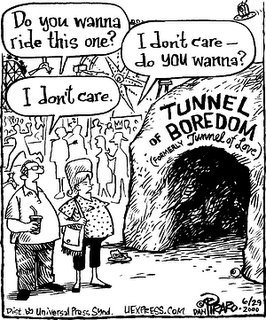
I find myself in my room as motionless as a man can be, who is completely and emptily restless, utterly hollow. I have done all the work I want to do--and now there is nothing. I could go out, travel down town on the subway, run to town. But I do not want to go down town, I do not want to run to town, I don't want to do anything. I am suspended motionless, in an agony of inertia, like a machine that is without power.
This is very bitter to me, who had never known what boredom was, who had gone from activity to activity, never at a loss. Now, gradually, everything seems to be stopping in me. I do not want any more to do the things that offer. Something dead within me just refuses to respond to any suggestion. I cast over in my mind, what it would be possible to do, to save myself from this misery of nothingness, relieve the stress of this hollowness. And there are only three things left, that would rouse me, make me live. One is to drink a beer, the other is to be soothed by a friend, and the third is women. And there is no one for the moment to drink with. Nor is there a woman. And I have no friends. So there is nothing to do but to bear the stress of my own emptiness.
Sunday, June 29, 2008
Dead to the World

It was not only the thought that other people were moving on in their lives while I, at age fifty-two, remained stuck in a farce of human existence--though that appalled me and wakened in me a primitive insanity: a man with a hatchet gets to his feet and begins to dance in my mind whenever I have these thoughts. There is something worse. The fact that I had never lived, that I had thrown away my entire life, or had lost any meaningfully-lived experience in the chaos of mental illness. In many ways my travels through life had been a dangerous trip. I remember the bad episodes, speaking metaphorically, the rickety buses on mountain roads; the poisonous encounters with so many people; the opportunities that turned out to be dead-end traps; the abusive and crazy people I had met. My early childhood. Had I ever been happy?
I might have died, I think, in consolation. Surely it is better to be alive than dead. At least I am alive.
In adolescence it had always been a persistent worry of mine that I was doomed to die in a nuclear attack in a dismal place, where I had no business to be. I often dreamed of horrific explosions and blinding flashes of light, of my arms being hacked off by an angry mob, of catching fire. I always traveled as a stranger, alone. But I reassured myself with the sentiment that my family was waiting. It was a methodical superstition, like singing to keep my spirits up, and as long as they were thinking of me I would be safe--they were keeping me alive; and if I died they would be brokenhearted.
Now I knew better. I know that if I had died it would have made little difference. They would have been sorry in the guilty way that people are when some awful thing they desire deep down actually occurs. It might have been convenient, my death.
And now my death would mean nothing to anyone. The person I am now is not even the person I was twenty years ago. I am estranged from myself and my origins. It's as if someone else has taken over and totally displaced me. He -- the alter ego that has assumed my identity -- sits in my chair, writes at my desk, uses my books. He puts his feet on my stool. He sleeps on my side of the bed and dreams the dreams that I should be dreaming. I imagine the loss of my self, my sanity in this way. My vision is of the dining table, and a pen sitting atop a tablet of paper, the visible page smeared with ink. It was there when I left; and then I died, and someone else was at the table. But the pen and paper hadn't moved. It remained, with the smeared ink on it. The pronouncement It doesn't matter if you die is devastating. No one says that, but that is what everyone thinks. All my acquaintances or barely acquainted strangers who know of me think this, I'm sure.
I see now that my death does not matter. I was a fool for ever believing in my importance. I feel now that I don't count. Knowing all this is like dying; not cut down with one swipe of a blade, but going slowly as the truth sinks in and spreads like an infection.
I had always thought the most cynical lines in literature were in the Jacobean play The White Devil, by John Webster, and went something like: Before your corpse is cold you will already be forgotten:
O man,
That lie upon your death-bed and are haunted
with howling memories of the people you have known! Ne'er trust them; they'll forget you
Ere the worm pierce your winding sheet,
Ere the spider make a thin curtain for your epitaph.
It had seemed too cruel and taunting to be true.
It was true. I believe my case is worse, for I have not died but only gone away. I am lost and alone.
Monday, June 23, 2008
Who is Gary Freedman -- The Story Behind the Story
Easygoing: DRIVE: Can sometimes appear casual about work. Modest concern towards accomplishing goals. Able to set work aside. Quality and timeliness of work may ebb and flow with interest in task. ORGANIZATION: Reasonably well organized. May become somewhat disordered under heavy workload.
Very Private: Shy and reserved. Does not seek attention from others. Doesn't say much. Behavior is usually deliberate, cautious, and purposeful. SOCIABILITY: Enjoys some degree of socializing and being around people, but also values privacy.
Critical/Agreeable Blend: Makes an effort to be cooperative in social settings. Not overly concerned with getting along. Is able to work for the benefit of the group. EMPATHY: Can balance objectivity with others' feelings. Shows a reasonable amount of concern for others. TRUST: Has a generally forgiving nature. Moderate trust in others.
Very Reactive: Sensitive, emotional, and prone to experience feelings that are upsetting. Prone to be tense, insecure, and nervous. Experiences very strong and passionate emotions. ANXIETY: May suffer from anxiety, leading to a negative disposition. Sometimes worries too much. Feelings can be easily hurt. MOOD: Mood is fairly consistent. Can let go of anger after a short period of time.
Very Inquisitive: Curious. Seeks new experiences. Likely to have an unconventional approach to life. Enjoys intellectual discussion. Considers all aspects an issue before reaching a conclusion. CREATIVITY: Is quite original, creative and enjoys breaking new ground.
Very Private: Shy and reserved. Does not seek attention from others. Doesn't say much. Behavior is usually deliberate, cautious, and purposeful. SOCIABILITY: Enjoys some degree of socializing and being around people, but also values privacy.
Critical/Agreeable Blend: Makes an effort to be cooperative in social settings. Not overly concerned with getting along. Is able to work for the benefit of the group. EMPATHY: Can balance objectivity with others' feelings. Shows a reasonable amount of concern for others. TRUST: Has a generally forgiving nature. Moderate trust in others.
Very Reactive: Sensitive, emotional, and prone to experience feelings that are upsetting. Prone to be tense, insecure, and nervous. Experiences very strong and passionate emotions. ANXIETY: May suffer from anxiety, leading to a negative disposition. Sometimes worries too much. Feelings can be easily hurt. MOOD: Mood is fairly consistent. Can let go of anger after a short period of time.
Very Inquisitive: Curious. Seeks new experiences. Likely to have an unconventional approach to life. Enjoys intellectual discussion. Considers all aspects an issue before reaching a conclusion. CREATIVITY: Is quite original, creative and enjoys breaking new ground.
Saturday, June 21, 2008
Letter from a Fellow Schizoid
This writeup is absolutely brilliant, articulate, and correct. I have been scouring the libraries and online journals for adequate information on SPD, and you seem to have it right here, good sir.
"Thus the schizoid's picture of 'good' behavior is distorted. The child learns never to nag or even yearn for love, because it makes the parent more distant and censorious. The child then may cover over the incredible loneliness, emptiness and ineptness he feels with a fantasy (often unconscious) that he is self-sufficient. Love and anger get hopelessly intertwined. Fairbairn argued that the tragedy of the schizoid child is that his conscience has been warped: he believes his love, not his hatred is the destructive force within. Love consumes. Hence the schizoid child's chief mental operation is to repress his or her normal wish to be loved."
So very true. I am a teenaged schizoid, and I found in my research on this condition that a lot of professionals have us tagged as "empty", "hollow", and "bitter". I would argue that we are not hollow; in fact, I think that if we were hollow we perhaps wouldn't suffer as much as we do. It is because we are not hollow that we suffer. We hate this need, this driving, fervent desire to love and be loved; we try to repress it and ignore it, and it is this love that causes pain. It is ironic therefore, that we even try to repress our pain until there is nothing left.
You are the first SPD source that has managed to pinpoint this crucial distinction: SPD emptiness does not derive from a lack of stimulation, but rather, too much of it causing subsequent withdrawal due to negative condition and traumatic experiences.
I got a lot of crap from my parents, teachers, professors, and other students about my seeming detachment and inability to commit.
Actually, I have recently met a friend who is, in all sense of the word, the most empathetic and compassionate individual I have ever met. We meet at both an intellectual level and a spiritual one, yet while I find myself wanting to spend time with this friend, it pains me to do so. It pains me to see this friend, and yet it pains me when I am not in her presence.
You have a fantastic writeup here, sir, and I commend you on your excellent research.
"Thus the schizoid's picture of 'good' behavior is distorted. The child learns never to nag or even yearn for love, because it makes the parent more distant and censorious. The child then may cover over the incredible loneliness, emptiness and ineptness he feels with a fantasy (often unconscious) that he is self-sufficient. Love and anger get hopelessly intertwined. Fairbairn argued that the tragedy of the schizoid child is that his conscience has been warped: he believes his love, not his hatred is the destructive force within. Love consumes. Hence the schizoid child's chief mental operation is to repress his or her normal wish to be loved."
So very true. I am a teenaged schizoid, and I found in my research on this condition that a lot of professionals have us tagged as "empty", "hollow", and "bitter". I would argue that we are not hollow; in fact, I think that if we were hollow we perhaps wouldn't suffer as much as we do. It is because we are not hollow that we suffer. We hate this need, this driving, fervent desire to love and be loved; we try to repress it and ignore it, and it is this love that causes pain. It is ironic therefore, that we even try to repress our pain until there is nothing left.
You are the first SPD source that has managed to pinpoint this crucial distinction: SPD emptiness does not derive from a lack of stimulation, but rather, too much of it causing subsequent withdrawal due to negative condition and traumatic experiences.
I got a lot of crap from my parents, teachers, professors, and other students about my seeming detachment and inability to commit.
Actually, I have recently met a friend who is, in all sense of the word, the most empathetic and compassionate individual I have ever met. We meet at both an intellectual level and a spiritual one, yet while I find myself wanting to spend time with this friend, it pains me to do so. It pains me to see this friend, and yet it pains me when I am not in her presence.
You have a fantastic writeup here, sir, and I commend you on your excellent research.
Tuesday, June 17, 2008
Monday, June 16, 2008
Happy Bloomsday!
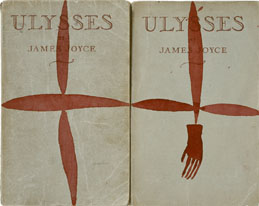 Monday, June 16th, marks the hundred-and-fourth anniversary of Bloomsday, the date on which the events in James Joyce's Ulysses take place. The customary celebrations surrounding Leopold Bloom's famous walk through Dublin take place on Monday: public readings and festivals in cities around the world, including Dublin, New York, Berlin, Paris, St. Petersburg, and Melbourne. In Budapest last year, two hundred or so academics convened a Joyce symposium -- the twentieth to be held on Bloomsday.
Happy Bloomsday!
Thursday, June 12, 2008
Watergate Revisited
The curtain is still down as I walk to the center of the proscenium and say this.
Abraham Pais, A Tale of Two Continents: A Physicist's Life in a Turbulent World.
There is no society in which reality and appearance coincide . . . . If Hamlet is obsessed by this discrepancy, this is not due to any psychopathology on his part; it is to be explained by the fact that he is in the unhappy state of knowing the truth, of having unveiled that secret on which the authority of the highest representative of the state basically rests.
K.R. Eissler, Discourse on Hamlet and HAMLET.
What is important is that chance has allotted Hamlet the role of judge of his own time and servant of the future.
Boris Pasternak, I Remember.
External events have forced him to do what everyone of us has to do if the potential of man's minds is to be used to its fullest: he has discovered the difference between appearance and reality—and the conflict between them. . . .
The problem in question is the necessity of keeping secret the foundation on which the state rests. Who has the courage to face this truth?
K.R. Eissler, Discourse on Hamlet and HAMLET.
Now the curtain rises.
Abraham Pais, A Tale of Two Continents: A Physicist's Life in a Turbulent World.
I walk out on the stage.
Leaning against a door jamb,
I try to catch in a distant echo . . .
Boris Pasternak, Dr. Zhivago (Excerpt from “Hamlet”).
. . . the story of that man . . .
Homer, The Odyssey.
. . . who, like . . .
Sigmund Freud, Psychoanalytic Notes Upon An Autobiographical Account of a Case of Paranoia.
. . . Hamlet once looked truly into the essence of things, . . .
Friedrich Nietzsche, The Birth of Tragedy.
. . . the very essence of the unknown;
Jack London, White Fang.
. . . gained knowledge, and . . .
Friedrich Nietzsche, The Birth of Tragedy.
. . . prepared for all the consequences . . .
William Manchester, The Glory and the Dream.
. . . dared to shatter . . .
Mark Frauenfelder, Cars for Arts Sake.
. . . the veils of illusion:
Friedrich Nietzsche, The Birth of Tragedy.
Who is the man who has wrought the deed ordained only for the strongest?
Richard Wagner, Gotterdammerung.
See him now!
Nathaniel Hawthorne, The Marble Faun.
. . . and see the breakers of misfortune swallow him!
Sophocles, Oedipus the King.
The following sketch, . . .
Kate Millett, Sexual Politics.
. . . drawn so clearly and in so much detail . . .
Boris Pasternak, I Remember.
. . . for the exclusive use of the highest authorities . . .
Hermann Hesse, Magister Ludi: The Glass Bead Game.
. . . is based primarily on background material and current impressions derived from press reports, including newspaper and magazine articles and television interviews. In addition, selected State Department and Federal Bureau of Investigation memoranda have been reviewed. As the data base is fragmentary and there has been no direct clinical evaluation of the subject, this indirect assessment should be considered . . .
C.I.A. Psychological Study.
. . . far from watertight . . .
Dr. Otto Eiser, Letter to Richard Wagner.
There is nothing to suggest in the material reviewed that subject suffers from a serious mental disorder in the sense of being psychotic and out of touch with reality. There are suggestions, however, that some of his long-standing personality needs were intensified by psychological pressures of the mid-life period and that this may have contributed significantly to his recent action.
An extremely intelligent and talented individual, subject apparently early made his brilliance evident. It seems likely that there were substantial pressures to succeed and that subject early had instilled in him expectations of success, that he absorbed the impression that he was special and destined for greatness. And indeed he did attain considerable academic success and seemed slated for a brilliant career. There has been a notable zealous intensity about the subject throughout his career. Apparently finding it difficult to tolerate ambiguity and ambivalence, he was either strongly for something or strongly against it. There were suggestions of problems in achieving full success, for although his ideas glittered, he had trouble committing himself in writing.
He had a knack for drawing attention to himself and at early ages had obtained positions of considerable distinction, usually attaching himself as a "bright young man" to an older and experienced man of considerable stature who was attracted by his brilliance and flair.
C.I.A. Psychological Study.
I have long been reminded of identical or very similar experiences with young men of great intellectual ability.
Richard Wagner, Letter to Dr. Otto Eiser.
But one can only sustain the role of "bright young man" so long. Most men between the ages of 35 and 45 go through a period of re-evaluation. Realizing that youth is at an end, that many of their golden dreams cannot be achieved, many men transiently drift into despair at this time.
In an attempt to escape from these feelings of despair and to regain a sense of competence and mastery, there is an increased thrust towards new activity at this time. Thus this is a time of career changes, of extramarital affairs and divorce.
It is a time when many men come to doubt their early commitments and are impelled to strike out in new directions.
For the individual who is particularly driven towards the heights of success and prominence, this mid-life period may be a particularly difficult time. The evidence reviewed suggests that this was so for Ellsberg, a man whose career had taken off like a rocket, but who found himself at mid-life not nearly having achieved the prominence and success he expected and desired.
Thus it may well have been an intensified need to achieve significance that impelled him to release the Pentagon Papers.
C.I.A. Psychological Study.
A brilliant and articulate member of the "military-intellectual complex" that was responsible for American military policy in Southeast Asia, Dr. Daniel Ellsberg underwent a conversion from cold-blooded hawk to committed dove and released to the . . .
Current Biography 1973.
. . . New York Times . . .
J. Moussaieff Masson, Final Analysis.
. . . portions of a top secret Pentagon study [the Pentagon Papers] tracing the history of American involvement in the Vietnam war.
Current Biography 1973.
Daniel Ellsberg, in whatever incarnation and in any job, was no ordinary man, he was an obsessive man; that which he saw, others must see, that which he believed, others must believe. Thus as he became increasingly disillusioned he also became a force. No one entered an argument with him lightly or left it exactly the same. As he became dovish, he was no ordinary dove; he was extraordinarily well informed, and his dovishness was that of formidable intelligence, of a mind that never stopped. As he reached each increment of doubt, he had to push on to one further level of knowledge and insight.
David Halberstam, The Powers That Be.
“I’ve always believed I could see things other people couldn’t. . . .”
Don Delillo, The Names.
. . . Ellsberg would muse . . .
Tom Wells, Wild Man: The Life and Times of Daniel Ellsberg.
“ . . . Elements falling into place. A design. A shape in the chaos of things. I suppose I find these moments precious and reassuring because they take place outside me, outside the silent grid, because they suggest an outer space that works somewhat the way my mind does but without the relentlessness, the predeterminative quality. I feel I’m safe from myself as long as there’s an accidental pattern to observe in the physical world.”
Don Delillo, The Names.
But whereas others might have been content with having come to the core of the rational explanation for the war (to the extent there was a rational explanation for something so irrational) he pressed on. He was a man who saw political events in terms of moral absolutes.
David Halberstam, The Powers That Be.
There is no suggestion that subject thought anything treasonous in his act. Rather, he seemed to be responding to what he deemed a higher order of patriotism. Many of subject's own words would confirm the impression that he saw himself as having a special mission, and indeed as bearing a special responsibility . . .
C.I.A. Psychological Study.
—that is to say, . . .
Sigmund Freud, Psychoanalytic Notes Upon An Autobiographical Account of a Case of Paranoia
. . . to show exactly how the minds of . . .
U.S. District Court (Southern District of New York), U.S. v. One Book Called “Ulysses.”
. . . those in authority . . .
Sigmund Freud, The Interpretation of Dreams.
. . . had become dehumanized by political conceit.
Boris Pasternak, Dr. Zhivago.
The articles in the New York Times made . . .
J. Moussaieff Masson, Final Analysis.
. . . a lot of officials look inept, foolish or worse.
William Manchester, The Glory and the Dream.
Let there be no mistake however:
Margaret Brenman-Gibson, Clifford Odets: American Playwright.
None of . . .
William Manchester, The Glory and the Dream.
. . . those passages of which the Government particularly complains . . .
U.S. District Court (Southern District of New York), U.S. v. One Book Called “Ulysses.”
. . . compromised American . . .
William Manchester, The Glory and the Dream.
. . . military operations
Boris Pasternak, Dr. Zhivago.
On several occasions he castigated himself for not releasing the papers earlier, observing that since he first brought them to the attention of . . .
C.I.A. Psychological Study.
. . . Members of Congress . . .
J. Moussaieff Masson, Final Analysis.
. . . there had been "two invasions," more than 9,000 American lives lost, and hundreds of thousands of Vietnamese deaths.
C.I.A. Psychological Study.
"Moreover"—he was not finished—
J. Moussaieff Masson, Final Analysis.
I will even go so far as to say, . . .
Emile Zola, The Debacle.
. . . if a nation . . .
K.R. Eissler, Discourse on Hamlet and HAMLET.
—if, that is, . . .
Sigmund Freud, The Ego and The Id.
. . . one’s country . . .
Emile Zola, The Debacle.
. . . is compelled to inflict such terrible destruction for the sake of establishing liberty, then this is indeed an unprecedented national disaster.
K.R. Eissler, Discourse on Hamlet and HAMLET.
He said, "I felt as an American citizen, a responsible citizen, I could no longer cooperate in concealing this . . .
William Manchester, The Glory and the Dream.
. . . cesspool of lies . . .
Henrik Ibsen, An Enemy of the People.
. . . from the American people. I took this action on my own initiative, and I am prepared for all the consequences."
William Manchester, The Glory and the Dream.
This myth of official infallibility must be destroyed.
Henrik Ibsen, An Enemy of the People.
What makes that description so significant is that it suggests a man who . . . believes sincerely in the values of his time and his society and is ready as well as able to live up to them. This is someone who has formed his ideals and developed his superego in conformity with the standards of his cultural setting. . . . Yet the harmony of his personality has rested on the assumption that the society whose ideals he has integrated has its foundations in an ethical base. K.R. Eissler, Discourse on Hamlet and HAMLET.
As it was, the Crusader felt . . .
Walter Scott, The Talisman.
. . . as if he were . . .
Walter Scott, Ivanhoe.
. . . here in the situation of the truly religious person who has been leading a spotless life in conformity with the demands of the Sacred Texts. If it were now to be proved that these Sacred Texts are fraudulent or forged or otherwise invalid, such a faithful person would be thrown into a crisis . . .
K.R. Eissler, Discourse on Hamlet and HAMLET.
In any case, . . .
Ernest Newman, Wagner as Man and Artist.
. . . Dr. E. . . .
Cosima Wagner's Diaries (Saturday, May 18, 1878).
. . . true to the role of a sleuth . . .
K.R. Eissler, Talent and Genius.
. . . had learned too much, . . .
Martin Gregor-Dellin, Richard Wagner: His Life, His Work, His Century.
. . . while the . . .
Wilkie Collins, The Evil Genius.
. . . President of the United States . . .
Cosima Wagner's Diaries (editors' notes).
. . . lost face and then tried to save it, either . . .
Martin Gregor-Dellin, Richard Wagner: His Life, His Work, His Century.
. . . by dissembling . . .
William Shakespeare, King Richard III.
. . . or by ascribing the disastrous outcome . . .
Martin Gregor-Dellin, Richard Wagner: His Life, His Work, His Century.
. . . of that dissembling . . .
Charles Dickens, A Christmas Carol.
. . . to the machinations of . . .
Martin Gregor-Dellin, Richard Wagner: His Life, His Work, His Century.
. . . the meaner Press—
Ernest Newman, The Life of Richard Wagner.
. . . which was ready . . .
Charles Dickens, The Pickwick Papers.
. . . and eager, as always and everywhere, to pull down anything or anyone elevated by nature above it.
Ernest Newman, The Life of Richard Wagner.
Without . . .
Henrik Ibsen, An Enemy of the People.
. . . the ability of a government to keep secrets . . .
William Manchester, The Glory and the Dream.
. . . said the President . . .
Bob Woodward and Carl Bernstein, The Final Days.
. . . I should not be able to guide and direct public affairs in the way I consider best serves the common weal.
Henrik Ibsen, An Enemy of the People.
But in the end, the . . .
Felicity Barringer, Journalism’s Greatest Hits: Two Lists of a Century’s Top Stories.
. . . CIA psychiatrists . . .
William Manchester, The Glory and the Dream.
. . . as it turned out—
Martin Gregor-Dellin, Richard Wagner: His Life, His Work, His Century.
. . .seemed to admire Ellsberg.
William Manchester, The Glory and the Dream.
Some had praise for his courage, . . .
K.R. Eissler, Crusaders.
. . . although no one . . .
Franz Kafka, The Metamorphosis.
. . . dared to join him publicly or to give him official support.
K.R. Eissler, Crusaders.
This reaction made . . .
E. James Lieberman, Acts of Will.
. . . the President . . .
Bob Woodward and Carl Bernstein, The Final Days.
. . . furious.
E. James Lieberman, Acts of Will.
I can see him now, and hear his . . .
H.G. Wells, Experiment in Autobiography.
. . . convoluted rhetoric and almost surrealistic thoughts, . . .
Bob Woodward and Carl Bernstein, The Final Days.
. . . like . . .
Gore Vidal, 1876: A Novel.
. . . Joyce’s Ulysses—strains of presidential consciousness.
Bob Woodward and Carl Bernstein, The Final Days.
Something had to be done at once.
Joseph Conrad, The Rescue.
But what could . . .
Jean-Denis Bredin, The Affair: The Case of Alfred Dreyfus.
. . . The President’s Men . . .
Bob Woodward and Carl Bernstein, All The President’s Men.
. . . do? Was not the press outside of the government’s control? The . . .
Jean-Denis Bredin, The Affair: The Case of Alfred Dreyfus.
. . . Administration . . .
Bob Woodward and Carl Bernstein, The Final Days.
. . . sought to navigate between the imperatives of its foreign policy and those of its domestic policy. What could it do . . .
Jean-Denis Bredin, The Affair: The Case of Alfred Dreyfus.
. . . to appease . . .
Emile Gaboriau, The Honor of the Name.
. . . those screaming treason?
Jean-Denis Bredin, The Affair: The Case of Alfred Dreyfus.
The simple facts of an . . .
Ernest Newman, The Life of Richard Wagner.
. . . intermezzo of the most shameful and insidious kind . . .
Martin Gregor-Dellin, Richard Wagner: His Life, His Work, His Century.
. . . are now known to be as follows.
Ernest Newman, The Life of Richard Wagner.
Several members . . .
Henry Adams, Democracy: An American Novel.
. . . of the President’s . . .
Henry Adams, The Education of Henry Adams.
. . . staff hit . . .
Miguel de Cervantes, Don Quixote.
. . . on the idea of . . .
Henry Adams, Democracy: An American Novel.
. . . sending a message to . . .
Wilkie Collins, A Rogue’s Life.
. . . Mr. Nixon, . . .
Somerset Maugham, Of Human Bondage.
. . . representing the profile . . .
Charles Dickens, Great Expectations.
. . . as "very superficial" and underscoring their belief that the CIA could do a better job. They wrote: "We will meet tomorrow with the head psychiatrist . . . to impress upon him the detail and depth we expect."
William Manchester, The Glory and the Dream.
Thereafter they . . .
Jack London, Created He Them.
. . . arranged a meeting . . .
Anthony Trollope, The Prime Minister.
. . . with the President.
Jack London, The Unparalleled Invasion.
How the . . .
L. Frank Baum, The Emerald City.
. . . attorney for . . .
Elden LaMar, The Clothing Workers In Philadelphia: History of Their Struggles for Union and Security.
. . . the President . . .
Sigmund Freud, The Interpretation of Dreams.
. . . would have liked to have a full record of that meeting!
Elden LaMar, The Clothing Workers In Philadelphia: History of Their Struggles for Union and Security.
In preparing this
Cosima Wagner’s Diaries (Translator’s Introduction).
. . . account of the meeting . . .
Ralph Connor, The Doctor.
. . . the editors . . .
Mark Twain, Roughing It.
. . . had to contend with a number of . . .
Cosima Wagner’s Diaries (Translator’s Introduction).
. . . transcript pages . . .
Bob Woodward and Carl Bernstein, The Final Days.
. . . which have been blocked out in . . .
Cosima Wagner’s Diaries (Translator’s Introduction).
. . . the original manuscript . . .
The Diary of Richard Wagner: The Brown Book — 1865-1882 (editor’s introduction).
. . . to prevent disclosure of the truth;
Bob Woodward and Carl Bernstein, The Final Days.
. . . presumably.
Joseph Conrad, Heart of Darkness.
The quality of the ink used in these . . .
Cosima Wagner’s Diaries (Translator’s Introduction).
. . . censorship . . .
Sigmund Freud, The Interpretation of Dreams.
. . . operations leaves no doubt that they were performed at some later date, but by whom is an unsolved question.
Cosima Wagner’s Diaries (Translator’s Introduction).
Mr. Nixon thoroughly disapproved . . .
Somerset Maugham, Of Human Bondage.
. . . of proceeding with . . .
Charles Dickens, Dombey and Son.
. . . any action, . . .
Edgar B.P. Darlington, The Circus Boys in Dixie Land.
. . . but his staff . . .
Nathaniel Hawthorne, The Ambitious Guest.
. . . urged him to . . .
Wilkie Collins, The Evil Genius.
. . . carry it out.
Edgar B.P. Darlington, The Circus Boys on the Mississippi.
They then crossed the line into contemplation of criminal activity. "In this connection," they continued, "we would recommend that a covert operation be undertaken . . . ”
William Manchester, The Glory and the Dream.
. . . in stealthy haste . . .
Richard Wagner, Gotterdammerung.
. . . to examine all the medical files still held by Ellsberg's psychiatrist . . .
William Manchester, The Glory and the Dream.
—and discover, as far as opportunity allows, whether there is . . .
William Shakespeare, Hamlet (Modern English Version).
. . . something in those files, something that . . .
Kristine Williams, When The Stars Walk Backwards.
. . . would serve as a . . .
Richard Wagner, My Life.
. . . weapon that . . .
Henrik Ibsen, An Enemy of the People.
. . . might be . . .
H.G. Wells, A Moonlight Fable.
. . . good enough to attack him with.
Henrik Ibsen, An Enemy of the People.
The President . . .
Robert Ludlum, The Parsifal Mosaic.
. . . cut off the discussion. “No, no, no,” he said, his voice rising.
Bob Woodward and Carl Bernstein, The Final Days.
It’s insanity!
Robert Ludlum, The Prometheus Deception.
In the foregoing . . .
Cosima Wagner’s Diaries (Friday, February 9, 1883) (editors’ emendation).
. . . the offensive word . . .
Anthony Trollope, The Prime Minister.
. . . sanitized . . .
The Oxford English Dictionary.
. . . has been . . .
Cosima Wagner’s Diaries (Friday, February 9, 1883) (editors’ emendation).
. . . inked over . . .
Leo Tolstoy, Resurrection.
. . . with the word . . .
Somerset Maugham, Of Human Bondage.
. . . insanity.
Jack London, The People of the Abyss.
With the help of various chemical processes . . .
Cosima Wagner’s Diaries (Translator’s Introduction).
. . . the editors . . .
Mark Twain, Roughing It.
. . . succeeded in bringing most of the obliterated passages . . .
Cosima Wagner’s Diaries (Translator’s Introduction).
. . . in the . . .
Wilkie Collins, The Evil Genius.
. . . tapes, transcripts, and notes of . . .
Janet Malcolm, Psychoanalysis: The Impossible Professions.
. . . Nixon’s . . .
Mark Twain, Christian Science.
. . . six-year . . .
Janet Malcolm, Psychoanalysis: The Impossible Professions.
. . . Presidency . . .
International Psychoanalytic Association Newsletter.
. . . back to light, and they are now included in the text with an identification.
Cosima Wagner’s Diaries (Translator’s Introduction).
Have you lost your . . .
Richard Wagner, Gotterdammerung.
[left blank]
Cosima Wagner’s Diaries (Sunday, February 11,1883) (editors’ emendation).
. . . senses?
Richard Wagner, Gotterdammerung.
Let us be silent, let us be silent . . .
Richard Wagner, Letter to Judith Gautier.
. . . said the President, . . .
Robert Ludlum, The Parsifal Mosaic.
. . . nothing, not a single word of this disastrous business must be made public.
Henrik Ibsen, An Enemy of the People.
Leave it unrevealed!—
Richard Wagner, Parsifal.
Added at the bottom of the page:
Cosima Wagner’s Diaries (Sunday, February 4, 1883) (editors’ emendation).
. . . the reader might be overwhelmed by the tone and ignore the substantive support for the President’s version.
Bob Woodward and Carl Bernstein, The Final Days.
From what I can gather, . . .
Robert Ludlum, The Parsifal Mosaic.
. . . Ellsberg had been psychoanalyzed . . .
William Manchester, The Glory and the Dream.
. . . for several years;
Edgar Rice Burroughs, The Mucker.
. . . a couple of Government . . .
Zane Grey, The Young Forester.
. . . agents had attempted to grill. . .
William Manchester, The Glory and the Dream.
. . . Mr. Fielding, . . .
Horatio Alger, Cast Upon the Breakers.
. . . the psychiatrist, but he had demurred, invoking the sanctity of the doctor-patient relationship.
William Manchester, The Glory and the Dream.
And there it stood.
John Le Carre, The Night Manager.
Let us remember that . . .
Friedrich Nietzsche, The Case of Wagner.
A physician has . . . to possess . . . the subtlety of an agent of police or an advocate in comprehending the secrets of the soul without betraying them —
Friedrich Nietzsche, Human, All Too Human.
How much did . . .
Martin Gregor-Dellin, Richard Wagner: His Life, His Work, His Century.
. . . the President . . .
Robert Ludlum, The Parsifal Mosaic.
. . . suspect or know?
Martin Gregor-Dellin, Richard Wagner: His Life, His Work, His Century.
“To be honest, I have no idea. I believe the . . .
Robert Ludlum, The Prometheus Deception.
. . . full extent of the . . .
Charles Darwin, Origin of Species.
. . . operation was . . .
Henry James, Confidence.
. . . concealed from him
Alexandre Dumas, The Three Musketeers.
Partly to protect the president from knowing too much about wet work and other sordid business, to provide him with plausible deniability . . .
Robert Ludlum, The Prometheus Deception.
. . . in the face of . . .
Henry James, In the Cage.
. . . the powers and limitations . . .
Oliver Wendell Holmes, The Guardian Angel.
. . . inherent in the constitution . . .
Karen Horney, New Ways in Psychoanalysis.
. . . that is, . . .
Henry James, In the Cage.
. . . the restrictions . . .
Somerset Maugham, Of Human Bondage.
. . . inherent in the office.
Bob Woodward and Carl Bernstein, The Final Days.
That’s standard operating procedure in intelligence outfits worldwide. And partly, I’m sure, because the president is considered by the permanent intelligence community to be a mere tenant of the White House. A renter. He moves in for four years, maybe eight if he’s lucky, buys new china, redecorates, hires and fires, gives a bunch of speeches, . . .
Robert Ludlum, The Prometheus Deception.
. . . and large dinner-parties, . . .
Jane Austen, Emma.
. . . and then he’s gone. Whereas the spies remain. They’re the permanent Washington, the true inheritors.”
Robert Ludlum, The Prometheus Deception.
It . . .
Sigmund Freud, The Ego and the Id.
. . . is very difficult for Americans—who are, on the whole, accustomed to open and direct dealing—to give full weight to this . . .
Raymond A. Bauer, Alex Inkeles, & Clyde Kluckhohn, How the Soviet System Works.
. . . principle of preservation . . .
Charles Darwin, Origin of Species.
. . . as I call it.
Anthony Trollope, The Last Chronicle of Barset.
Perhaps only those who have had fairly intimate and sustained contact with . . .
Raymond A. Bauer, Alex Inkeles, & Clyde Kluckhohn, How the Soviet System Works.
. . . the underground ways . . .
Richard Wagner, ‘The Capitulation’ (sketch for a planned farce).
. . . of secret intelligence . . .
Edith Wharton, The Reef.
. . . have a picture that approaches imaginative reality. The deviousness of behavior, the disposition to “read between the lines” and to interpret the acts of others at several different levels, the whole system of wheels within wheels—all of this is so foreign to American experience and psychology that it is all too easy to laugh it off as “E. Phillips Oppenheim stuff.”
Raymond A. Bauer, Alex Inkeles, & Clyde Kluckhohn, How the Soviet System Works.
As for the evidence . . .
Wilkie Collins, The Law and the Lady.
Well, I say, . . .
Jack London, At the End of the Rainbow.
. . . it’s not . . .
John Galsworthy, Beyond.
. . . like the overture of an opera in which all the themes are announced.
Janet Malcolm, Psychoanalysis: The Impossible Profession.
Explaining the origin of . . .
David Berlinski, Has Darwin Met His Match?
. . . covert operations . . .
Robert Ludlum, The Parsifal Mosaic.
. . . by an appeal to . . .
David Berlinski, Has Darwin Met His Match?
. . . tangible evidence . . .
Jack London, Burning Daylight.
Abraham Pais, A Tale of Two Continents: A Physicist's Life in a Turbulent World.
There is no society in which reality and appearance coincide . . . . If Hamlet is obsessed by this discrepancy, this is not due to any psychopathology on his part; it is to be explained by the fact that he is in the unhappy state of knowing the truth, of having unveiled that secret on which the authority of the highest representative of the state basically rests.
K.R. Eissler, Discourse on Hamlet and HAMLET.
What is important is that chance has allotted Hamlet the role of judge of his own time and servant of the future.
Boris Pasternak, I Remember.
External events have forced him to do what everyone of us has to do if the potential of man's minds is to be used to its fullest: he has discovered the difference between appearance and reality—and the conflict between them. . . .
The problem in question is the necessity of keeping secret the foundation on which the state rests. Who has the courage to face this truth?
K.R. Eissler, Discourse on Hamlet and HAMLET.
Now the curtain rises.
Abraham Pais, A Tale of Two Continents: A Physicist's Life in a Turbulent World.
I walk out on the stage.
Leaning against a door jamb,
I try to catch in a distant echo . . .
Boris Pasternak, Dr. Zhivago (Excerpt from “Hamlet”).
. . . the story of that man . . .
Homer, The Odyssey.
. . . who, like . . .
Sigmund Freud, Psychoanalytic Notes Upon An Autobiographical Account of a Case of Paranoia.
. . . Hamlet once looked truly into the essence of things, . . .
Friedrich Nietzsche, The Birth of Tragedy.
. . . the very essence of the unknown;
Jack London, White Fang.
. . . gained knowledge, and . . .
Friedrich Nietzsche, The Birth of Tragedy.
. . . prepared for all the consequences . . .
William Manchester, The Glory and the Dream.
. . . dared to shatter . . .
Mark Frauenfelder, Cars for Arts Sake.
. . . the veils of illusion:
Friedrich Nietzsche, The Birth of Tragedy.
Who is the man who has wrought the deed ordained only for the strongest?
Richard Wagner, Gotterdammerung.
See him now!
Nathaniel Hawthorne, The Marble Faun.
. . . and see the breakers of misfortune swallow him!
Sophocles, Oedipus the King.
The following sketch, . . .
Kate Millett, Sexual Politics.
. . . drawn so clearly and in so much detail . . .
Boris Pasternak, I Remember.
. . . for the exclusive use of the highest authorities . . .
Hermann Hesse, Magister Ludi: The Glass Bead Game.
. . . is based primarily on background material and current impressions derived from press reports, including newspaper and magazine articles and television interviews. In addition, selected State Department and Federal Bureau of Investigation memoranda have been reviewed. As the data base is fragmentary and there has been no direct clinical evaluation of the subject, this indirect assessment should be considered . . .
C.I.A. Psychological Study.
. . . far from watertight . . .
Dr. Otto Eiser, Letter to Richard Wagner.
There is nothing to suggest in the material reviewed that subject suffers from a serious mental disorder in the sense of being psychotic and out of touch with reality. There are suggestions, however, that some of his long-standing personality needs were intensified by psychological pressures of the mid-life period and that this may have contributed significantly to his recent action.
An extremely intelligent and talented individual, subject apparently early made his brilliance evident. It seems likely that there were substantial pressures to succeed and that subject early had instilled in him expectations of success, that he absorbed the impression that he was special and destined for greatness. And indeed he did attain considerable academic success and seemed slated for a brilliant career. There has been a notable zealous intensity about the subject throughout his career. Apparently finding it difficult to tolerate ambiguity and ambivalence, he was either strongly for something or strongly against it. There were suggestions of problems in achieving full success, for although his ideas glittered, he had trouble committing himself in writing.
He had a knack for drawing attention to himself and at early ages had obtained positions of considerable distinction, usually attaching himself as a "bright young man" to an older and experienced man of considerable stature who was attracted by his brilliance and flair.
C.I.A. Psychological Study.
I have long been reminded of identical or very similar experiences with young men of great intellectual ability.
Richard Wagner, Letter to Dr. Otto Eiser.
But one can only sustain the role of "bright young man" so long. Most men between the ages of 35 and 45 go through a period of re-evaluation. Realizing that youth is at an end, that many of their golden dreams cannot be achieved, many men transiently drift into despair at this time.
In an attempt to escape from these feelings of despair and to regain a sense of competence and mastery, there is an increased thrust towards new activity at this time. Thus this is a time of career changes, of extramarital affairs and divorce.
It is a time when many men come to doubt their early commitments and are impelled to strike out in new directions.
For the individual who is particularly driven towards the heights of success and prominence, this mid-life period may be a particularly difficult time. The evidence reviewed suggests that this was so for Ellsberg, a man whose career had taken off like a rocket, but who found himself at mid-life not nearly having achieved the prominence and success he expected and desired.
Thus it may well have been an intensified need to achieve significance that impelled him to release the Pentagon Papers.
C.I.A. Psychological Study.
A brilliant and articulate member of the "military-intellectual complex" that was responsible for American military policy in Southeast Asia, Dr. Daniel Ellsberg underwent a conversion from cold-blooded hawk to committed dove and released to the . . .
Current Biography 1973.
. . . New York Times . . .
J. Moussaieff Masson, Final Analysis.
. . . portions of a top secret Pentagon study [the Pentagon Papers] tracing the history of American involvement in the Vietnam war.
Current Biography 1973.
Daniel Ellsberg, in whatever incarnation and in any job, was no ordinary man, he was an obsessive man; that which he saw, others must see, that which he believed, others must believe. Thus as he became increasingly disillusioned he also became a force. No one entered an argument with him lightly or left it exactly the same. As he became dovish, he was no ordinary dove; he was extraordinarily well informed, and his dovishness was that of formidable intelligence, of a mind that never stopped. As he reached each increment of doubt, he had to push on to one further level of knowledge and insight.
David Halberstam, The Powers That Be.
“I’ve always believed I could see things other people couldn’t. . . .”
Don Delillo, The Names.
. . . Ellsberg would muse . . .
Tom Wells, Wild Man: The Life and Times of Daniel Ellsberg.
“ . . . Elements falling into place. A design. A shape in the chaos of things. I suppose I find these moments precious and reassuring because they take place outside me, outside the silent grid, because they suggest an outer space that works somewhat the way my mind does but without the relentlessness, the predeterminative quality. I feel I’m safe from myself as long as there’s an accidental pattern to observe in the physical world.”
Don Delillo, The Names.
But whereas others might have been content with having come to the core of the rational explanation for the war (to the extent there was a rational explanation for something so irrational) he pressed on. He was a man who saw political events in terms of moral absolutes.
David Halberstam, The Powers That Be.
There is no suggestion that subject thought anything treasonous in his act. Rather, he seemed to be responding to what he deemed a higher order of patriotism. Many of subject's own words would confirm the impression that he saw himself as having a special mission, and indeed as bearing a special responsibility . . .
C.I.A. Psychological Study.
—that is to say, . . .
Sigmund Freud, Psychoanalytic Notes Upon An Autobiographical Account of a Case of Paranoia
. . . to show exactly how the minds of . . .
U.S. District Court (Southern District of New York), U.S. v. One Book Called “Ulysses.”
. . . those in authority . . .
Sigmund Freud, The Interpretation of Dreams.
. . . had become dehumanized by political conceit.
Boris Pasternak, Dr. Zhivago.
The articles in the New York Times made . . .
J. Moussaieff Masson, Final Analysis.
. . . a lot of officials look inept, foolish or worse.
William Manchester, The Glory and the Dream.
Let there be no mistake however:
Margaret Brenman-Gibson, Clifford Odets: American Playwright.
None of . . .
William Manchester, The Glory and the Dream.
. . . those passages of which the Government particularly complains . . .
U.S. District Court (Southern District of New York), U.S. v. One Book Called “Ulysses.”
. . . compromised American . . .
William Manchester, The Glory and the Dream.
. . . military operations
Boris Pasternak, Dr. Zhivago.
On several occasions he castigated himself for not releasing the papers earlier, observing that since he first brought them to the attention of . . .
C.I.A. Psychological Study.
. . . Members of Congress . . .
J. Moussaieff Masson, Final Analysis.
. . . there had been "two invasions," more than 9,000 American lives lost, and hundreds of thousands of Vietnamese deaths.
C.I.A. Psychological Study.
"Moreover"—he was not finished—
J. Moussaieff Masson, Final Analysis.
I will even go so far as to say, . . .
Emile Zola, The Debacle.
. . . if a nation . . .
K.R. Eissler, Discourse on Hamlet and HAMLET.
—if, that is, . . .
Sigmund Freud, The Ego and The Id.
. . . one’s country . . .
Emile Zola, The Debacle.
. . . is compelled to inflict such terrible destruction for the sake of establishing liberty, then this is indeed an unprecedented national disaster.
K.R. Eissler, Discourse on Hamlet and HAMLET.
He said, "I felt as an American citizen, a responsible citizen, I could no longer cooperate in concealing this . . .
William Manchester, The Glory and the Dream.
. . . cesspool of lies . . .
Henrik Ibsen, An Enemy of the People.
. . . from the American people. I took this action on my own initiative, and I am prepared for all the consequences."
William Manchester, The Glory and the Dream.
This myth of official infallibility must be destroyed.
Henrik Ibsen, An Enemy of the People.
What makes that description so significant is that it suggests a man who . . . believes sincerely in the values of his time and his society and is ready as well as able to live up to them. This is someone who has formed his ideals and developed his superego in conformity with the standards of his cultural setting. . . . Yet the harmony of his personality has rested on the assumption that the society whose ideals he has integrated has its foundations in an ethical base. K.R. Eissler, Discourse on Hamlet and HAMLET.
As it was, the Crusader felt . . .
Walter Scott, The Talisman.
. . . as if he were . . .
Walter Scott, Ivanhoe.
. . . here in the situation of the truly religious person who has been leading a spotless life in conformity with the demands of the Sacred Texts. If it were now to be proved that these Sacred Texts are fraudulent or forged or otherwise invalid, such a faithful person would be thrown into a crisis . . .
K.R. Eissler, Discourse on Hamlet and HAMLET.
In any case, . . .
Ernest Newman, Wagner as Man and Artist.
. . . Dr. E. . . .
Cosima Wagner's Diaries (Saturday, May 18, 1878).
. . . true to the role of a sleuth . . .
K.R. Eissler, Talent and Genius.
. . . had learned too much, . . .
Martin Gregor-Dellin, Richard Wagner: His Life, His Work, His Century.
. . . while the . . .
Wilkie Collins, The Evil Genius.
. . . President of the United States . . .
Cosima Wagner's Diaries (editors' notes).
. . . lost face and then tried to save it, either . . .
Martin Gregor-Dellin, Richard Wagner: His Life, His Work, His Century.
. . . by dissembling . . .
William Shakespeare, King Richard III.
. . . or by ascribing the disastrous outcome . . .
Martin Gregor-Dellin, Richard Wagner: His Life, His Work, His Century.
. . . of that dissembling . . .
Charles Dickens, A Christmas Carol.
. . . to the machinations of . . .
Martin Gregor-Dellin, Richard Wagner: His Life, His Work, His Century.
. . . the meaner Press—
Ernest Newman, The Life of Richard Wagner.
. . . which was ready . . .
Charles Dickens, The Pickwick Papers.
. . . and eager, as always and everywhere, to pull down anything or anyone elevated by nature above it.
Ernest Newman, The Life of Richard Wagner.
Without . . .
Henrik Ibsen, An Enemy of the People.
. . . the ability of a government to keep secrets . . .
William Manchester, The Glory and the Dream.
. . . said the President . . .
Bob Woodward and Carl Bernstein, The Final Days.
. . . I should not be able to guide and direct public affairs in the way I consider best serves the common weal.
Henrik Ibsen, An Enemy of the People.
But in the end, the . . .
Felicity Barringer, Journalism’s Greatest Hits: Two Lists of a Century’s Top Stories.
. . . CIA psychiatrists . . .
William Manchester, The Glory and the Dream.
. . . as it turned out—
Martin Gregor-Dellin, Richard Wagner: His Life, His Work, His Century.
. . .seemed to admire Ellsberg.
William Manchester, The Glory and the Dream.
Some had praise for his courage, . . .
K.R. Eissler, Crusaders.
. . . although no one . . .
Franz Kafka, The Metamorphosis.
. . . dared to join him publicly or to give him official support.
K.R. Eissler, Crusaders.
This reaction made . . .
E. James Lieberman, Acts of Will.
. . . the President . . .
Bob Woodward and Carl Bernstein, The Final Days.
. . . furious.
E. James Lieberman, Acts of Will.
I can see him now, and hear his . . .
H.G. Wells, Experiment in Autobiography.
. . . convoluted rhetoric and almost surrealistic thoughts, . . .
Bob Woodward and Carl Bernstein, The Final Days.
. . . like . . .
Gore Vidal, 1876: A Novel.
. . . Joyce’s Ulysses—strains of presidential consciousness.
Bob Woodward and Carl Bernstein, The Final Days.
Something had to be done at once.
Joseph Conrad, The Rescue.
But what could . . .
Jean-Denis Bredin, The Affair: The Case of Alfred Dreyfus.
. . . The President’s Men . . .
Bob Woodward and Carl Bernstein, All The President’s Men.
. . . do? Was not the press outside of the government’s control? The . . .
Jean-Denis Bredin, The Affair: The Case of Alfred Dreyfus.
. . . Administration . . .
Bob Woodward and Carl Bernstein, The Final Days.
. . . sought to navigate between the imperatives of its foreign policy and those of its domestic policy. What could it do . . .
Jean-Denis Bredin, The Affair: The Case of Alfred Dreyfus.
. . . to appease . . .
Emile Gaboriau, The Honor of the Name.
. . . those screaming treason?
Jean-Denis Bredin, The Affair: The Case of Alfred Dreyfus.
The simple facts of an . . .
Ernest Newman, The Life of Richard Wagner.
. . . intermezzo of the most shameful and insidious kind . . .
Martin Gregor-Dellin, Richard Wagner: His Life, His Work, His Century.
. . . are now known to be as follows.
Ernest Newman, The Life of Richard Wagner.
Several members . . .
Henry Adams, Democracy: An American Novel.
. . . of the President’s . . .
Henry Adams, The Education of Henry Adams.
. . . staff hit . . .
Miguel de Cervantes, Don Quixote.
. . . on the idea of . . .
Henry Adams, Democracy: An American Novel.
. . . sending a message to . . .
Wilkie Collins, A Rogue’s Life.
. . . Mr. Nixon, . . .
Somerset Maugham, Of Human Bondage.
. . . representing the profile . . .
Charles Dickens, Great Expectations.
. . . as "very superficial" and underscoring their belief that the CIA could do a better job. They wrote: "We will meet tomorrow with the head psychiatrist . . . to impress upon him the detail and depth we expect."
William Manchester, The Glory and the Dream.
Thereafter they . . .
Jack London, Created He Them.
. . . arranged a meeting . . .
Anthony Trollope, The Prime Minister.
. . . with the President.
Jack London, The Unparalleled Invasion.
How the . . .
L. Frank Baum, The Emerald City.
. . . attorney for . . .
Elden LaMar, The Clothing Workers In Philadelphia: History of Their Struggles for Union and Security.
. . . the President . . .
Sigmund Freud, The Interpretation of Dreams.
. . . would have liked to have a full record of that meeting!
Elden LaMar, The Clothing Workers In Philadelphia: History of Their Struggles for Union and Security.
In preparing this
Cosima Wagner’s Diaries (Translator’s Introduction).
. . . account of the meeting . . .
Ralph Connor, The Doctor.
. . . the editors . . .
Mark Twain, Roughing It.
. . . had to contend with a number of . . .
Cosima Wagner’s Diaries (Translator’s Introduction).
. . . transcript pages . . .
Bob Woodward and Carl Bernstein, The Final Days.
. . . which have been blocked out in . . .
Cosima Wagner’s Diaries (Translator’s Introduction).
. . . the original manuscript . . .
The Diary of Richard Wagner: The Brown Book — 1865-1882 (editor’s introduction).
. . . to prevent disclosure of the truth;
Bob Woodward and Carl Bernstein, The Final Days.
. . . presumably.
Joseph Conrad, Heart of Darkness.
The quality of the ink used in these . . .
Cosima Wagner’s Diaries (Translator’s Introduction).
. . . censorship . . .
Sigmund Freud, The Interpretation of Dreams.
. . . operations leaves no doubt that they were performed at some later date, but by whom is an unsolved question.
Cosima Wagner’s Diaries (Translator’s Introduction).
Mr. Nixon thoroughly disapproved . . .
Somerset Maugham, Of Human Bondage.
. . . of proceeding with . . .
Charles Dickens, Dombey and Son.
. . . any action, . . .
Edgar B.P. Darlington, The Circus Boys in Dixie Land.
. . . but his staff . . .
Nathaniel Hawthorne, The Ambitious Guest.
. . . urged him to . . .
Wilkie Collins, The Evil Genius.
. . . carry it out.
Edgar B.P. Darlington, The Circus Boys on the Mississippi.
They then crossed the line into contemplation of criminal activity. "In this connection," they continued, "we would recommend that a covert operation be undertaken . . . ”
William Manchester, The Glory and the Dream.
. . . in stealthy haste . . .
Richard Wagner, Gotterdammerung.
. . . to examine all the medical files still held by Ellsberg's psychiatrist . . .
William Manchester, The Glory and the Dream.
—and discover, as far as opportunity allows, whether there is . . .
William Shakespeare, Hamlet (Modern English Version).
. . . something in those files, something that . . .
Kristine Williams, When The Stars Walk Backwards.
. . . would serve as a . . .
Richard Wagner, My Life.
. . . weapon that . . .
Henrik Ibsen, An Enemy of the People.
. . . might be . . .
H.G. Wells, A Moonlight Fable.
. . . good enough to attack him with.
Henrik Ibsen, An Enemy of the People.
The President . . .
Robert Ludlum, The Parsifal Mosaic.
. . . cut off the discussion. “No, no, no,” he said, his voice rising.
Bob Woodward and Carl Bernstein, The Final Days.
It’s insanity!
Robert Ludlum, The Prometheus Deception.
In the foregoing . . .
Cosima Wagner’s Diaries (Friday, February 9, 1883) (editors’ emendation).
. . . the offensive word . . .
Anthony Trollope, The Prime Minister.
. . . sanitized . . .
The Oxford English Dictionary.
. . . has been . . .
Cosima Wagner’s Diaries (Friday, February 9, 1883) (editors’ emendation).
. . . inked over . . .
Leo Tolstoy, Resurrection.
. . . with the word . . .
Somerset Maugham, Of Human Bondage.
. . . insanity.
Jack London, The People of the Abyss.
With the help of various chemical processes . . .
Cosima Wagner’s Diaries (Translator’s Introduction).
. . . the editors . . .
Mark Twain, Roughing It.
. . . succeeded in bringing most of the obliterated passages . . .
Cosima Wagner’s Diaries (Translator’s Introduction).
. . . in the . . .
Wilkie Collins, The Evil Genius.
. . . tapes, transcripts, and notes of . . .
Janet Malcolm, Psychoanalysis: The Impossible Professions.
. . . Nixon’s . . .
Mark Twain, Christian Science.
. . . six-year . . .
Janet Malcolm, Psychoanalysis: The Impossible Professions.
. . . Presidency . . .
International Psychoanalytic Association Newsletter.
. . . back to light, and they are now included in the text with an identification.
Cosima Wagner’s Diaries (Translator’s Introduction).
Have you lost your . . .
Richard Wagner, Gotterdammerung.
[left blank]
Cosima Wagner’s Diaries (Sunday, February 11,1883) (editors’ emendation).
. . . senses?
Richard Wagner, Gotterdammerung.
Let us be silent, let us be silent . . .
Richard Wagner, Letter to Judith Gautier.
. . . said the President, . . .
Robert Ludlum, The Parsifal Mosaic.
. . . nothing, not a single word of this disastrous business must be made public.
Henrik Ibsen, An Enemy of the People.
Leave it unrevealed!—
Richard Wagner, Parsifal.
Added at the bottom of the page:
Cosima Wagner’s Diaries (Sunday, February 4, 1883) (editors’ emendation).
. . . the reader might be overwhelmed by the tone and ignore the substantive support for the President’s version.
Bob Woodward and Carl Bernstein, The Final Days.
From what I can gather, . . .
Robert Ludlum, The Parsifal Mosaic.
. . . Ellsberg had been psychoanalyzed . . .
William Manchester, The Glory and the Dream.
. . . for several years;
Edgar Rice Burroughs, The Mucker.
. . . a couple of Government . . .
Zane Grey, The Young Forester.
. . . agents had attempted to grill. . .
William Manchester, The Glory and the Dream.
. . . Mr. Fielding, . . .
Horatio Alger, Cast Upon the Breakers.
. . . the psychiatrist, but he had demurred, invoking the sanctity of the doctor-patient relationship.
William Manchester, The Glory and the Dream.
And there it stood.
John Le Carre, The Night Manager.
Let us remember that . . .
Friedrich Nietzsche, The Case of Wagner.
A physician has . . . to possess . . . the subtlety of an agent of police or an advocate in comprehending the secrets of the soul without betraying them —
Friedrich Nietzsche, Human, All Too Human.
How much did . . .
Martin Gregor-Dellin, Richard Wagner: His Life, His Work, His Century.
. . . the President . . .
Robert Ludlum, The Parsifal Mosaic.
. . . suspect or know?
Martin Gregor-Dellin, Richard Wagner: His Life, His Work, His Century.
“To be honest, I have no idea. I believe the . . .
Robert Ludlum, The Prometheus Deception.
. . . full extent of the . . .
Charles Darwin, Origin of Species.
. . . operation was . . .
Henry James, Confidence.
. . . concealed from him
Alexandre Dumas, The Three Musketeers.
Partly to protect the president from knowing too much about wet work and other sordid business, to provide him with plausible deniability . . .
Robert Ludlum, The Prometheus Deception.
. . . in the face of . . .
Henry James, In the Cage.
. . . the powers and limitations . . .
Oliver Wendell Holmes, The Guardian Angel.
. . . inherent in the constitution . . .
Karen Horney, New Ways in Psychoanalysis.
. . . that is, . . .
Henry James, In the Cage.
. . . the restrictions . . .
Somerset Maugham, Of Human Bondage.
. . . inherent in the office.
Bob Woodward and Carl Bernstein, The Final Days.
That’s standard operating procedure in intelligence outfits worldwide. And partly, I’m sure, because the president is considered by the permanent intelligence community to be a mere tenant of the White House. A renter. He moves in for four years, maybe eight if he’s lucky, buys new china, redecorates, hires and fires, gives a bunch of speeches, . . .
Robert Ludlum, The Prometheus Deception.
. . . and large dinner-parties, . . .
Jane Austen, Emma.
. . . and then he’s gone. Whereas the spies remain. They’re the permanent Washington, the true inheritors.”
Robert Ludlum, The Prometheus Deception.
It . . .
Sigmund Freud, The Ego and the Id.
. . . is very difficult for Americans—who are, on the whole, accustomed to open and direct dealing—to give full weight to this . . .
Raymond A. Bauer, Alex Inkeles, & Clyde Kluckhohn, How the Soviet System Works.
. . . principle of preservation . . .
Charles Darwin, Origin of Species.
. . . as I call it.
Anthony Trollope, The Last Chronicle of Barset.
Perhaps only those who have had fairly intimate and sustained contact with . . .
Raymond A. Bauer, Alex Inkeles, & Clyde Kluckhohn, How the Soviet System Works.
. . . the underground ways . . .
Richard Wagner, ‘The Capitulation’ (sketch for a planned farce).
. . . of secret intelligence . . .
Edith Wharton, The Reef.
. . . have a picture that approaches imaginative reality. The deviousness of behavior, the disposition to “read between the lines” and to interpret the acts of others at several different levels, the whole system of wheels within wheels—all of this is so foreign to American experience and psychology that it is all too easy to laugh it off as “E. Phillips Oppenheim stuff.”
Raymond A. Bauer, Alex Inkeles, & Clyde Kluckhohn, How the Soviet System Works.
As for the evidence . . .
Wilkie Collins, The Law and the Lady.
Well, I say, . . .
Jack London, At the End of the Rainbow.
. . . it’s not . . .
John Galsworthy, Beyond.
. . . like the overture of an opera in which all the themes are announced.
Janet Malcolm, Psychoanalysis: The Impossible Profession.
Explaining the origin of . . .
David Berlinski, Has Darwin Met His Match?
. . . covert operations . . .
Robert Ludlum, The Parsifal Mosaic.
. . . by an appeal to . . .
David Berlinski, Has Darwin Met His Match?
. . . tangible evidence . . .
Jack London, Burning Daylight.
. . . is rather like explaining the origin of Don Quixote by an appeal to the physical properties of ink and paper.
David Berlinski, Has Darwin Met His Match?
The functional importance of the . . .
Sigmund Freud, The Ego and the Id.
. . . the presidential office . . .
Ronald C. White, Jr., Lincoln’s Greatest Speech: The Second Inaugural.
. . . in this field . . .
William Shakespeare, Coriolanus.
. . . is manifested in the fact that normally control over . . .
Sigmund Freud, The Ego and the Id.
. . .domestic-intelligence-gathering activities by the FBI, the CIA and military intelligence units. . .
Bob Woodward and Carl Bernstein, The Final Days.
. . . devolves upon it. Thus in . . .
Sigmund Freud, The Ego and the Id.
. . . the President’s . . .
Robert Ludlum, The Parsifal Mosaic.
. . . relation to . . .
Sigmund Freud, The Ego and the Id.
. . . covert operations . . .
Robert Ludlum, The Parsifal Mosaic.
. . . he is . . .
Anthony Trollope, The Last Chronicle of Barset.
. . . like a man on horseback, who has to hold in check the superior strength of the horse; with this difference, that the rider tries to do so with his own strength while the . . .
Sigmund Freud, The Ego and the Id.
. . . President of the United States . . .
Robert Ludlum, The Parsifal Mosaic.
. . . uses borrowed forces. The analogy may be carried a little further. Often a rider, if he is not to be parted from his horse, is obliged to guide it where it wants to go; so in the same way . . .
Sigmund Freud, The Ego and the Id.
. . . the President . . .
Robert Ludlum, The Parsifal Mosaic.
. . . is in the habit of transforming the . . .
Sigmund Freud, The Ego and the Id.
. . . intelligence community’s . . .
James Risen, Probe Faults CIA on 9/11 Terrorist.
. . . will into action as if it were . . .
Sigmund Freud, The Ego and the Id.
. . . his own.
Anthony Trollope, The Last Chronicle of Barset.
But then . . .
Somerset Maugham, Of Human Bondage.
. . . as the saying goes, . . .
H.G. Wells, The War of the Worlds.
. . . the President . . .
Robert Ludlum, The Parsifal Mosaic.
. . . is not master in . . .
Sigmund Freud, A Difficulty in the Path of Psycho-Analysis.
. . . his . . .
Sigmund Freud, The Ego and the Id (editor’s note).
. . . own house.
Sigmund Freud, A Difficulty in the Path of Psycho-Analysis.
Chief’s orders . . .
John Le Carre, The Night Manager.
. . . were to . . .
Joseph Conrad, The Secret Agent.
. . . use undercover operatives with no White House ties, . . .
William Manchester, The Glory and the Dream.
. . . to break into . . .
Jack London, The People of the Abyss.
. . . the office of Daniel Ellsberg’s psychiatrist . . .
Bob Woodward and Carl Bernstein, The Final Days.
. . . and tell them . . .
William Shakespeare, A Midsummer Night’s Dream.
. . . the job . . .
Edgar B.P. Darlington, The Circus Boys on the Flying Rings.
. . . concerned a traitor who was passing information to the Soviet embassy. Except for the fact that the Russians subscribe to the New York Times, this was untrue.
William Manchester, The Glory and the Dream.
How much, to repeat, did . . .
Martin Gregor-Dellin, Richard Wagner: His Life, His Work, His Century.
. . . the President . . .
Robert Ludlum, The Parsifal Mosaic.
. . . know of all this?
Martin Gregor-Dellin, Richard Wagner: His Life, His Work, His Century.
As always—
Henry James, The Ambassadors.
. . . the short answer is that we don’t know.
Think Tank: A Few Questions, Mr. Shakespeare.
The President . . .
Henry Adams, The Education of Henry Adams.
. . . liked the passage from Nietzsche that . . .
Peter Gay, Freud: A Life for Our Time.
. . . the Secretary of State . . .
Joseph Conrad, The Secret Agent.
. . . quoted to him: “ ‘I did this,’ says my Memory. ‘I cannot have done this,’ says my Pride and remains inexorable. In the end—memory yields.”
Peter Gay, Freud: A Life for Our Time.
As to the moral part of his character, . . .
Alexandre Dumas, Ten Years Later.
. . . the President, . . .
Henry Adams, The Education of Henry Adams.
. . . as a matter of routine, . . .
Jack London, The Sea Wolf.
. . . Amalgamated . . .
Elden LaMar, The Clothing Workers In Philadelphia: History of Their Struggles for Union and Security.
. . . Fiction and Truth.
Johann Wolfgang von Goethe, Fiction and Truth.
In Nixon the . . .
Bruce Mazlish, In Search of Nixon: A Psychohistorical Inquiry.
. . . good reasons . . .
Peter Gay, Freud: A Life for Our Time.
. . . and the . . .
Somerset Maugham, Of Human Bondage.
. . . real reasons . . .
Peter Gay, Freud: A Life for Our Time.
. . . would embrace . . .
H.G. Wells, A Moonlight Fable.
. . . interlace, part and unite; like a dance.
The Diary of Richard Wagner 1865-1882 — The Brown Book.
The subject . . .
Joe Klein, The Running Mate.
. . . of covert . . .
William Shakespeare, Measure for Measure.
. . . action had been . . .
Edith Wharton, The Age of Innocence.
. . . broached gingerly . . .
Joe Klein, The Running Mate.
. . . darkly, . . .
Richard Wagner, Gotterdammerung.
. . . and almost as a . . .
Leo Tolstoy, War and Peace.
. . . bothersome subplot of the greater drama, the quest to get . . .
Joe Klein, The Running Mate.
. . . the President’s . . .
Henry Adams, The Education of Henry Adams.
. . . political . . .
Robert Ludlum, The Parsifal Mosaic.
. . . future squared away.
Joe Klein, The Running Mate.
Whatever the . . .
Henry Adams, The Education of Henry Adams.
. . . President knew . . .
Bob Woodward and Carl Bernstein, The Final Days.
. . . the order of the acts . . .
Boris Pasternak, Dr. Zhivago (Excerpt from “Hamlet”).
. . . had been . . .
William Shakespeare, Hamlet.
. . . schemed and plotted,
And nothing . . .
Boris Pasternak, Dr. Zhivago (Excerpt from “Hamlet”).
. . . could . . .
William Shakespeare, Hamlet.
. . . avert the final curtain’s fall.
Boris Pasternak, Dr. Zhivago (Excerpt from “Hamlet”).
In the end, . . .
Edgar B.P. Darlington, The Circus Boys Across the Continent.
. . . the President . . .
Robert Ludlum, The Parsifal Mosaic.
. . . would be forced to . . .
Somerset Maugham, Of Human Bondage.
. . . stand alone . . .
Boris Pasternak, Dr. Zhivago (Excerpt from “Hamlet”).
. . . on the political stage, . . .
Alexandre Dumas, The Black Tulip.
. . . accountable for the . . .
Charles Dickens, Hard Times.
. . . deeds of others.
Dante Alighieri, The Divine Comedy.
The attorney for . . .
Elden LaMar, The Clothing Workers In Philadelphia: History of Their Struggles for Union and Security.
. . . the President . . .
Robert Ludlum, The Parsifal Mosaic.
. . . later described . . .
Booth Tarkington, Penrod.
. . . Nixon as a stage manager . . .
Bob Woodward and Carl Bernstein, The Final Days.
—nothing more!
John Galsworthy, The Dark Flower.
. . . of a run of rehearsals for a play he had failed to take part in.
John Le Carre, The Night Manager.
It is plain that denial and hypocrisy . . .
K.R. Eissler, Discourse on Hamlet and HAMLET.
. . . two qualities that are present . . .
LuxSonor Semiconductors, Inc., The LuxSonor LS188.
. . . in every individual . . .
Sigmund Freud, Civilization and Its Discontents.
. . . are also . . .
Charles Darwin, Origin of Species.
. . . the very foundations of society
K.R. Eissler, Discourse on Hamlet and HAMLET.
To take an analogy from . . .
Sigmund Freud, An Outline of Psychoanalysis.
. . . psychoanalysis—
Leonard Garment, Crazy Rhythm.
We see the ego, Freud wrote, "as a poor thing, which is in threefold dangers: from the external world, from the libido of the id, and from the severity of the superego." Exposed to anxieties corresponding to these dangers, the ego, for Freud, is a beleaguered, far from omnipotent negotiator earnestly trying to mediate among the forces that threaten it and that war with one another. It labors to make the id tractable to the pressures of the world and of the superego, and at the same time tries to persuade the world and the superego to comply with the id's wishes. Since it stands midway between id and reality, the ego is in danger of "succumbing to the temptation of becoming sycophantic, opportunistic, and mendacious, rather like a statesman who, with all his good insights, still wants to keep himself in the favor of public opinion."
Peter Gay, Freud: A Life for Our Time.
David Berlinski, Has Darwin Met His Match?
The functional importance of the . . .
Sigmund Freud, The Ego and the Id.
. . . the presidential office . . .
Ronald C. White, Jr., Lincoln’s Greatest Speech: The Second Inaugural.
. . . in this field . . .
William Shakespeare, Coriolanus.
. . . is manifested in the fact that normally control over . . .
Sigmund Freud, The Ego and the Id.
. . .domestic-intelligence-gathering activities by the FBI, the CIA and military intelligence units. . .
Bob Woodward and Carl Bernstein, The Final Days.
. . . devolves upon it. Thus in . . .
Sigmund Freud, The Ego and the Id.
. . . the President’s . . .
Robert Ludlum, The Parsifal Mosaic.
. . . relation to . . .
Sigmund Freud, The Ego and the Id.
. . . covert operations . . .
Robert Ludlum, The Parsifal Mosaic.
. . . he is . . .
Anthony Trollope, The Last Chronicle of Barset.
. . . like a man on horseback, who has to hold in check the superior strength of the horse; with this difference, that the rider tries to do so with his own strength while the . . .
Sigmund Freud, The Ego and the Id.
. . . President of the United States . . .
Robert Ludlum, The Parsifal Mosaic.
. . . uses borrowed forces. The analogy may be carried a little further. Often a rider, if he is not to be parted from his horse, is obliged to guide it where it wants to go; so in the same way . . .
Sigmund Freud, The Ego and the Id.
. . . the President . . .
Robert Ludlum, The Parsifal Mosaic.
. . . is in the habit of transforming the . . .
Sigmund Freud, The Ego and the Id.
. . . intelligence community’s . . .
James Risen, Probe Faults CIA on 9/11 Terrorist.
. . . will into action as if it were . . .
Sigmund Freud, The Ego and the Id.
. . . his own.
Anthony Trollope, The Last Chronicle of Barset.
But then . . .
Somerset Maugham, Of Human Bondage.
. . . as the saying goes, . . .
H.G. Wells, The War of the Worlds.
. . . the President . . .
Robert Ludlum, The Parsifal Mosaic.
. . . is not master in . . .
Sigmund Freud, A Difficulty in the Path of Psycho-Analysis.
. . . his . . .
Sigmund Freud, The Ego and the Id (editor’s note).
. . . own house.
Sigmund Freud, A Difficulty in the Path of Psycho-Analysis.
Chief’s orders . . .
John Le Carre, The Night Manager.
. . . were to . . .
Joseph Conrad, The Secret Agent.
. . . use undercover operatives with no White House ties, . . .
William Manchester, The Glory and the Dream.
. . . to break into . . .
Jack London, The People of the Abyss.
. . . the office of Daniel Ellsberg’s psychiatrist . . .
Bob Woodward and Carl Bernstein, The Final Days.
. . . and tell them . . .
William Shakespeare, A Midsummer Night’s Dream.
. . . the job . . .
Edgar B.P. Darlington, The Circus Boys on the Flying Rings.
. . . concerned a traitor who was passing information to the Soviet embassy. Except for the fact that the Russians subscribe to the New York Times, this was untrue.
William Manchester, The Glory and the Dream.
How much, to repeat, did . . .
Martin Gregor-Dellin, Richard Wagner: His Life, His Work, His Century.
. . . the President . . .
Robert Ludlum, The Parsifal Mosaic.
. . . know of all this?
Martin Gregor-Dellin, Richard Wagner: His Life, His Work, His Century.
As always—
Henry James, The Ambassadors.
. . . the short answer is that we don’t know.
Think Tank: A Few Questions, Mr. Shakespeare.
The President . . .
Henry Adams, The Education of Henry Adams.
. . . liked the passage from Nietzsche that . . .
Peter Gay, Freud: A Life for Our Time.
. . . the Secretary of State . . .
Joseph Conrad, The Secret Agent.
. . . quoted to him: “ ‘I did this,’ says my Memory. ‘I cannot have done this,’ says my Pride and remains inexorable. In the end—memory yields.”
Peter Gay, Freud: A Life for Our Time.
As to the moral part of his character, . . .
Alexandre Dumas, Ten Years Later.
. . . the President, . . .
Henry Adams, The Education of Henry Adams.
. . . as a matter of routine, . . .
Jack London, The Sea Wolf.
. . . Amalgamated . . .
Elden LaMar, The Clothing Workers In Philadelphia: History of Their Struggles for Union and Security.
. . . Fiction and Truth.
Johann Wolfgang von Goethe, Fiction and Truth.
In Nixon the . . .
Bruce Mazlish, In Search of Nixon: A Psychohistorical Inquiry.
. . . good reasons . . .
Peter Gay, Freud: A Life for Our Time.
. . . and the . . .
Somerset Maugham, Of Human Bondage.
. . . real reasons . . .
Peter Gay, Freud: A Life for Our Time.
. . . would embrace . . .
H.G. Wells, A Moonlight Fable.
. . . interlace, part and unite; like a dance.
The Diary of Richard Wagner 1865-1882 — The Brown Book.
The subject . . .
Joe Klein, The Running Mate.
. . . of covert . . .
William Shakespeare, Measure for Measure.
. . . action had been . . .
Edith Wharton, The Age of Innocence.
. . . broached gingerly . . .
Joe Klein, The Running Mate.
. . . darkly, . . .
Richard Wagner, Gotterdammerung.
. . . and almost as a . . .
Leo Tolstoy, War and Peace.
. . . bothersome subplot of the greater drama, the quest to get . . .
Joe Klein, The Running Mate.
. . . the President’s . . .
Henry Adams, The Education of Henry Adams.
. . . political . . .
Robert Ludlum, The Parsifal Mosaic.
. . . future squared away.
Joe Klein, The Running Mate.
Whatever the . . .
Henry Adams, The Education of Henry Adams.
. . . President knew . . .
Bob Woodward and Carl Bernstein, The Final Days.
. . . the order of the acts . . .
Boris Pasternak, Dr. Zhivago (Excerpt from “Hamlet”).
. . . had been . . .
William Shakespeare, Hamlet.
. . . schemed and plotted,
And nothing . . .
Boris Pasternak, Dr. Zhivago (Excerpt from “Hamlet”).
. . . could . . .
William Shakespeare, Hamlet.
. . . avert the final curtain’s fall.
Boris Pasternak, Dr. Zhivago (Excerpt from “Hamlet”).
In the end, . . .
Edgar B.P. Darlington, The Circus Boys Across the Continent.
. . . the President . . .
Robert Ludlum, The Parsifal Mosaic.
. . . would be forced to . . .
Somerset Maugham, Of Human Bondage.
. . . stand alone . . .
Boris Pasternak, Dr. Zhivago (Excerpt from “Hamlet”).
. . . on the political stage, . . .
Alexandre Dumas, The Black Tulip.
. . . accountable for the . . .
Charles Dickens, Hard Times.
. . . deeds of others.
Dante Alighieri, The Divine Comedy.
The attorney for . . .
Elden LaMar, The Clothing Workers In Philadelphia: History of Their Struggles for Union and Security.
. . . the President . . .
Robert Ludlum, The Parsifal Mosaic.
. . . later described . . .
Booth Tarkington, Penrod.
. . . Nixon as a stage manager . . .
Bob Woodward and Carl Bernstein, The Final Days.
—nothing more!
John Galsworthy, The Dark Flower.
. . . of a run of rehearsals for a play he had failed to take part in.
John Le Carre, The Night Manager.
It is plain that denial and hypocrisy . . .
K.R. Eissler, Discourse on Hamlet and HAMLET.
. . . two qualities that are present . . .
LuxSonor Semiconductors, Inc., The LuxSonor LS188.
. . . in every individual . . .
Sigmund Freud, Civilization and Its Discontents.
. . . are also . . .
Charles Darwin, Origin of Species.
. . . the very foundations of society
K.R. Eissler, Discourse on Hamlet and HAMLET.
To take an analogy from . . .
Sigmund Freud, An Outline of Psychoanalysis.
. . . psychoanalysis—
Leonard Garment, Crazy Rhythm.
We see the ego, Freud wrote, "as a poor thing, which is in threefold dangers: from the external world, from the libido of the id, and from the severity of the superego." Exposed to anxieties corresponding to these dangers, the ego, for Freud, is a beleaguered, far from omnipotent negotiator earnestly trying to mediate among the forces that threaten it and that war with one another. It labors to make the id tractable to the pressures of the world and of the superego, and at the same time tries to persuade the world and the superego to comply with the id's wishes. Since it stands midway between id and reality, the ego is in danger of "succumbing to the temptation of becoming sycophantic, opportunistic, and mendacious, rather like a statesman who, with all his good insights, still wants to keep himself in the favor of public opinion."
Peter Gay, Freud: A Life for Our Time.
Tuesday, June 10, 2008
Ancient Stones
In 1978 I made a trip to Rome. Rome, Italy. Not Rome, New York. I had wanted to visit Rome since childhood. I had always been entranced by ancient Rome. A feeling of astonishment mingled with joy always attended my contemplation of books about the ancient city. I had especially wanted to see the Pantheon, an ancient temple in the heart of Rome that is the most perfectly preserved of all ancient Roman structures -- and next to the Coliseum, the most famous. It is made of brick and covered with a huge concrete dome. The exterior of the Pantheon remains much as it always was. The interior, however, was thoroughly looted of its marble, its bronze statues, its precious coffering and ornaments.

For some time after I arrived in Rome I stayed away from the Pantheon. It daunted me, that somber edifice. I preferred to wander in the modern city, imperfect, blaring. The weight and moment of those bricks and mortar promised to make the business of seeing them a complicated one. So much converges there. It's what we've rescued from the madness. Beauty, dignity, order, proportion. There are obligations attached to such a visit.
Then there was the question of its renown. I saw myself walking the rough streets of central Rome, past the discos, the handbag shops, the rows of bamboo chairs. Slowly, out of every bending lane, in waves of color and sound, came tourists in striped sneakers, fanning themselves with postcards, the lovers of Rome, laboring through the streets, vastly unhappy, mingling in one unbroken line to the monumental piazza in front of the Pantheon.
What ambiguity there is in exalted things. We despise them a little.
I kept putting off a visit. The building stood apart from the hissing traffic like some monument to doomed expectations. I'd turn a corner, adjusting my stride among jostling shoppers, there it was, the tanned concrete riding its mass on the concrete of the Piazza San Macuto. I'd dodge a packed bus, there it was, at the edge of my field of vision.
One night (as we enter narrative time) I was riding in a bus back to my hotel after dinner and we, the passengers, seemed to be lost in some featureless zone when the driver made a sharp turn into a one-way street, and there it was again, directly ahead, the Pantheon, floodlit for an event, some holiday or just the summer sound-and-light, floating in the dark, a gray fire of such clarity and precision I was startled into sharp awareness.
We sat there a moment, considering this vision. It was a street in decline, closed shops and demolition, but the buildings at the far end framed the temple perfectly. Someone at the back of the bus said something, then a car came toward us, horn blowing. The driver stuck an arm out the window to gesture. Then his head appeared, he started shouting. The structure hung ahead of us like a star lamp. I gazed a moment longer and the driver proceeded down the street.
I asked the person next to me what the man had called the bus driver.
"Masturbator. It's standard. An Italian will never say anything he hasn't already said a thousand times."
For some time after I arrived in Rome I stayed away from the Pantheon. It daunted me, that somber edifice. I preferred to wander in the modern city, imperfect, blaring. The weight and moment of those bricks and mortar promised to make the business of seeing them a complicated one. So much converges there. It's what we've rescued from the madness. Beauty, dignity, order, proportion. There are obligations attached to such a visit.
Then there was the question of its renown. I saw myself walking the rough streets of central Rome, past the discos, the handbag shops, the rows of bamboo chairs. Slowly, out of every bending lane, in waves of color and sound, came tourists in striped sneakers, fanning themselves with postcards, the lovers of Rome, laboring through the streets, vastly unhappy, mingling in one unbroken line to the monumental piazza in front of the Pantheon.
What ambiguity there is in exalted things. We despise them a little.
I kept putting off a visit. The building stood apart from the hissing traffic like some monument to doomed expectations. I'd turn a corner, adjusting my stride among jostling shoppers, there it was, the tanned concrete riding its mass on the concrete of the Piazza San Macuto. I'd dodge a packed bus, there it was, at the edge of my field of vision.
One night (as we enter narrative time) I was riding in a bus back to my hotel after dinner and we, the passengers, seemed to be lost in some featureless zone when the driver made a sharp turn into a one-way street, and there it was again, directly ahead, the Pantheon, floodlit for an event, some holiday or just the summer sound-and-light, floating in the dark, a gray fire of such clarity and precision I was startled into sharp awareness.
We sat there a moment, considering this vision. It was a street in decline, closed shops and demolition, but the buildings at the far end framed the temple perfectly. Someone at the back of the bus said something, then a car came toward us, horn blowing. The driver stuck an arm out the window to gesture. Then his head appeared, he started shouting. The structure hung ahead of us like a star lamp. I gazed a moment longer and the driver proceeded down the street.
I asked the person next to me what the man had called the bus driver.
"Masturbator. It's standard. An Italian will never say anything he hasn't already said a thousand times."
Sunday, June 01, 2008
A Monstrous Absurdity: An Experiment in Prose
 I am a fugitive from the world of everyday reality. At times, my conscience is oppressed, and expects or makes for itself new oppressions from the world I have left behind but that nonetheless proclaims itself in all its power all around me. In the manifold bustle that fills day and night there is probably not a single task in which I can participate with all my heart, and my failure to venture into anything should not be regarded with the certainty of blame or disdain, or even contempt. There is in this a remarkable peace! It might perhaps be said, to alter a proverb, that a bad conscience, as long as it is bad enough, may almost provide a better pillow on which to rest than a good one: the incessant ancillary activity in which the mind engages with a view to acquiring a good individual conscience as the final outcome of all the injustice in which it is embroiled is then abolished, leaving behind in mind and emotions a hectic independence. A tender loneliness, a sky-high arrogance, sometimes pours their splendor over these holidays from the world, alongside one's own feelings the world can then appear clumsily bloated, like a captive balloon circled by swallows, or mutatis mutandis, humbled to a background as small as a forest at the periphery of one's field of vision. The offended civic obligations echo like a distant and crudely intrusive noise; they are insignificant, if not unreal. A monstrous order, which is in the last analysis nothing but a monstrous absurdity: that is the world. And yet every detail I encounter also has the tensed, high-wire-act nature of the once-and-never again, the nature of discovery, which is magical and admits of no repetitions; and whenever I want to speak of this, I do so in the awareness that no word can be uttered twice without changing its meaning.
Tuesday, May 27, 2008
What is it that God does in the Bible?
 What is it that God does in the Bible? Put simply, he gets people. He takes care of them. He lays on this monumental justice. Oh the curses, the admonitions; the plagues, the scatterings, the ruinations, the strikings dead, the renderings unto and the tearings asunder. The floods. The fires. It is interesting to note that God as a character in the Bible seems almost always concerned with the idea of his recognition by mankind. He is constantly declaring His Authority, with rewards for those who recognize it and punishment for those who don't. He performs fancy tricks. He enlists the help of naturally righteous humans who become messengers, or carriers of his miracles, or who deliver their people. Each age has by trial to achieve its recognition of Him -- or to put it another way, every generation has to learn anew the lesson of His existence. The drama in the Bible is always in the conflict of those who have learned with those who have not learned. Or in the testing of those who seem that they might be able to learn. And that's what God does in the Bible.
Monday, May 19, 2008
The Truth
 Good morning. Actually, that's not true. I've just looked at my watch and realized that it's a few minutes after noon. That's a lie. It's early evening. I apologize.
So. Good evening. This isn't easy for me. Wait. That's also a lie. Oddly, this is easy for me. I don't know why, but it is. I very rarely mean it when I apologize to someone. Maybe that's why it's so easy.
Recently, questions have come to light regarding one . . . a few . . . every blog post I've written over a brief period . . . two months . . . four months . . . for a certain popular . . . actually not so popular . . . in truth, rarely read . . . blog called My Daily Struggles.
I'd like to take this opportunity to set the record straight. Perhaps I should start with my name. Which isn't Gary Freedman. It's Jim Halpert. Actually, that's not true, either. Jim Halpert is a name I heard on the TV show, The Office. My real name is J. Robert Oppenheimer. No, it's not. It's William Faulkner. I'm sorry, that's not wholly true. My birth name is Pierre Dupont Circle. Was. Before I changed it. I'm so sorry. My name, my given name, is Count Almasy. My father was a Hungarian nobleman. Honest. This feels good.
I was wrong to write a blog post titled "How I Burned My Foot." Wrong, too, to make up people's names and quotes. Especially wrong to plagiarize the story about how I burned my foot on a Foreman Grill. I don't even own a Foreman Grill. And I don't eat bacon. I'm kosher. Actually, that's a fabrication. I'm not kosher. But, in fact, I don't eat bacon.
Not a day . . . week . . . season . . . planting cycle passes when I don't think about a travel post I wrote about a trip to Rome I made in 1978. I failed to actually go to Rome, owing to prior commitments as well as to my general lack of interest in Latin countries. It is difficult to express the depth of my sympathy to President Berlusconi of Italy, who is a close friend of mine.
I stand by my blog post about an incident that happened to me while in summer camp in which I wrote that fellow campers doused my buttocks and genitals with green paint. Despite the fact that that was a lie. I stand by both my post and the lie. And I apologize for both.
The post that perhaps did go too far was "My Interview with Jesus Christ." Parts of that story were untrue, though I did strike up a friendly correspondence with Mr. Christ, whom I now claim as a dear friend. Stop it. That's a lie. And a lie is a sin. Mr. Christ told me that.
It is difficult to say why I lied so often, though perhaps it has something to do with having seen my parents brutally murdered when I was nine years old by a deranged cleaning woman while my grandparents, brothers, sisters, and friends languished in a hospital, dying of cancer, leukemia, typhus, and mumps. Which is not what happened, and I am sorry for even typing those words, though I did like, just for a moment the way they looked on the page and the effect they had on you. And on the Pulitzer committee. Sorry.
When the wall of lies finally did come crashing down around me, I remember thinking, Can I lie my way out? I know now that my reaction was a cry for help. And in its own way, for a book contract. I have spent much time in the past few years in the care of a fine Viennese psychoanalyst and believe that I have got to the bottom of my mendacity, a word that the character Big Daddy uses in the play "Cat on a Hot Tin Roof," by Tennessee Williams. Who was my uncle.
Know this, my fellow bloggers: without honesty, there can be no trust. Even if the blog posts you fabricated were very, very convincing.
Thursday, May 15, 2008
On Borrowed Wings: The Plagiarized Confession of a Plagiarist
 I would give almost anything I have to reverse the course of my life in the last year. The past doesn't change for anyone. But at least I can learn from the past.
I've learned a lot about life. I've learned a lot about myself and about the responsibilities any man has to his fellow man. I've learned a lot about good and evil -- they're not always what they appear to be.
I was involved, deeply involved, in a deception. I have deceived my friends, and I have millions of them. I lied to the American people. I lied about what I knew and then I lied about what I did not know. In a sense, I was like a child who refuses to admit a fact in the hope that it will go away.
Of course it did not go away. I was scared, scared to death. I had no solid position, no basis to stand on for my self. There was one way out and that was simply to tell the truth.
It may sound trite to you, but I've found myself again after a number of years. I've been acting a role, maybe all my life, of thinking that I've done more, accomplished more, produced more than I have. I have had all the breaks. I have stood on the shoulders of life, and I've never gotten down into the dirt to build, to erect a foundation of my own. I have flown too high on borrowed wings. Everything came too easy.
The foregoing is the testimony of Charles van Doren before a Congressional committee investigating the TV quiz show scandal of the late 1950s.
Friday, May 02, 2008

Subscribe to:
Posts (Atom)
My Daily Struggles


My Daily Struggles


