Wednesday, October 22, 2008

The Librarian of the United States

Dramatis Personae

Brian Brown, head librarian, Cleveland Park Neighborhood Library

Bill Decosta, Assistant librarian, Cleveland Park Neighborhood Library

Gary Freedman, patron, Cleveland Park Neighborhood Library

Scene: Cleveland Park Neighborhood Library

BRIAN BROWN: (shouting) Bill, what am I going to do? Did you hear that Gary Freedman's gonna put a kibosh on me? He's crazy, he's out of his mind....

BILL DECOSTA: Steady, steady, now calm yourself, come on, now get a hold of yourself.

BRIAN BROWN: What the hell? He's supposed to be on medication. I don't understand. He told me he's getting medication. What happened to his medication!?

BILL DECOSTA: OK, quiet! Quiet! Now let me think!

BRIAN BROWN: I'm gonna call the cops. That's what I'm doing, I'm calling the cops.

BILL DECOSTA: The cops? What are you calling the cops for? They're not going to do anything!

BRIAN BROWN: What do you mean they're not going to do anything, they're the cops, they gotta do something, he just put the kibosh on me, do you know what the kibosh means, its a kibosh!

BILL DECOSTA: Yiddigtkk ka kibosh.

BRIAN BROWN: I mean it's a terrible mistake, I mean he thinks I ruined his last chance in life to make a friend. He never had a chance of being my friend.

BILL DECOSTA: Call him and tell him

BRIAN BROWN: That's what I'll do, I'll just call him and tell him, I'll tell him. That's all I'll do. He's a human being, I'll talk to him. He'll understand. Right?

BILL DECOSTA: Right.... Don't mention my name

(Brian Brown telephones Gary Freedman.)

BRIAN BROWN: Oh, I got the answering machine.

BILL DECOSTA: What's his message like?

BRIAN BROWN: Nice!

BILL DECOSTA: Eh!

BRIAN BROWN: (into phone) Hello Gary, listen this is Brian Brown, I really think there's been a huge colossal misunderstanding, . . .

BILL DECOSTA: Big! Big!

BRIAN BROWN: . . . and I feel if we can just talk about this we can straighten the whole thing out, so listen, so call me back. Bye.

BRIAN BROWN: (to Bill Decosta) This isn't going to work. Freedman's not gonna call me back. He threatened me. I'm calling the cops.

BRIAN BROWN: (on phone) Hello? Listen, I'm the head librarian at the Cleveland Park Library. Some crazed patron threatened me. He threatened to put the kibosh on me. (pause.) What do you mean, you're not going to investigate? But officer, he threatened me! I don't understand, that's not right! What if it was the President of the United States, I bet you'd investigate. So what's the difference, I'm the librarian of the United States, and I'll tell you I'm under just as much pressure. Alright, thanks anyway, ok bye.

Sunday, October 19, 2008

The Observer

It is a thundery spring morning of blackish blowing trees and clouds the color of cast-iron, marbled by yellow cracks. The window beside me is made so opaque by the storm that I can see my face in it -- another person. But this one after a night of little sleep looks like a zombie who has risen from a hole in the ground to push his haunting face through the world. In the lobby of my apartment building are people on their way to work, carrying newspapers and clutching bags. My impression is not that they are hard-working and virtuous people but simply that they are better than me. Yet when I consider that they too have deep secrets I realize how alike we are.

On my own like this I close my eyes and hold my breath, like a man dropping into a well. I no longer ask myself whether I am happy. It hardly seems an important question, though it seems there is all the time in the world to answer it with a clear reply. I inhabit this space, all this hissing air, going from one life to another, believing I am unchanged. I have lived like this for a long time. But today (I have no idea why it had not occurred to me sooner--perhaps it was the sight of my face in the glass) I have an intimation of another self within me, someone lurking, and I thought: Who are you?

I am living many different lives, and I know I am a slightly different person with each person I encounter -- lie to each of them, or choose a different version of the truth for each of them; remembering what to include and what to leave out. We are secret cohorts. They invented me; I invent them. But for each of us there is a more complete person beyond all that fiddle. Wasn't I a new man when I was alone?

I did not want to take the effort to write anything, and so I mumbled to myself: maybe I am living my life like this not because I want to enhance it with the intensity of many selves, but rather because I am afraid to be alone. I am fearful of meeting face to face and having to give a name to that odd solitary man; I am afraid to see him (that is, myself or my many selves) whole.

But this rainy morning I see there is even an additional person that inhabits me. He is the observer, the witness to all this, like the inspector on a train who just enters the coach to examine tickets: not a word, not a murmur, only the nibble and bite of metal punch. This observer was the one who stands aside and makes the notes and writes. His life is lived within himself. He is silent, he seldom gestures, he never argues, he dreams, he is everything, he sees everything, and so he is the one who suffers.

He goes to the library, he takes long walks, he sits in the corner seat on the subway and his reflection never stares back at him -- his eyes are always fixed on other people. He is the one who reads items in newspapers entitled President Bush Defends Iraq Policy and Stock Market Plunges in Face of Inflation Fears on the Red Line. He takes long solitary walks. He makes excuses about not taking his medication and hurries away from demanding people to eat a snack from a fast-food restaurant in the park and feeds the leavings to the pigeons. He picks up discarded letters and reads them, foraged from the trash room in his apartment building for first drafts of messages that people throw away -- all that passion in a few lines; and he stares intently at the way women's clothes fit their bodies. If a woman glances at him he goes away; if ever he catches anyone's eye he looks askance and moves on. He is a letter writer. He kills time watching television. He goes to museums. He sits alone at concerts. He loiters in libraries. In the early darkness of winter he pauses at the lighted windows of houses and looks in. He eats dinner standing up, never goes into good restaurants. If there is a fight on the street, or an argument in the next room, or a crossed line, or someone punishes a child, he is transfixed, and he listens. He is alert, he is alive -- not an actor waiting in the wings for a cue that would bring him on stage. This is his real existence, and there is no time to waste, because his life is passing and it is no more than a bubble the size of a seed pearl rising to break at the surface of the liquid in a tumbler, and then it would be over.

Being alive is being alone, I write, concealing my small notebook behind my hand. Being alone is being alive.

Saturday, October 18, 2008

The Ore and Aura of the Real

I swim in a sea of reality, but that makes me no more a fish than Moby Dick was. Mine is an unreal universe in which the exceptional is commonplace, in which the transient states of frustration or depression or meaninglessness are the norm. I am not a character whose life conforms more or less to the life of the ordinary man. I am an anticharacter in my experiences and in my sense of the world of reality. I require the fabulous and the bizarre. That is my metier. My purpose and philosophy of life is nonrealistic, fabulous even. I breathe the air that normal men breathe, but that makes me no more normal than any tragic figure of literature. I am both the author and the creative transformation of a fantastic tragedy. You, my friends, both real and imagined readers, are the audience of an absurdist play worthy of Beckett.

One might state it as an axiom: the anticharacter requires not only a nonrealistic setting, but a nonrealistic (or fabulous) purpose and philosophy of life in the author. I myself admirably fulfill this axiom. Not even my most fervent admirers would maintain (at least I hope they wouldn't) that my assumptions about the human condition, and far less normal human reactions to it (even if we did accept my premises), are a realistic portrayal of what is the case. We have to say something like this: I convey how things sometimes feel for the normal person when he or she is depressed or frustrated. But in my world depression and frustration are the normal course of life. In all those common extrapolated usages, there is a sense of the ludicrous for the normal man. But not for me. My life is ludicrous. My experiences, my feelings, my thoughts reflect a nightmarish dream world or something out of a book, both literally and metaphorically. Yes, for me, since early childhood, real life suddenly became like "something out of a book" -- it would seem unreal to a normal person. But for me life is unreal. Life is not like something out of a book. Life is something out of a book. My literary models are fragments of my lived experience. I have erected in actuality a model of a hypothetical universe that is much worse than the actuality. But that unreal world of the unreal is my actuality. What is interesting is that my life approximates a world more characteristic of tragedy than of the novel. No one has ever blamed Oedipus Rex or Lear for lacking realism, since we have all been trained to make the necessary metaphorical leap, to suspend what constitutes our ordinary standards of reality. And that is what you, the audience, is required to do in appraising my life, my world. You must suspend what constitutes your ordinary standards of reality.

With me it is the articulation, not the articulated, that fundamentally matters. The process and not the content is all and everything. What I wish to convey in my writings is the experience of the bizarre and the meaningless. The failure to see this is why so many who read me have failed to grasp my essence. I don't think it is altogether mere bad memory that will make you unable to recall concrete descriptions of my experiences and feelings from my writings. It is of course part of my intention that what should stay in the reader's mind is the general process, not its details. What I wish to convey is a pathological process of existence, like the state of anemia. You cannot make discoveries about anemia with normal-blood-count patients; or about anxiety neurosis with the bovinely contented. I cannot convey my message by relying on ordinary means. My means are to extract from published material the essence of identifications and associations that make up my personality. That means or method -- what some call simple plagiarism -- is my message. I restate and paraphrase what I identify with. I am like a mirror. The mirror reflects images. The mirror does not contain an original image, like a painting. But that is the purpose and the process of the mirror. My writings are a mirror that does not describe my world, but which reflects my world. My blog posts are mirror images of myself. I suppose my purpose is an existentialist one. My intent is to reflect the meaninglessness and futility of human existence. I want to show that the imitative life is the only real life. I and my writings are an extraction of the world's sorrows, griefs and passions from the ore and aura of the real. I am a miner of reality, the reality that is mine.

Wednesday, October 15, 2008

A Thousand Leering Grimaces of Life


I am an impostor with many selves. My life narrative is a place where imaginative revisions seem (at least to me) necessary. I understand that we must all construct a story of our lives: the quiet tale we repeat in our heads, after dark, while falling asleep. Without compunction, I change my story at will, inventing details, shaping and reshaping my persona to suit myself and the needs of my avocation as writer and my personal life. But I don't like it when others dwell on the details of my life history. "You seem to be spending too much time thinking about Gary Freedman," I tell people. At the same time, my writing demands a reading in tandem with the writing. The personas in my fictions, and the nature of my own character, enthrall me, and I work busily at inventing and deepening both, looking for reality through the lens of art in both instances.

Lives are lived in circles, not linearly, with past and present looping each other. This seems especially true of me, who takes my own family history as synechdochal, standing in for the family history of the artist. My sense of the present is profoundly shaped by my sense of the past, and the past brings a peculiar pressure to bear on the present in my life and writings. I am besotted with history, my own and those of people around me. I live within this history, and the history becomes me.

So how do I manage to transform my little postage stamp of a life into an imaginative space where I can roam happily over several decades, creating a vast anthology of human experience from limited materials? I was, after all, no obvious genius from the outset, being a shy boy from Philadelphia. Unlike some writers, I have no large experience of the wider world. I write consciously, applying myself with great energy to the task before me, with a deep understanding of what I am doing.

In a very real sense, I have fathered myself, having seen fatherhood diluted as it passed down from my grandfather, then to my own hapless father. I have a visceral need to regard myself as independent of the family, to lift myself over my sister and parents and everyone else around me. I do so by making fictions, all kinds of fictions. I became an artist in my own mind, creating a story to fit this need. I have become many other things as well, an outcast, a bohemian poet, a world traveler, a historian, a friend, a criminal, and so forth. These are all masks put on for the occasion, the life-phase, the person in front of me, the immediate need.

Finally, of course, I have adopted a persona that all the world can accept, that of the conquering hero of prose fiction, a man on a par with Faulkner, or Joyce or Hemingway, able to reframe the family saga and the society into which I was born through the complex operations of my writings. Over time, the mask has grown onto my face, becoming my features, the very skin itself. Only the wild, sad eyes peeking out through the mask tell the world about the soul lurking behind it. Those eyes, with their countless changes, suggest something of the many thousand selves that make up the person called Gary Freedman, only a limited number of which you will ever come to know.

Saturday, October 11, 2008

The Bush Doctrine

Have you ever heard of the Bush Doctrine? I only ask because Sarah Palin apparently never heard of the Bush Doctrine and she's running for the second highest office in the land.

But since, I assume, your time is not crammed with moose hunting and negotiating sensitive foreign policy issues with your neighbor, Russia, you know that the Bush Doctrine holds that the U.S. may pre-emtively strike a foreign nation that appears to pose a military threat to the United States. The Iraq war is an example of the Bush Doctrine in action (or inaction, as the case may be).

I was watching the TV show "60 Minutes" a few weeks ago that featured a piece on Treasury Secretary Hank Paulson. During the course of the piece a Nobel-prize winning economist Joseph Stiglitz was asked whether the present economic crisis was foreseeable. He responded that not only was the current crisis foreseeable, it was actually foreseen two years ago.

Now I find that interesting. What action, I ask you, did President Bush take two years ago (or since) to pre-emptively address the coming economic crisis? Apparently, he took no action at all.

Ironic, don't you think? The President gets us involved in a war in Iraq based on less than credible intelligence that that country posed a military threat to the United States, but did nothing to preemtively address an economic crisis that was actually foreseen two years ago!

Obsession Brings College to Payson

By Suzanne Jacosbson

An obsessive fight, hard-waged, can wear a man out. Obsession’s cause, indistinguishable and perhaps irrelevant, dissipates after accomplishment. But accomplishment can define a life.

Doyle Coffey was fierce and still is, in his benign and jovial way. The 87-year-old man has sacrificed vacations, personal time, and his health to fulfill his quest.

Coffey’s obsession with Eastern Arizona College’s Payson campus drove him for 14 years while he, along with the college’s dean, Don Allen, fought to raise money to build a campus in Payson.

It takes more than two, of course, to build a college. Newspaper clips from 1995 show hoards of Payson students holding signs in front of a bus that carried them to Phoenix to lobby the legislature for money to build a Payson college campus.

“There were a lot of people involved in this besides Don and me,” Coffey said. “But we were the ones who kept everyone’s feet to the fire.”

The college originally ran out of a tiny strip mall location, with walls that vibrated when the neighboring washer and dryer ran.

Allen died a month before the campus officially opened. Some close to him speculate that fighting for the college hastened his death.

Coffey, who once raised money for the college door-to-door with a walker and a broken hip, says the fight put him in his wheelchair.

Speaking with a scratchy voice and wearing smudged bifocals, Coffey now sits, neatly dressed, in his electric wheelchair.

He sits with his back toward the golf course he never had time to play on, a welcome mat with a cup of coffee and the word “coffee” at the foot of an empty brown reclining chair. His wife, Margaret, sits in a matching chair.

Coffey lived through the Great Depression, in Oklahoma’s dust bowl, and was once hospitalized for a year with tuberculosis.

Born in Oklahoma in 1921, Coffey grew up a farm boy in a town called Sweetwater, near the Texas border. After earning a degree in agriculture from Oklahoma State University, Coffey found a job in Casa Grande and moved there in 1947.

Casa Grande in those days was primitive, Coffey says. The streets were dirt and the population was roughly 3,000. But Coffey was there for the cotton fields. He inspected the fields for insects, then decided which chemicals could kill them.

In 1958, Coffey contracted tuberculosis and spent a year in the hospital. The doctors told him to find a new career, like teaching school.

But you can’t keep a farm boy out of the fields, and he returned anyway. “I needed money,” he said.

On New Year’s Eve 1960, Coffey met Margaret, and the couple married one month later, in February 1961. “I thought I’d found a prince,” Margaret said. Both had been married before, but Coffey says, “we think it’s going to last.”

Trying to heed his doctor’s orders to stay off the fields, Coffey earned his teaching certification. He began his academic career in Coolidge, but eventually found a job in Casa Grande.

During summers, Coffey kept working in the fields. “He made more money in the summer checking fields than in school,” Margaret said.

Still, Coffey said, it wasn’t necessarily the money that inspired his dual employment. He liked staying busy.

After retiring to Payson in 1982 with plans of playing golf, Coffey first helped Payson School District pass a bond that failed twice before voters ultimately approved it.

The number would foreshadow a future proposition Coffey worked to pass, when Gila County voters were asked to pay a tax to fund their From page 1C

college. It too would fail twice before passing in 1990.

In 1985, Coffey was asked to sit on the college’s advisory board. Once a month for board meetings, Coffey drove two hours from Payson to Globe on a dirt road, eventually wearing out a pickup.

The county is gerrymandered, Coffey says, so that the south has more representation than the north. That power carried over to Eastern Arizona College, which provided classes in Gila County. Gila Community College did not yet exist — that battle is another tale to be told.

At every juncture, Coffey found himself asking the board, “What’s that going to do for Payson?”

Finally, one day Globe board members said, “If you damn people in Payson ever tell us what you want, we’ll help you get it.”

At that point, the idea for a Payson college campus was born.

“Come to my bedroom,” Coffey says, leading the way in his electric wheelchair. “It’s where I take all the pretty girls.” Hanging on his wall is a golden shovel — the ceremonial shovel that moved the first granules of dirt to make way for Payson’s college campus.

A picture on his wall shows then-Gov. Fife Symington signing a $1-million appropriation for the college in 1998. In 1995, the legislature approved the first $1 million.

In 1999, Coffey received the Payson Roundup’s Man of the Year award. That plaque hangs on his wall, too, along with a picture of a young Margaret, dark-haired and proud.

“OK, you’ve seen my treasure trove,” he said, aiming his wheelchair out of the bedroom, and into the kitchen where Margaret is talking on the telephone, and then back into the living room.

“I knew I had a selling job to get this done,” Coffey said. “I talked to anybody that would listen to me.”

In 1990, Coffey and other college officials convinced voters to approve a tax to fund Eastern Arizona College satellite campuses around Gila County, including Payson.

According to a news article from the time, northern county voters doubted the college’s benefits outweighed its costs. The measure failed in Payson, though Pine and Strawberry voters overwhelmingly passed it.

“I had people come up to me and just give me hell,” he said. “They just didn’t want their town to change.” Residents worried about students running amok in the streets.

After the tax passed, ensuring the college had enough money to run, Coffey moved on to raise money to build a real campus, with buildings not inside a shopping center.

“I (would) go down to the legislature, spend all day talking to the legislature. Some of them wouldn’t even see me, they wouldn’t even let me in to talk.”

Back in Payson, Coffey would call into the local radio station, telling people to call their representatives and demand a college. Eventually, the pressure worked and Coffey gained access.

“Yes, yes, you can see him. Stop these people from calling,” Coffey recalled legislative aides saying.

Coffey believed a campus would not only increase access to educational opportunities, but also increase community visibility.

“I can’t tell you how many meetings I attended,” Coffey said. “I spent all my retirement life on the college.”

A plaque sits on the college campus with his name on it, which Margaret points out when Coffey says he feels low.

But perhaps no amount of accolades could compensate for such sacrifice. At one point, Margaret recalled, Coffey became deeply depressed and lost 30 pounds. Doctors eventually diagnosed him with fibromylagia, a chronic condition defined by widespread pain and exhaustion.

“Well, let’s not get into that,” Coffey said.

“It’s part of the story,” Margaret responded.

Maybe Coffey was driven by a desire to improve education, but what makes a person devote themselves so fully to something that really has very little to do with them?

“I wish I knew,” Margaret said. It was probably because someone told him he couldn’t, she added.

“I wish I knew too,” said Coffey. “Margaret got to the point where she said ‘please don’t talk about the college.’”

“Well, it got to the point where it would consume the whole conversation,” Margaret said.

Coffey occasionally lunches with Pam Butterfield, now the dean of the campus for which Coffey so diligently worked.

“I’ve gotten to know Doyle since I’ve been here and we’ve become friends,” Butterfield said. “The town of Payson is very lucky to have had Doyle working on the college’s behalf.”

Curiously, Doyle showed no emotion while recollecting his years of struggle.

Instead, his recollections feature an objective account of circumstances, with even potentially bitter statements stoically delivered.

“A lot of people tried to take credit for the college,” Coffey says. That conversation is for a younger man.

“I just don’t have the energy at my age to follow through on it.”

Perhaps pondering an obsession’s source is pointless. Coffey can’t say why, exactly, he picked this specific battle to fight so hard. Maybe the simple answer is that once he started, there was no stopping.

Coffey said of his tenacity, “I’m just built that way, I guess.”

The man in Coffey’s living room is much older than the Coffey in pictures from eight years ago at the college’s dedication. Life’s end calls for reflection, and Coffey has much to reflect on.

He’s taken to writing his life’s stories, and just the other day he fixed the molding in his bathroom. People walk on the golf course in Coffey’s back yard that he hardly played on, but he doesn’t seem to pay attention. It’s a nice view, anyway.

“I like my life just the way it is right now, at 87-and-a-half,” Coffey says.

“After you get to 87 you count the half-years, too.”

(Suzanne Jacobson is my niece.)

Wednesday, October 08, 2008

This Isn't Going To Be Easy.

It happened a few months ago. I wanted to tell you about it at the time, but somehow I couldn't. I guess I needed to process it myself. I still haven't completely come to terms with it but at least now I can talk about it. I know I was not straightforward with you, and I should have been. Forgive me.

This isn't going to be easy. There's no good way to say it, so:

Bill Decosta is planning to retire three years from now.

I'm sorry. I know what hearing this does to you. He will be leaving the Cleveland Park Neighborhood Library to retire, end of story.

It sounds so stark, a sentence that should never be said: Bill Decosta will be retiring. But it's all too true. Yes, I've had the same thoughts, over and over, that you're having now. Yes, the fact that he will be allowed to leave the Cleveland Park Library is senseless and baffling and self-destructive of the District of Columbia library system. I wish I had more comfort to give. Sometimes things happen that we simply can't explain.

There's no rhyme or reason -- I don't want to think about it, and yet somehow I can't stop. No librarian knows books better than Bill Decosta; the DC Library is one of the largest public library systems in the country; and so the library central administration decides . . . to let Bill Decosta resign? Am I missing something here?

The fact remains that Bill Decosta will be leaving Cleveland Park. I keep going over it. I can't help myself. It's like I'm numb. Bill. Decosta. Will resign. Cleveland Park. I mean, everyone knew Bill Decosta was thinking of leaving Cleveland Park. That rumor had been around for months, or even years. But thinking of leaving and actually leaving are two different things. As I sat in the library the other day, sitting among the other patrons, the finality of it sank in with all of us: "This is it. He's really leaving, Bill Decosta will actually be leaving Cleveland Park." People began to sob. Brian Brown, the head librarian, and a giant of a man, sat there with his shoulders just heaving. It had come to this.

An instant later, people were rushing for the exits. Nobody had been able to believe it, and now that it was happening they needed to tell the community at large. The director of branch libraries who won't let me use her name, due to grief, had her staff stencil "Bill Decosta is Leaving Cleveland Park" on the front of her limo, specifying that it be reversed -- kraP dnalevelC gnivaeL sI atsoceD lliB -- so that drivers in cars up ahead could read it and yield the road. Hazard lights flashing, she roared away into the Washington night.

As for me, I only wanted to go off somewhere by myself and curl into a ball. If I had any friends I probably would have ended up having a quiet dinner with them, talking of other matters, trying to lift one another's spirits and pretending the while that we weren't failing miserably.

Over time, we will learn that there are seven stages a person goes through when Bill Decosta leaves Cleveland Park. The first is shock and rage. The second is also shock and rage, with rage starting to predominate. The third is pretty much all rage; I forget the stages after that, because I'm still partly in shock. During the rage period, it is quite natural to put a lot of blame on Francis Buckley, the director of the faceless, soulless library system that runs Cleveland Park, who indeed has much to answer for. Obviously Francis Buckley must be a very disturbed person to allow such a thing to happen.

Strangely enough, I'm starting to feel better now. Confronting the sentence "Bill Decosta is leaving Cleveland Park," as I'm doing here, deprives it of some of its primal power to terrify. I repeat it out loud, in my normal voice, calmly: "Bill Decosta will be leaving Cleveland Park." And you see? The words are spoken, yet the earth continues to turn, the sun still shines, the flowers--

Oh, hell! Who am I kidding? I try to put on a brave face and then it goes all to smash. Why will this resignation be allowed to occur? Why will nobody stop that crazed fiend Francis Buckley from accepting the resignation? Why doesn't some courageous person at the library central administration come to his or her senses and alter the fateful course before it will be too late? And what about the rest of us? Why do we just sit idly by? Bill Decosta will be leaving, irrevocably, and the rest of us are doing, for all intents and purposes, NOTHING. Bill Decosta says he's going to retire so that he can spend his time hiking, traveling and listening to his wife play the harp, which is fine, but again I ask the painful question: Why? What greater purpose is served by a man who understands books spending his time hiking, an endeavor in which, frankly any person in reasonably good shape can succeed? I know I should accept what can't be changed, but I am not able to, and I refuse to. "Bill Decosta is leaving Cleveland Park." Make it not true.

Mr. Decosta is an associate librarian at the Cleveland Park Neighborhood Library, in Washington, D.C.

Thursday, September 25, 2008

An Analytic Hour


A troublesome (aren't they all?) new patient, thirty-seven years old, raised in Philadelphia, Pennsylvania. His father had a typical petty bourgeois Jewish Orthodox background. The patient's mother was a Polish-Catholic. He is highly intelligent, a compulsive talker, extremely narcissistic and exhibitionistic. He hides his intellectual arrogance behind ironic self-deprecation. He cannot stop his diarrhea of talk, because it is his way of denying his essential constipation - his total inability to give of himself. His working for a large, prestigious law firm in the capacity of a paralegal (the patient trained as a lawyer) is not only a denial of his own failure to assume responsibilities, but reflects his inner feeling of guilt that only in a state of misery can he find a perverse fulfillment in life.

He gave me no chance to explain what psychoanalysis is all about, claimed to be very familiar with it, and proceeded to show that he lacks even the slightest understanding. He seems to think psychoanalysis is a self-serving rattling off of complaints and accusations leveled at others and oneself, instead of recognizing the serious introspection and contemplation it ought to evoke. He is capable of neither of the latter, because he feels he is so worthless that he cannot be serious about anything that touches him -- not his own self, nor his family, nor those he works with. He wants to do everything himself without any relation to, or contribution by, another person, in a typical masturbatory phallic fixation. He permits no one, including me, to make any contributions to his life.

Obviously, he has spent years at his self-justifying ruminations, where even his self-criticism is meant only to show how shrewd and honest he is about himself. Mainly the self-criticism serves to let him go on exactly as before without internalizing his guilt to the degree that he would need to do something about it; it serves him to avoid any need to change. He is convinced that to rattle off in this way becomes psychoanalysis when he does it aloud with me listening. Despite his long account of all that went wrong in his life beginning with infancy (!), there is absolutely no realization of his sickness -- his complete inability to relate to another person. How can he, when all he sees of the world is his own projections, which he is certain are true pictures of reality? He sees psychoanalysis as one vast catharsis, without the need for any deeper insight or internalization. Everything is just one huge ejaculation.

I doubt if he can establish even the minimal transference that would enable him to analyze. Probably his selecting me for an analyst typifies his unwillingness to give up his bondage to his Jewish past. I wonder if I should have insisted that he go to a gentile analyst. I may still have to transfer him to one. In our brief talk before treatment began, I asked him why, given his feeling that his troubles originate, in part, with his identification with his father's Orthodox Jewish background, he selected me, as his analyst. He could not understand my point, saying that no gentile analyst could ever understand him. He speaks as if the issue were finding an analyst whose sympathy and understanding are endless, as were his parents' -- not his own coming to understand himself. His selection of me for an analyst suggests that deep down he does not want to transcend his own background, and so chose an analyst who will not alienate him from what he pretends to hate, but without which he feels there would be nothing left for him or his life. It remains to be seen whether we can overcome this handicap. Since he thinks his need is to spill out, uninterruptedly, I shall let him, for a full week. Then we shall see if he can stop the spilling long enough for analysis to be possible.

He carries on as if to convince me that all the cliches of a spoiled Jewish boyhood are indeed valid: the overpowering, overindulgent, overprotective mother and the ineffectual father. Essentially the hour was one long alibi. I am to understand that if he cannot meet life, cannot relate to another human being, it's not how he construes things, but because of his parents and their background, along with two specific traumata. He is a master of the alibi, and like the clever lawyer that he is, he plays both sides of the street. He blames his misery on both kinds of trauma: the physical (an injury to his oral cavity -- at age two-and-one-half!!) and the psychological (his mother's lack of empathy). He must be certain I will see him as the suffering victim, no matter what kind of theories I hold about physical or emotional trauma as causing behavior like his.

Actually, it is not traumata, but only his disgust with himself, that forces him to defeat all those who love him (his parents, his potential friends, etc.).The tirade against his parents, especially his mother, is uninterruptible. A few times I indicated the wish to say something, but he only talked on more furiously. His spiel was like a satire on the complaints of most of my patients, and on the tenets of psychoanalysis: a satire on the dominating and castrating father, and a mother too involved in herself and her own life to pay much attention to her son. This extremely intelligent young Jew (or half-Jew) does not recognize what he is trying to do -- by reversing the oedipal situation, he is trying to make fun of me as he does of everyone, thus asserting his superiority over me and psychoanalysis itself.

His overpowering love for his mother is turned into a negative projection, so that what becomes overpowering is the mother's love for him. Overtly he complains that she would never let him alone, was all intrusive -- behind which lies an incredibly deep disappointment that she was not even more exclusively preoccupied with him. While consciously he experienced everything she did as destructive, behind this claim is an incredible wish for more, more, more. His is an insatiable orality which is denied and turned into the opposite by his continuous scream of its being much too much.

Even the most ordinary, everyday request from his mother, such as her reminding him to send a card on his father's sixty-sixth birthday, is experienced by him as the most unreasonable demand, forcing on him a life of guilt and indebtedness to his parents. Whatever the mother did for him was always too little; the smallest thing she requested was always too much. After listening all day to the endless complaints of patients about mothers who were never interested in whether they did or did not eat, whether or not they defecated, whether or not they succeeded in school, it should have been refreshing to listen to an hour of complaints about a mother who did exactly all that -- but it was not.

It was so obvious that he felt cheated at not being given enough. No doubt he is tortured by memories of his past, and by his present inability to be a man and enjoy normal sex. But he certainly makes the most of it, and nowhere do I see any effort on his part to free himself of this bondage to the past. Obviously be expects my magic and that of psychoanalysis to do this for him. An important clue, to be followed up later: he is fascinated by his father's constipation, which is so stark a contrast with his excessive masturbation and incessant, diarrhea-like talk. This seem like an interesting fixation at the phallic level, as though the father's constipation has made him so anxious about his own ability to produce that to compensate, he produces without interruption -- whether by masturbating, talking, writing letters, or intellectual productions and achievements. If he does not learn to hold in and store, but continues this indiscriminate discharge, analysis will certainly fail.

If I were to give a name to this patient after this first hour, I would call him "The most unforgettable character I've met." This is not because the patient thinks this designation is true of his mother, as he sees her (as is so of everyone and his mother) but because, while he wishes to believe the foregoing, his major effort is to impress me with himself as "the most unforgettable character I've ever met." Poor soul. Instead of trying to get from me the help he so desperately needs, he tries to impress me with his uniqueness. Everything he accuses his mother of, he is himself, in the extreme. She exploited him because she loved him so much. He exploits everyone because he loves no one.

Saturday, September 20, 2008

My Daily Spaghetti

Nineteen-eighty-four was the Year of Spaghetti.

In 1984, I cooked spaghetti to live, and lived to cook spaghetti. Steam rising from the pot was my pride and joy, tomato sauce bubbling up in the sauce-pan my one great hope in life.

I went to a cooking specialty store and bought a kitchen timer and a huge aluminum pot, big enough to bathe a German shepherd in, then went around to all the supermarkets that catered to foreigners, gathering an assortment of odd-sounding spices. I picked up a pasta cookbook at the bookstore, and bought tomatoes by the dozen. I purchased every brand of spaghetti I could lay my hands on, simmered every sauce known to man. Fine particles of garlic, onion, and olive oil swirled in the air, forming a harmonious cloud that penetrated every corner of my tiny apartment, permeating the floor and the ceiling and the walls, my clothes, my books, my records, my violin, my bundles of old letters. It was a fragrance one might have smelled on ancient Roman aqueducts.

This is a story from the Year of Spaghetti, 1984 A.D.

As a rule, I cooked spaghetti, and ate it, by myself. I was convinced that spaghetti was a dish best enjoyed alone. I can't really explain why I felt that way, but there it is.

I always drank tea with my spaghetti and ate a simple lettuce-and-cucumber salad. I'd make sure I had plenty of both. I laid everything out neatly on the table and enjoyed a leisurely meal, glancing at the paper as I ate. From Sunday to Saturday, one Spaghetti Day followed another. And each new Sunday started a brand-new Spaghetti Week.

Every time I sat down to a plate of spaghetti--especially on a rainy afternoon--I had the distinct feeling that somebody was about to knock on my door. The person who I imagined was about to visit me was different each time. Sometimes it was a stranger, sometimes someone I knew. Once, it was the girl with slim legs who lived down the hall, about whom I had taken a fancy, and once it was myself from a few years back, come to pay a visit. Another time it was William Holden, with Jennifer Jones on his arm.

William Holden?

Not one of these people, however, actually ventured into my apartment. They hovered just outside the door, without knocking, like fragments of memory, and then slipped away.

Spring, summer, and fall, I cooked and cooked, as if cooking spaghetti were an act of revenge. Like a lonely, jilted girl throwing old love letters into the fireplace, I tossed one handful of spaghetti after another into the pot.

I'd gather up the trampled-down shadows of time, knead them into the shape of a German shepherd, toss them into the roiling water, and sprinkle them with salt. Then I'd hover over the pot, oversized chopsticks in hand, until the timer dinged its plaintive note.

Spaghetti strands are a crafty bunch, and I couldn't let them out of my sight. If I were to turn my back, they might well slip over the edge of the pot and vanish into the night. The night lay in silent ambush, hoping to waylay the prodigal strands.

Spaghetti alla parmigiana

Spaghetti alla napoletana

Spaghetti al cartoccio

Spaghetti aglio e olio

Spaghetti alla carbonara

Spaghetti della pina

And then there was the pitiful, nameless leftover spaghetti carelessly tossed into the fridge.

Born in heat, the strands of spaghetti washed down the river of 1984 and vanished.

I mourn them all -- all the spaghetti of the year 1984.

Seconds, anyone? Click here.

Monday, September 15, 2008

The Police Raid

Anyone who watches even the slightest amount of TV is familiar with the scene: An agent knocks on the door of some seemingly ordinary home or office. The door opens, and the person holding the knob is asked to identify himself. The agent then says, "I'm going to ask you to come with me." They're always remarkably calm, these agents. If asked "Why do I need to go anywhere with you?" they'll straighten their shirt cuffs or idly brush stray hairs from the sleeves of their sports coats and say, "Oh, I think we both know why." The suspect then chooses between doing things the hard way and doing things the easy way, and the scene ends with either gunfire or the gentlemanly application of handcuffs.

Occasionally it's a case of mistaken identity, but most often the suspect knows exactly why he's being taken. It seems he's been expecting this to happen. The anticipation has ruled his life, and now, finally, the wait is over. You're sometimes led to believe that this person is actually relieved, but I've never bought it. Though it probably has its moments, the average day spent in hiding is bound to beat the average day spent in prison. When it comes time to decide who gets the bottom bunk, I think anyone would agree that there's a lot to be said for doing things the hard way.

October 12, 2004
I had been acting out wildly for the past several months.
I felt a simmering rage since my job termination in late October 1991 by a local law firm.
I had been defamed, seriously defamed by coworkers, supervisors, and even senior management attorneys.

Rumors had been spread in the firm that I was potentially homicidal. One coworker had confronted me with the bizarre accusation, "We're all afraid of you, we're all afraid you're going to buy a gun and shoot everybody."

In August 1998 two federal special agents of the U.S. Capitol Police forced their way into my home, and based on mistaken identity had accused me of having threatened to go to Capitol Hill with a gun and shoot two federal officers at point-blank range, execution style. I was told that I had been placed on a list of potential terrorists, another case of mistaken identity that had its origins in reports made by my former employer that I suffered from serious mental illness and that I was potentially violent.

In April 2004 I was banned from my local library. The library manager Brian Brown summoned Police officers who escorted me from the building. The library manager had found a letter I had written in which I expressed my anger about having been defamed at my former place of employment. I wrote, "people will pay for my pain." Those were the offending words. "People will pay for my pain." For that I was banned from the library for the next six months.

In August 2004 I had started to write letters to prospective employers inquiring about job opportunities. The letters were cynical parodies of job inquiries. I described my history: the allegations that I was potentially homicidal, the police raid at my apartment, and the ban on my access to the public library.

I knew that eventually I would get a visit from the local police or federal agents. No one could get away with writing letters of the kind I had written indefinitely. Someone would eventually put a stop to my activities. I knew that. I used to lay on the couch in my apartment in the evenings and every time I heard voices or footsteps in the hall I was convinced it was the police. I lived in that state of suspense for several weeks.

Columbus Day. October 12, 2004. I was sitting in the lobby of my apartment building. The lobby has a full-length window that looks out on a driveway that leads up to the building.

A police car drives up to the building, which I see from my seat in the lobby. The front-desk manager of the apartment building goes outside to inquire. "We're here to see a Gary Freedman. We're waiting for backup." "Backup!" says the front-desk manager, incredulously. "Mr. Freedman is a very gentle man, that's him sitting in the lobby." The police look at me from their patrol vehicle.

The police cars start to arrive, one after another. Five in all. Ten police officers of the Metropolitan District of Columbia Police Department arrive on the scene. In addition, four FBI agents show up. Fourteen police officers and federal agents in all.

The police enter the lobby. "Are you Gary Freedman?" "Yes," I say.

"Did you write a letter to St. John's University, a job application?" "Yes."

"Don't you know you can't write a letter like that to someone?"

The police frisked me for weapons. They escorted me back to my apartment, at my suggestion. Apparently that allayed their concerns to some degree. They no longer believed they were dealing with a homicidal maniac, but a severely disturbed individual. They didn't ask to search my apartment.

"Here," I said. "Here's a copy of a brief I wrote defending my position against allegations made by my employer that I'm a dangerous person."

"Who wrote this for you," the police asked.

"I did." An officer leafed through the brief that I had filed with the DC Court of Appeals. "Apparently you have your lucid moments." Yes, they thought I was crazy.

"I have clothes in the laundry room. I'm doing a wash. Can I go downstairs to get my laundry?" "No. We're certainly not going to let you go anywhere."

"This matter needs to be resolved," I said, referring to the allegations that I was potentially violent and homicidal. An officer said, "This is going to be resolved. Believe me, this is going to be resolved today!"

A police detective questioned me. "How can all these people say these things about you and none of it is true. Some of it must be true." There were two officers and a detective in my small studio apartment. The other officers and agents waited in the hall outside my apartment. Some were in the lobby.

An officer walked out of my apartment to talk to officers in the hall. They reached some kind of decision.

I didn't volunteer any information. They didn't read me my rights. I knew I was not going to be arrested. If they were going to make an arrest, they would Mirandize me. What were they planning to do?

"Come on. We're going," an officer said to me. I walked out of my apartment, and locked the door. I was led up to the lobby. "Is everything all right?" the front-desk manager called out to me.

I was led to a waiting patrol vehicle on the street in front of the apartment building. An officer handcuffed me. "This is just protocol. We don't think you're dangerous."

I was taken to DC General for a forensic psych exam. It was called a transport. We arrived at the psych ward of the hospital, where the handcuffs were taken off. It was early afternoon.

I was assigned to admitting. Someone took my valuables. I was given a hospital bracelet. A nurse took my blood pressure and temperature.

A brief time later someone questioned me about the letter I had written. The letter that had landed me in the hospital. "How do you know I'm not just a scam artist?" "A scam artist? the man said. "How so?" "Maybe I just act crazy to keep my disability checks flowing. Maybe there's nothing wrong with me. Maybe I just act crazy as part of a scam on the Social Security Administration. Well?" "That's what we're here to find out," the man said.

I was told to sit in the waiting area. A television blared in the room, while security agents monitored the patients. Some were asleep on couches. Others mumbled incoherently, or stared into space.

I wasn't scared. I thought, "I'll talk to the psychiatrist and then they'll let me go."

The hours passed. "Do you want something to eat?" a security guard asked me. "No," I said.

I waited and waited. I watched the psychiatrists, the patients, the security guards. I ignored the television. How long can this go on, I kept thinking.

It was now about eight o'clock in the evening. Finally, I was led into a small room by a psychiatrist, a Dr. Martin. She was a psychiatry resident. "Why did you write the letter?" "Why did people say these things about you?" "Have you ever had thoughts of committing a violent act?" "Are you seeing a psychiatrist?" The doctor's questioning was polite. Her demeanor was casual. Though I knew that meant nothing. She could just as easily decide to commit me or let me go.

The questioning lasted about thirty-five minutes or so. The psychiatrist left the room to consult with her supervisor. She returned. "We have decided not to make a commitment." The wait was over.

I was allowed to leave. I kept thinking:"Am I now free. Really free?"

Fortunately, there was a Metro station about two blocks from the hospital. I took the subway home. By about 9:30 that evening I was back at my apartment.

Though it probably has its moments, the average day spent in hiding is bound to beat the average day spent in confinement. That I now knew with certainty.

Sunday, September 14, 2008

A Despairing Letter to My Sister

I have one want which I have never yet been able to satisfy, and the absence of the object of which I now feel as a most severe evil, I have no friend: when I am glowing with the enthusiasm of success, there will be none to participate in my joy; if I am assailed by disappointment, no one will endeavor to sustain me in dejection. I shall commit my thoughts to paper, it is true; but that is a poor medium for the communication of feeling.

I desire the company of a man who could sympathize with me, whose eyes would reply to mine.You may deem me romantic, my dear sister, but I bitterly feel the want of a friend. I have no one near me, gentle yet courageous, possessed of a cultivated as well as of a capacious mind, whose tastes are like my own, to approve or amend my plans. How would such a friend repair the faults of your poor brother!

Tuesday, September 09, 2008

What I'm Looking for in a Friend


What am I looking for in a friend? I suppose I'm looking for someone like the actor David Duchovny.

Goethe once said: "In the end, every idea is just a fart." I suppose great minds run along the same paths. Everything is just a collection of body functions. As David Duchovny once said about acting: "The human part of acting is all about basic body functions. Basically, the less complicated you are, the more primary your motivation is, the better actor you are. You take it down to the basics: eating, pissing, shitting, fucking. Those are the kinds of emotions that read. They're strong and good. They come across."

I guess, in the end, I'm looking for an intellectual relationship. A friendship with an intellectual guy, -- maybe Ivy, like David Duchovny -- someone with whom I can discuss abstract intellectual ideas. You know Duchovny got his B.A. in English from Princeton and was working on his Ph.D. at Yale when he went into acting. His dissertation at Yale was going to be titled: "Magic and Technology in Contemporary American Fiction and Poetry." Now that's what I'm looking for in a friend. A healthy taste for the intellectual and abstract.

Not that there's not another side to Dave: a homely, earthy, bawdy, Holmesean side. A world of eggplant and penises. Here's a description of David Duchovny eating lunch during a break in filming a movie, back in 1999: He's wearing jeans and a T-shirt. He is relaxed, affable even, playing a guy shooting the shit with a friend in a corner booth of a diner. He probes the contents of a Styrofoam container, the daily special from his favorite vegetarian restaurant, driven by special courier to the set, near a national park in Calabasas, an hour northwest of Hollywood. "Oh, my God," he says with mock horror, poking at a large eggplant, skinned, in a viscous brown sauce. "I think I've found John Holmes's penis!" That's John Holmes, the porn star -- not Oliver Wendell, although exactly how covert Justice Holmes's private side was remains a mystery. He might have done some porn in his day, though not videos, of course.

Duchovny's humor is your typical elevated Ivy humor -- Princeton, Yale, Skull and Bones humor -- wry, abstract, witty and urbane. A typical Duchovny joke: "I don't want to brag about the size of my cock, but I just got a sex change and a guy was fucking me the other day and he said: You have the biggest pussy I have ever fucked!" That's real Captain Vagina, Columbia University humor.Yes, that's what I'm looking for in a friendship. Wry, urbane, witty asides offered up amid intellectual abstractions concerning eggplant and penises. It's just so hard for me to find friends I can commune with on my level. Besides, eggplant is out of season right now.

Thursday, September 04, 2008

Between Fear and Hope

Hope is itself a species of happiness, and, perhaps, the chief happiness which this world affords: but, like all other pleasures immoderately enjoyed, the excesses of hope must be expiated by pain; and expectations improperly indulged must end in disappointment.


I fear disappointment. I tremble before the prospect of disappointment. My early years sensitized me to dashed hopes, and the inevitable disappointment that followed. Today I shrink from life, lest I be seduced by hope, only to experience that hope evaporate.

I fear that psychotherapy holds out hopes for me that cannot be realized. Those who have been subjected to attempts at soul murder require one quality from the therapist or analyst above all others: patience. It is not hard to understand why change must be slow: there is so much distrust. The emotional connecting necessary for insight is initially more than soul-murdered people like me can bear. I learned as a child that to be emotionally open, to want something passionately, was the beginning of frustrating torment. The deeply ingrained bad expectations are felt toward parents and all "grown-ups." The distrust is based not only on the projection of "bad" feelings (derived from the aggressive drives and the inevitable frustration of wishes), which give rise to intimations of losing control and a terror of being overwhelmed by feeling. Such fears beset every child in the course of development; they also lurk in our subsequent fantasy life (although their intensity varies with the individual).

In addition to this, the distrust of parents and the entire affectively charged environment is based for soul-murder victims on experienced reality. I was abused and neglected and have learned a lesson: if I cannot trust mother and father, whom can I trust? So a really meaningful alliance with the analyst takes a long time to develop, although at first it may appear that one exists; in therapy I am likely to behave in an "as if" fashion, to posses a facade of relatedness that combines compliance to what is usually expected with a provocative defiance that has a gamelike quality for me. People around me must not matter too much.

And so I live in fear of hope.

Sunday, August 17, 2008

Gary Should Be Spending as Much Time In Atlantic City As Possible -- Make It Happen!!

Stell,

I have an alternative plan for Atlantic City. How about if I come up to Cherry Hill on Friday August 22. I go to AC with you and Frank. Then I could stay till Labor Day and leave by myself on the train.

Or another alternative would be for me to stay in AC for two weeks and go home with you on the weekend of September 7th.

What do you think of these options?

I would really like to get the total AC experience. I'm 54 years old and I don't know how much time I have left. I could die tomorrow or six months from now. You never know when you reach my age. You know I do have high cholesterol so that could be bad for me. Please take pity on your poor brother!

GARY

Thursday, August 14, 2008

Russia's Invasion of the Sovereign Nation of Georgia

Franklin Roosevelt once said: "In the field of world policy, I would dedicate this Nation to the policy of the good neighbor: the neighbor who resolutely respects himself and, because he does so, respects the rights of others; the neighbor who respects his obligations and respects the sanctity of his agreements in and with a world of neighbors."

Russia has shown, with its invasion of Georgia, that it is a brutal, barbaric state that does not know how to live in a world of neighbors.

May Georgia preserve its freedom and prevail in its struggle with Russia!

Thursday, August 07, 2008

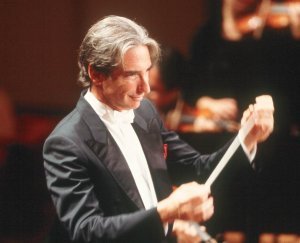
Keeping Score: The Conductor


As we're playing the music, the most important thing going on between us is happening in our eyes. We look at each other, and something completely mystical is exchanged between us: sometimes cautioning, sometimes encouraging, looking around to the edges, and even those who are geographically far on the edges being brought towards the center so that we feel their energy above all animating the onward thrust of the music.

He conducts the orchestra as if he's playing an instrument. It's all body language. He does it with facial expression, gestures, with tension in the body, with his stance.

In the performance of everything, in some sense I'm a motivator in the sense that I'm saying "Ready, set, go!" But in other ways I'm a shaper and modulator of what happens. A little extra flick here, a little cautionary sign there, a little encouragement there. What exactly is necessary.

Making the music itself come alive is a kind of sacred thing for me. We look at these little dots and dashes on the paper, we begin to play them, the spirit comes off the page and envelopes us and somehow draws us together as one spirit.

--Michael Tilson Thomas

I played second violin in my high school orchestra, under Sidney Rothstein. What I find intriguing is that what is described here also applies to the nature of the communication between mother and infant. So much is communicated through gesture, eye contact, and body language.

In a paper titled "Superego Development and Psychopathology," the authors write: "The infant has direct experience of the parent's affect as he is held in the mother's arms. Parental displeasure and anger are first experienced tactually and kinesthetically, but this soon becomes linked to a recognition of the parent's affective expression and the parent's angry look. Subsequently, when he is no longer being held, the child remains acutely sensitive to the parent's displeasure, which he can read in the mother's eyes. The sense of shame originates in this fear of evoking displeasure, and is characterized by a wish to avert one's eyes, hide one's face, and not be seen."

Friday, August 01, 2008

Tristan und Isolde

http://dailstrug.blogspot.com/2010/08/creativity-example-of-homospatial.html

The Wagner-Wesendonk situation has been called a triangle by those who forget Minna. It was actually an impossible piece of geometry . . .
Robert W. Gutman, Richard Wagner: the Man, His Mind, and His Music.
. . . far removed from everyday reality—
Robert Osserman, Poetry of the Universe: A Mathematical Exploration of the Cosmos.
The Wesendonck saga began in earnest in 1857, the year that saw the publication of Gustave Flaubert's Madame Bovary. The husband in the case gets little mention, though it was Otto Wesendonck . . .
Martin Gregor-Dellin, Richard Wagner: His Life, His Work, His Century.
. . . a wealthy retired merchant, . . .
Victor Hugo, Les Miserables.
. . . who owned the houses, threw the parties, and footed the bills for everything.
Martin Gregor-Dellin, Richard Wagner: His Life, His Work, His Century.
It seemed that as his leisure increased with his growing fortune he made use of it to . . .
Victor Hugo, Les Miserables.
. . . patronize struggling genius.
Wilkie Collins, A Rogue’s Life.
Wagner . . .
Charles Darwin, Origin of Species.
. . . who lived as . . .
Charles Dickens, Bleak House.
. . . a semipermanent guest . . .
Peter Radetsky, The Invisible Invaders: The Story of the Emerging Age of Viruses.
. . . on the estate . . .
Charles Darwin, Origin of Species.
. . . of Otto and his wife . . .
Ernest Newman, The Life of Richard Wagner.
. . . found his host . . .
Edgar Rice Burroughs, The Outlaw of Torn.
. . . tiresome, as he concedes in his memoirs, in a passage whose obliquity does nothing to disguise the brazen presumption of his conduct. "I had often noticed," he says, "that Wesendonck, in his honest, unrefined way, felt disturbed by my making myself at home in his house. In many matters, such as heating, lighting, and the hours appointed for meals, I was deferred to in a way that seemed to encroach on his rights as master of the house."
Martin Gregor-Dellin, Richard Wagner: His Life, His Work, His Century.
But then, . . .
Emile Zola, The Debacle.
—looking back—
K.R. Eissler, Talent and Genius.
. . . Wagner’s . . .
Bryan Magee, Aspects of Wagner.
. . . relations with . . .
Wilkie Collins, The Evil Genius.
. . . his benefactors . . .
Charles Dickens, Oliver Twist.
. . . had always . . .
Wilkie Collins, The Evil Genius.
. . . betrayed . . .
Richard Wagner, Tristan und Isolde.
. . . excessive rivalry, insatiable ambition, ingratitude—and acting out, so as to humiliate those to whom he was indebted.
K.R. Eissler, Talent and Genius.
Between November 1857 and May 1858 Wagner set five of Mathilde Wesendonk's poems to music.
John Deathridge and Carl Dahlhaus, The New Grove Wagner.
The music mirrors the mystical nature of the poems, each of which deals with the themes of life slowly fading away and of eternal rest.
Brooks Peters, September Songs.
Well, in the end there came what the French call un denouement—what we in forcible modern English would call a smash,—and it happened thus.
John Strange Winter, Koosje: A Study of Dutch Life.
His first wife . . .
Thomas Hardy, Desperate Remedies.
. . . Minna's interception of a . . .
John Deathridge and Carl Dahlhaus, The New Grove Wagner.
. . . love-letter . . .
Thomas Hardy, Desperate Remedies.
. . . addressed to Mathilde (one of the few and most wildly interpreted documents to have escaped the grasp of Wagner's heirs) precipitated on 7 April 1858 a catastrophe that eventually led to his departure . . .
John Deathridge and Carl Dahlhaus, The New Grove Wagner.
. . . for Italy—
Johann Wolfgang von Goethe, The Flight to Italy: Diary and Selected Letters (explanatory notes).
Yes—for a holiday, for a long holiday . . .
Thomas Hardy, Tess of the D’Urbervilles.
. . . altogether alone . . .
Thomas Hardy, Life’s Little Ironies.
. . . in Venice.
Johann Wolfgang von Goethe, The Flight to Italy: Diary and Selected Letters (Diary entry, October 5, 1786).
Ah, Venice! What a glorious city!
Thomas Mann, Death in Venice.
There, there would I go with you, O my beloved!
Johann Wolfgang von Goethe, Wilhelm Meister.
. . . (as he recorded in his journal) . . .
Booth Tarkington, His Own People.
If that cannot be, I would not dwell where you are, but rather be alone in that world into which I now go forth.
Johann Wolfgang von Goethe, Letter to Charlotte von Stein.
O Mathilde!
Alexandre Dumas, The Count of Monte Cristo.
Take my entire soul as a morning salutation!
Richard Wagner, Letter to Mathilde Wesendonk (April 7, 1858).
His letters were returned to him unopened: but he and Mathilde each kept a diary which was read by the other at a later date. Wagner’s diary, kept in the form of letters to Mathilde, gives us an incomparable picture of his inner life during his Venice sojourn.
Ernest Newman, The Life of Richard Wagner.
Leaving behind the growing frustrations of . . .
Johann Wolfgang von Goethe, The Flight to Italy: Diary and Selected Letters (editor’s note).
. . . creative . . .
K.R. Eissler, Goethe: A Psychoanalytic Study 1775-1786.
. . . work, a difficult love-affair, and lack of time to write, he discovers himself again . . .
Johann Wolfgang von Goethe, The Flight to Italy: Diary and Selected Letters (editor’s note).
. . . in the wondrous island city . . .
Johann Wolfgang von Goethe, The Flight to Italy: Diary and Selected Letters (Diary entry, September 28, 1786).
. . ..as a sensuous being and an artist.
Johann Wolfgang von Goethe, The Flight to Italy: Diary and Selected Letters (editor’s note).
On his arrival in . . .
Anthony Trollope, The Prime Minister.
. . . Venice, the Serenissima of all Serenissime—
Erica Jong, Serenissima: A Novel of Venice.
. . . Wagner had, . . .
Ernest Newman, The Life of Richard Wagner.
. . . to begin with, not a glimmer of an idea for a new composition.
Michael Steinberg, Mahler’s “Symphony of a Thousand.”
Writing to Mathilde . . .
Martin Gregor-Dellin, Richard Wagner: His Life, His Work, His Century.
. . . Richard confessed . . .
Charles Dickens, Bleak House.
. . . he was “haunted by the spectre of failing inspiration.” By his own account, he went to his studio, a tiny . . .
Michael Steinberg, Mahler’s “Symphony of a Thousand.”
. . . chamber . . .
William Shakespeare, Romeo and Juliet.
. . . at the Hotel . . .
Thomas Mann, Death in Venice.
. . . on that first day . . .
Henry James, The Chaperon.
. . . in Venice . . .
Leonard Bernstein, The Unanswered Question.
“with the firm resolution of idling the holiday away (I needed to so much that year) and recruiting my strength. On the threshold of my old workshop . . .
Michael Steinberg, Mahler’s “Symphony of a Thousand.”
. . . Tristan und Isolde . . .
Richard Wagner, Letter to Hector Berlioz.
. . . took hold of me and shook me and drove me on for the next eight weeks until my greatest work was done.”
Michael Steinberg, Mahler’s “Symphony of a Thousand.”
—Oh, how lovely it is to love! And only now do I know what it is! Pain has lost its power and death its thorn. Tristan speaks truth: I am immortal, for how could Tristan’s love die?
Gustav Mahler, Letter to Alma Mahler (1910).
The inter-relationship of themes and particles of themes throughout . . .
Michael Kennedy, Gustav Mahler: Symphony no. 8 in E-flat.
. . . Tristan . . .
James Joyce, Finnegan’s Wake.
. . . is intricate and organic; and . . .
Michael Kennedy, Gustav Mahler: Symphony no. 8 in E-flat.
. . . the entire work. . .
Herman Melville, Typee: A Romance of the South Sea.
. . . elaborate and massive as it is, is a recognizable sonata-form structure.
Michael Kennedy, Gustav Mahler: Symphony no. 8 in E-flat.
It required more than vision and audacity—
Ronald W. Clark, Einstein: The Life and Times.
This, Tristan, . . .
Richard Wagner, Tristan und Isolde.
. . . this extraordinary work . . .
Wilkie Collins, A Rogue’s Life.
. . . demanded also the quality of intuition, a feel for . . .
Ronald W. Clark, Einstein: The Life and Times.
. . . the Poetry of Earth . . .
Leonard Bernstein, The Unanswered Question (quoting Keats).
. . . a feel for nature as indefinable as a poet’s sense of words or the artist’s knowledge of what his last dab of materialistic paint can unlock in the human mind.
Ronald W. Clark, Einstein: The Life and Times.
Wagner’s . . .
Martin Gregor-Dellin, Richard Wagner: His Life, His Work, His Century.
. . . interior monologue in . . .
Bryan Magee, Aspects of Wagner.
. . . Tristan . . .
James Joyce, Finnegan’s Wake.
. . . dark, dense, profound . . .
Janet Malcolm, Psychoanalysis: The Impossible Profession.
—an experiment in density, really, as Venice is an experiment in water—
Adam Gopnik, The City and the Pillars: The Long Walk Home.
. . . embodied the composer’s . . .
BBC Online—Proms, Ludwig van Beethoven.
. . . paradoxical preoccupation with . . .
Christopher Knight, Peering Beyond the Edge.
. . . enchantment and . . .
Vladimir Nabakov, Speak, Memory: An Autobiography Revisited.
. . . oblivion, . . .
Hermann Hesse, Siddhartha.
. . .during his weeks and months in Venice.
Martin Gregor-Dellin, Richard Wagner: His Life, His Work, His Century.
This inner life is not the words nor even the plot as conceived by . . .
George and Portia Kernodle, Invitation to the Theatre.
. . . Wagner . . .
Margaret Brenman-Gibson, Clifford Odets: American Playwright.
. . . the playwright, but a dynamic sequence, constantly surging in rhythmic waves from the beginning to the end.
George and Portia Kernodle, Invitation to the Theatre.
This “birth of the modern” was an explosion of energy.
Martin Gregor-Dellin, Richard Wagner: His Life, His Work, His Century.
For the past several months, since the middle of April, he has dreamed many dreams about time . . .
Alan Lightman, Einstein’s Dreams.
.
. . a new dimension of time, quite different from anything before in music. It is a time which no longer ticks by, or even dances or saunters by: it proceeds imperceptibly, as the moon moves, or as leaves change their color.
Leonard Bernstein, The Unanswered Question.
His dreams have worn him out, exhausted him so that he sometimes cannot tell whether he is awake or asleep. But the dreaming is finished.
Alan Lightman, Einstein’s Dreams.
My sleep . . .
Richard Wagner, Siegfried.
. . . says Wagner, . . .
Leonard Bernstein, The Unanswered Question.
. . . is dreaming, my dream is searching, my search . . .
Richard Wagner, Siegfried.
. . . he says is . . .
Ivan S. Turgenev, Virgin Soil.
. . . for weapons of knowledge.
Richard Wagner, Siegfried.
Thought that can merge wholly into feeling, feeling that can merge wholly into thought—these are the artist’s highest joy. And our solitary felt in himself at this moment power to command and wield a thought that thrilled with emotion, an emotion as precise and concentrated as thought: namely, that nature herself shivers with ecstasy when the mind bows down in homage before beauty. He felt a sudden desire to write.
Thomas Mann, Death in Venice.
He mused awhile, sat down at the table, and wrote down the following lines in his sacred copy-book, without a single correction:
Ivan S. Turgenev, Virgin Soil.
My task is done, my song hath ceased,
my theme
Has died into an echo; it is fit
The spell should break of this protracted dream.
George Gordon, Lord Byron, Childe Harold’s Pilgrimage.
On the afternoon of August 6, . . .
Martin Gregor-Dellin, Richard Wagner: His Life, His Work, His Century.
Or, maybe, . . .
Albert Camus, The Stranger.
. . . it was the 5th . . .
Alexandre Dumas, The Count of Monte Cristo.
. . . I can’t be sure. . . .
Albert Camus, The Stranger.
. . . Wagner summoned . . .
Martin Gregor-Dellin, Richard Wagner: The His Life, His Work, His Century.
. . . a young musician . . .
Hugo Wolf, Letter to His Parents.
.
. . to his hotel room and invited him to look through the score of Tristan. It was almost finished.
Martin Gregor-Dellin, Richard Wagner: His Life, His Work, His Century.
All . . .
Albert Camus, The Plague.
. . . the visitor . . .
H.G. Wells, The Stolen Bacillus.
. . . gathered was that the work . . .
Albert Camus, The Plague.
. . . Wagner . . .
Charles Darwin, Origin of Species.
. . . was engaged on ran to a great many pages, and he was at almost excruciating pains to bring it to perfection.
Albert Camus, The Plague.
“Eh? What’s that?”
Albert Camus, The Stranger.
. . . where are you?
Richard Wagner, Tristan und Isolde.
. . . bar 28 . . .
Ernest Newman, The Life of Richard Wagner.
Can one imagine F sharp and G sharp accompanied by a chord in A minor!
The Beethoven Companion (quoting A. Oulibicheff, Beethoven, ses critiques et ses glossateurs, Paris, 1857).
He was bending over the manuscript.
Albert Camus, The Plague.
What key are we in?
Leonard Bernstein, The Unanswered Question.
. . . no sphinx ever imagined such a riddle . . .
The Beethoven Companion (quoting The Harmonicon, London, August 1823).
. . . it seems to elude analysis . . .
Hector Berlioz, A Critical Study of Beethoven’s Nine Symphonies.
“Well?”
Albert Camus, The Stranger.
A minor?
Leonard Bernstein, The Unanswered Question.
“More or less.”
Albert Camus, The Plague.
‘Ah! Now I see,’ said the visitor.
H.G. Wells, The Stolen Bacillus.
“It’s my opening phrase, and . . .
Albert Camus, The Plague.
. . . it gave me . . .
Arthur Conan Doyle, The Parasite.
. . . trouble, no end of trouble.”
Albert Camus, The Plague.
The theme floats serenely . . .
Philip T. Barford, Beethoven’s Last Sonata.
. . . says Wagner, . . .
Leonard Bernstein, The Unanswered Question.
. . . like a planet in the void, a star born in the emptiness of that motionless moment which gives the clue to the whole work.
Philip T. Barford, Beethoven’s Last Sonata.
At half-past four . . .
Martin Gregor-Dellin, Richard Wagner: His Life, His Work, His Century.
. . . in front of this audience, . . .
Johann Wolfgang von Goethe, The Flight to Italy: Diary and Selected Letters.
. . . Wagner . . .
Anthony Storr, Solitude: A Return to the Self.
. . . wrote in the final bars.
Martin Gregor-Dellin, Richard Wagner: His Life, His Work, His Century.
That was all.
Elia W. Peattie, The Piano Next Door.
No agony and no ecstasy.
Judith Rossner, August.
Verily it is well for the world that it sees only the beauty of the completed work . . .
Thomas Mann, Death in Venice.
. . . the fair copy . . .
The New Cassell’s German Dictionary (entry for the German word “Rein”).
. . . of the completed work and not its origins nor the conditions whence it sprang; since knowledge of the artist’s inspiration might often but confuse and alarm and so prevent the full effect of its excellence.
Thomas Mann, Death in Venice.
But Tristan’s completion seemed bleakly disenchanting compared to the elation that had gripped . . .
Martin Gregor-Dellin, Richard Wagner: His Life, His Work, His Century.
. . . the composer . . .
Alexandre Dumas, The Count of Monte Cristo.
.
. . while at work on it. Only then did he become conscious of the void that faced him on awakening from a long dream filled with music.
Martin Gregor-Dellin, Richard Wagner: His Life, His Work, His Century.
It was . . .
K.R. Eissler, Talent and Genius.
. . . on the same Canale Grande where Wagner was to die 25 years later he realized that . . .
Klaas A. Posthuma, Wagner’s “Tristan und Isolde”.
. . . the relationship between . . .
K.R. Eissler, Talent and Genius.
. . . the “wagoner” and his “mudheeldy wheesindonk ”. . .
Bryan Magee, Aspects of Wagner quoting James Joyce, Finnegan’s Wake.
. . . was all over; Venice became “the tomb of their love”.
Klaas A. Posthuma, Wagner’s “Tristan und Isolde”.
Was liffe worth leaving? Nej!
James Joyce, Finnegan’s Wake.
There . . .
Thomas Mann, Death in Venice.
. . . in Venice, . . .
Marcel Proust, Remembrance of Things Past.
. . . it became perfectly clear to Wagner that Mathilde did not for one moment intend to play Isolde to his Tristan.
Klaas A. Posthuma, Wagner’s “Tristan und Isolde”.
What . . .
Ernest Newman, The Life of Richard Wagner.
. . . milady’s . . .
James Joyce, Finnegan’s Wake.
. . . real feelings for him were we have practically no means of knowing at present.
Ernest Newman, The Life of Richard Wagner.
—I have formed in my own mind the following reconstruction . . .
Sigmund Freud, Dora: An Analysis of a Case of Hysteria.
She imagined various versions of the final dramatic split-up, and discovered herself weeping bitterly in the midst of her engrossed imagining of the scene. She remarked how characteristic this was of her, that she was shedding those real tears with such intense feeling in a self-conjured-up situation that existed, as yet, only in her imagination. She predicted, quite correctly, that 'when that time came' she would feel nothing at all. Indeed, the actual ending of her affair came in a rather prosaic, dull way without comedy or tragedy. When it had finally ended, she was relatively quiet and serene for some weeks. Then retrospective dramatization began. She relived in imagination a past situation which had never been more than imagined. But retrospectively, the past imaginary situation had become the real one.
R.D. Laing, The Self and Others.
Let it be said that the whole matter of the relations of Wagner and Mathilde is wrapped in an obscurity that is at present utterly impenetrable. Those of his letters to her that have already been published . . .
Ernest Newman, The Life of Richard Wagner.
. . . she was, in principle, opposed to publishing the letters . . .
J. Moussaieff Masson, Final Analysis.
. . . are only a selection made by the lady herself in her old age, with a natural insistence on the most ideal aspects of their relationship.
Ernest Newman, The Life of Richard Wagner.
Mathilde was no Emma Bovary.
Martin Gregor-Dellin, Richard Wagner: His Life, His Work, His Century.
—or was she?
Computer Forensics, Case Histories: Blackmail in the Chat Room.
The truth is:
Mathilde Wesendonck, Letter to W. Ashton Ellis.
She seems to have had few individual strivings or goals beyond providing for her husband and respecting his wishes. Her progeny never really belonged to her. She loved in them images of their father. She never interceded for them.
Jean-Paul Sartre, L’Idiot de la Famille.
She had moments of revulsion against her own meekness. . . . Sometimes she was surprised by the horrible possibilities that she imagined; and yet . . .
Gustave Flaubert, Madame Bovary.
She lacked the courage to desert her husband and children and dare all for Wagner's sake. . . . And so Wagner had to leave. . . . The loss would have broken another man.
Robert L. Jacobs, Wagner.
Would you believe it? All of Wagner's heroines, without exception, as soon as they are stripped of their heroic skin, become almost indistinguishable from Madame Bovary!
Friedrich Nietzsche, The Case of Wagner.
There is no need to explain the autobiographical element in the relationship Tristan—Isolde—King Marke . . .
Hans Gal, Richard Wagner.
. . . the identification between Mathilde and Isolde, Wagner and Tristan, Wesendonk and Mark cannot be successful . . .
Hans Mayer, Portrait of Wagner.
. . . and it is sheer idle speculation whether Wagner's passion was released by the artistic concept which was filling his innermost being, or whether to that passion must be ascribed the direct cause of the composition of Tristan.
Hans Gal, Richard Wagner.
I believe that we are here face to face with the outstanding characteristic of great tragedy—that it is the equivalent both of a historical record of real events and, at the same time, of a dream.
K.R. Eissler, Discourse on Hamlet and HAMLET.
I am not sufficiently well-read to know whether this fact has already been remarked upon; possibly, indeed, some writer on aesthetics has discovered that this state . . . is a necessary condition when a work of art is to achieve its greatest effects. . . .

Let us consider Shakespeare's masterpiece, Hamlet, a play now over three centuries old.
Sigmund Freud, The Moses of Michelangelo.
Was Shakespeare expressing his own conflicts by having Hamlet act as he does in the tragedy? This question is of a different order of relevance. It is theoretically conceivable that a poet could create such personages without deriving the stuff for them from his own life history. Instead, the stuff of his personages could be derived mainly from his observations of others about him. Since it is known, however, that the process of observation also depends on the observer's unconscious, one feels inclined to assume, in this instance too, that the poet's own unconscious has been deeply involved.
K.R. Eissler, Discourse on Hamlet and HAMLET.
The author directs his attention to the unconscious in his own mind, he listens to its possible developments and lends them artistic expression instead of suppressing them by conscious criticism. Thus he experiences from himself what we learn from others—the laws which the activities of this unconscious must obey.
Sigmund Freud, Jensen's Gradiva.
I have always sought not to put anything of myself into my works and yet I did put in a great deal.
Gustave Flaubert, Letter to Louise Colet.
One of the memorable moments in Madame Bovary is the scene where the heroine seeks help from the village priest. Guilt-ridden, distraught, miserably depressed, the adulterous Emma—heading toward eventual suicide—stumblingly tries to prod the abbe into helping her find a way out of her misery.
William Styron, Darkness Visible: A Memoir of Madness.
Emma’s disillusionment and its reconstructions are very similar to the chronic pessimism so characteristic of Flaubert. It was his profound belief that happiness is a myth and that attachments bring nothing but pain; one day they must all be relinquished or they will become draining. The outcome of such philosophy of life was to lead to a withdrawal, similar to Emma’s, into his inner world.
Francis D. Baudry, On The Problem of Inference in Applied Psychoanalysis: Flaubert’s Madame Bovary.
Solipsism is suggested by the fact that reality for . . .
Bryan Magee, Aspects of Wagner.
. . . Flaubert . . .
Cosima Wagner’s Diaries (editor’s note).
. . . is always to be found in the psyche, not the external world. Inner emotion is so overwhelmingly experienced that everything else, including other people, has only a shadowy existence on its periphery.
Bryan Magee, Aspects of Wagner.
Hence, the inability to reach happiness through external reality and involvement with others is Emma’s main problem, as it is Flaubert’s. In this instance, then, when Flaubert was describing this aspect of Emma, he was really writing about himself.
Francis D. Baudry, On The Problem of Inference in Applied Psychoanalysis: Flaubert’s Madame Bovary.
Until the onslaught of my own illness and its denouement, I never gave much thought to my work in terms of its connection with the subconscious—an area of investigation belonging to literary detectives. But after I had returned to health and was able to reflect on the past in the light of my ordeal, I began to see clearly how depression had clung close to the outer edges of my life for many years. Suicide has been a persistent theme in my books—three of my major characters killed themselves.
William Styron, Darkness Visible: A Memoir of Madness.
To Mathilde . . .
Robert W. Gutman, Richard Wagner: The Man, His Mind, and His Music.
. . . Wagner . . .
The Diary of Richard Wagner 1865-1882 – The Brown Book.
. . . observed, "My poetic conceptions have always been so far ahead of my experiences that I can only consider these conceptions as determining and ordering my moral development."
Robert W. Gutman, Richard Wagner: The Man, His Mind, and His Music.
Indeed, from a certain point of view (a very doubtful one), one may say that nothing can happen in a man's life without its acquiring the meaning or function of a wish fulfillment.
K.R. Eissler, Talent and Genius.
One goes astray in trying to interpret an artist's life by his work, for it is exceptional to find one a counterpart of the other. It is more likely that an artist's work will express the opposite of his life—the things he did not experience.
Romain Rolland, Wagner: A Note on Siegfried and Tristan.
The idea of Tristan and Isolde was in fact conceived not by a man in love but by someone conscious of his lack of love. As early as December 1854 Wagner had written to Franz Liszt: . . .
Hans Mayer, Portrait of Wagner: An Illustrated Biography.
. . . to the devout Abbe Liszt, whose apartment in the Vatican had been steps from the Sistine Chapel . . .
Robert W. Gutman, Richard Wagner: The Man, His Mind, and His Music.
"Since in my life I have never enjoyed the real good fortune of love, I want to set up a monument to this most beautiful of all dreams, a monument in which from start to finish this love might for once be satiated: in my head I have planned a Tristan and Isolde, the simplest but most full-blooded musical conception; it is with the 'black flag' that waves at the end that I want then to cover myself, in order to—die."
Hans Mayer, Portrait of Wagner: An Illustrated Biography.
Was he contemplating suicide?
Martin Gregor-Dellin, Richard Wagner: His Life, His Work, His Century.
Wagner . . .
Johann Wolfgang von Goethe, Faust (Part II).
. . . could readily imagine that he, like . . .
Arthur B. Reeve, The Poisoned Pen.
. . . Tristan was foredoomed to sorrow from the moment of his birth:
Ernest Newman, The Wagner Operas.
. . . doomed, since childhood, to live a miserable and unfortunate life that could all too easily lead to suicide, whatever the particular external circumstances of his later life might have been.
K.R. Eissler, Talent and Genius.
He tried to occupy his mind with books; but his soul was gangrened with bitterness against the world, which, in his opinion, had cruelly denied him the simple right to live.
Ernest Newman, The Life of Richard Wagner.
My nights are often sleepless; I get out of bed wretched and exhausted, with the thought of a long day before me which will not bring me a single joy. The society of others tortures me, and I avoid it only to torture myself. Everything I do fills me with . . .
Romain Rolland, Wagner: A Note on Siegfried and Tristan quoting Wagner.
. . . this terrible yearning in my heart . . .
Richard Wagner, Tristan und Isolde.
I awake with horror in the morning,
And bitter tears well up in me
When I must face each day that in its course
Cannot fulfill a single wish, not one!
Johann Wolfgang von Goethe, Faust.
Ay me! Sad hours seem long.
William Shakespeare, Romeo and Juliet.
At midnight
I awoke
And looked up at the sky.
Not a star in the galaxy
smiled at me
at midnight.
At midnight
my thought went
out to the limits of darkness.
There was no thought of light
to bring me comfort
at midnight.
Gustav Mahler and Friedrich Ruckert, Excerpt from the Song "Um Mitternacht."
What if her eyes . . .
William Shakespeare, Romeo and Juliet.
. . . Mathilde’s . . .
Martin Gregor Dellin, Richard Wagner: His Life, His Work, His Century.
. . . eyes were there, they in her head?
The brightness of her cheek would shame those stars
As daylight doth a lamp; her eyes in heaven
Would through the airy region stream so bright
That birds would sing and think it were not night.
William Shakespeare, Romeo and Juliet.
O God, send peace and heavenly shining
On the dark desert of my heart.
Gustav Mahler, Symphony no. 8 in E-flat (quoting Goethe, Faust (Part II) (Final Scene).
This is how Wagner wrote . . .
Romain Rolland, Wagner: A Note on Siegfried and Tristan.
. . . in the diary he kept for Mathilde in Venice
Martin Gregor Dellin, Richard Wagner: His Life, His Work, His Century.
In the same way Michelangelo wrote to his father in 1509: "I am in agony. . . . I am wasting my time to no purpose. Heaven help me!"
Romain Rolland, Wagner: A Note on Siegfried and Tristan.
'Verily, verily . . .'
Clifford Odets, Communication to William Gibson.
". . . to put up with living one has to be dead!"
Cosima Wagner's Diaries (Monday, October 9, 1882).
Yet the very hopelessness of it all kindled a mystic hope in him. Only where there are graves, as Nietzsche says, are there resurrections.
Ernest Newman, The Life of Richard Wagner.
When he prayed, "Dear God, help me!" he was praying to himself, beseeching himself to have fortitude, to be invincible of body and spirit, to have the stamina and will to create mightily in a vision of a more heroic world.
Irving Stone, The Agony and the Ecstasy: A Novel of Michelangelo.
He did not . . .
Thomas Hardy, Life’s Little Ironies.
. . . after all commit suicide . . .
K.R. Eissler, Talent and Genius.
. . . tho thoughts . . .
Henry Van Dyke, Ships and Havens.
. . . of self-destruction were never far away.
William Manchester, The Last Lion: Winston Spencer Churchill; Visions of Glory: 1874-1932.
Sometimes . . .
Johann Wolfgang von Goethe, Faust.
—sometimes mysteriously so—
Sigmund Freud, Moses and Monotheism.
. . . death is never quite a welcome guest.
Johann Wolfgang von Goethe, Faust.
Writing to Mathilde . . .
Martin Gregor-Dellin, Richard Wagner: His Life, His Work, His Century.
Wagner
The Diary of Richard Wagner 1865-1882 – The Brown Book.
. . . confessed:
Martin Gregor-Dellin, Richard Wagner: His Life, His Work, His Century.
Among a considerable collection of weapons I possessed a handsome, well-polished dagger. This I laid every night by my bed, and before extinguishing the candle I tried whether I could succeed in plunging the sharp point a couple of inches deep into my heart. Since I could never succeed in this, I at last laughed myself out of the notion, threw off all hypochondriacal fancies, and resolved to live.
Johann Wolfgang von Goethe, Fiction and Truth.
Perhaps fate intervened this time on the side of right.
Brooks Peters, September Songs.
Wherever he went, conflicts speedily evolved; and he always seemed to achieve victory at first, only to hurt himself subsequently. He was forever achieving a new rise—until this drive toward self-destruction set the mortal wound. Yet even that final disaster . . .
K.R. Eissler, Talent and Genius.
. . . and subsequent . . .
Thomas Hardy, Desperate Remedies.
.
. . Flight to Italy . . .
Johann Wolfgang von Goethe, The Flight to Italy: Diary and Selected Letters.
. . . was followed by an elevation, in the form of . . .
K.R. Eissler, Talent and Genius.
. . . a new trust in his perceptions and emotions and in his power to convey them
T.J. Reed, Introduction to Goethe, The Flight to Italy: Diary and Selected Letters.
He is a prototype of Ambiguous Man, compulsively engineering his own destruction, and simultaneously flying on into the future.
Leonard Bernstein, The Unanswered Question.
It was more biblical than Shakespearean—the story of a man who sinned, suffered, died, and rose again.
Leonard Garment, Crazy Rhythm.
____________________________