Saturday, October 20, 2007

No Sex Please, We're Indian

How strange his life had been, he thought. He had wandered along strange paths. As a boy I was occupied with the gods and sacrifices, as a youth with asceticism, with thinking, and meditation. I was in search of Brahman and revered the eternal Atman. As a young man I was attracted to expiation. I lived in the woods, suffered heat and cold. I learned to fast, I learned to conquer my body. I then discovered with wonder the teachings of the great Buddha. I felt knowledge and the unity of the world circulate in me like my own blood, but I also felt compelled to leave the Buddha and the great knowledge. I went and learned the pleasures of love from Kamala and business from Kamaswami. I hoarded money, I squandered money, I acquired a taste for rich food, I learned to stimulate my senses.


I was also having trouble with the so-called parietal rules at my university which said that a woman must leave a student's room by 10 P.M. Every second that I was not studying, I spent at a local women's college, meeting women. This was a paradox that was becoming more and more pronounced in my character. While I still considered myself a spiritual person, I was becoming increasingly obsessed—an even stronger word would not be out of place—with sex. I saw it everywhere. I wanted it. I thought about it all the time. No woman seemed safe from my predations. I look back at it with horror. I had absolutely no understanding of what I was doing.

—I was afraid of myself, I was fleeing from myself.

One evening I was invited to meet an older (perhaps forty-five) professor of Indian philosophy who was visiting from India. She had something of a following in India and was even considered a kind of guru. Somehow the discussion turned to spiritual matters. This woman said she had never felt sexual desire in her life because her mind was filled with spiritual thoughts. There was simply no room. As the guests were leaving her apartment, she asked me to stay a little bit, as there was something she wanted to tell me.

When we were alone she said: "You looked as though you did not believe what I was saying. Is that true?"
"Well, actually I don't, no," I replied.
"You don't believe I am free of sexual desire?"
"No."
"I will prove it to you. Touch my breasts."
I did as I was told.
"See, I feel nothing. Now touch my thighs."
I did as I was told.
"Again, nothing. Even if you enter me with your penis, I will feel nothing. Do you believe me?"
"No."
"Try."
I did.
"See, I feel nothing. The whole time this is going on I am thinking only about the higher self, the atman."

To whom else should one offer sacrifices, to whom else should one pay honor, but to Him, Atman, the Only One? And where was Atman to be found, where did He dwell, where did His eternal heart beat, if not within the Self, in the innermost, in the eternal which each person carried within him? But where was this Self, this innermost?

Where was it? Where was it?

It is not surprising that the very word for asceticism, tapas, is insidiously related, tied to, and involved with a word commonly associated with seemingly opposite things—with virility, with sexual prowess, especially with increased potency (evidence for this is found not only in the Sanskrit texts, but in the observations of many travelers in India). The myths of Siva show such connections in detail. It is not surprising that the concern with incontinence would lead to fantasies about the powers inherent in semen; we can see this attested to in the ancient stories containing oral pregnancy fantasies (a ubiquitous theme in the Mahabharata: e.g., Kasyapa, Rsyasrnga's father, lost his semen at the sight of Urvasi, and it was swallowed by a female antelope who subsequently gave birth to Rsyasrnga—hence his name "Antelope-Horned").These sexual fantasies of immense prowess are of course only the other side of the coin from constant fears of sexual depletion. Such concerns, universal and timeless, are particularly well documented in the case of the Indian villager.

‘The Victors’ Have you heard about it?

The sketch of ‘The Victors’ Wagner's projected music drama on a Buddhist theme pictures Ananda, a disciple of Buddha, hospitably given water by a maiden Prakriti.The Buddha warns Ananda not to speak with women; if he must speak to one to keep his eyes on the ground; and if he must look, "Then beware Ananda, beware."Prakriti falls deeply in love and seeks out Gotama, The Buddha, beneath a tree at the city gate to ask permission for union with Ananda. The Buddha reveals her identity in a former incarnation as an overproud girl who scorned the love of an unfortunate, an arrogant act she must now expiate by experiencing the torture of unsatisfied passion. Only by sharing Ananda's vow of chastity may she stay at his side. Grasping his condition of salvation, she joyfully agrees, and Ananda receives as his sister one who has risen to his own level of self-denial.

So what is it that Gotama, The Buddha, says? He says:One must find the source within one’s own Self, one must possess it.Everything else was seeking—a detour, error.In the figure of the maiden, who was one day to become Kundry in Parsifal, Wagner sought finally to resolve his concern with the realm of unbridled sexual fantasy.These were Wagner’s thoughts; this was his thirst, his sorrow.

Wagner saw resignation as the only solution to his infatuation for Mathilde Wesendonk the object of his ill-starred adoration.

I have no inclination any more, no will!—Would there were an end to it, an end!—

He wished passionately for oblivion, to be at rest, to be dead. "The Victors" was a product of this frame of mind.

When the Self was conquered and dead, when all passions and desire were silent, then the last must awaken, the innermost of Being that is no longer Self—the great secret.The ascetic theme of "The Victors" sustained Wagner and Mathilde in a state of exaltation after Wagner’s first wife Minna had put an end to what was evidently the less abstemious phase of their affair.

Wagner wrote that at this particular epoch of his life he had one single goal—to become empty, to become empty of thirst, desire, dreams, pleasure and sorrow—to let the Self die. No longer to be Self, to experience the peace of an emptied heart, to experience pure thought—that was his goal.

It had been more than a little characteristic of the conflict between asceticism and world-devouring hunger that made up the drama of his nature.

I believe that the concern voiced ubiquitously by the ascetic in Indian literature—‘seeing the world and the human self in one great all including vision,’ in sum, the search for mystical experiences; as if only the ecstatic stillness of trance-states could fill the void of a happiness never experienced—is an oblique reference to a sad past. The apparent reliving of a lost past in terms of grasping at the illusion of ecstasy can only represent a falsification of memory for the purpose of defence. And the dry, brittle memories of an emotionally arid childhood are as fearsome as those of more openly violent abuse.

Gradually it has become clear to me that all ascetics must have suffered from harsh and unloving parents in their childhood. I should add, however, that most analysts would disagree, and would qualify this by saying that often the harsh treatment was only imagined—often as retaliation for imagined evil in the little child himself, for his own destructive fantasies vis-a-vis his parents and siblings.

It seems to me that all ascetics suffered massive traumas in their childhood in one of three ways: they were sexually seduced, or they were the object of overt or covert aggression, or they lost those closest to them early in their lives. Their lives were pervaded with sadness; their rituals, their obsessive gestures of every kind, are an attempt to recapture the lost childhood they never had. It is not surprising to find that all addicts have suffered such loss.

At a later date I would gradually be persuaded that devastating loss in childhood figured as a probable genesis of my own disorder. Psychoanalytic studies of addiction have enabled us to see "addictive" features in many areas seemingly unrelated to pure drug or alcohol addiction. Compulsive sexuality can serve as an addiction, as can the practices of asceticism.

Friday, October 12, 2007

The Philosopher in the Distant Solitude of the Woods

Thoreau required of any writer a simple and sincere account of his life, and no doubt if Friedrich Nietzsche had been able to write straightforwardly of the ugly growths and parasitic creepers infecting the dense forest of his relationship with his mentor Richard Wagner, All Too Human would not have been written or would have been very different.


I should not forget that during my last winter at the pond there was a serious but welcome visitor, a gentle, perceptive soul who would have been an ideal companion in the woods, a young man named Friedrich Nietzsche who at one time came through the village, through snow and rain and darkness, till he saw my lamp through the trees, and shared with me some long winter evenings. One of the last of the philosophers--one of my Waldensian friends.

At that time I lived alone, in the woods, a mile from any neighbor, in a house which I had built myself, on the shore of Walden Pond.

Now I conserve pathologically precise memories of my encounters in that by now remote world: well, . . . I had last seen him a weedy youth, timid and deferential, much given to clicking of heels and bowing. Now in stalked a wiry, tough man with a masterful air whose first act was to deposit on the table a draft copy of a book with the marks of a great destiny, a collection of aphorisms that bears the title Human, All-Too-Human.

I asked him if he would like me to contribute to this book. If he would, he should tell me a story and, if he would allow me to make a suggestion, it should be our kind of story, in which you thrash about in the dark for a week or a month, it seems that it will be dark forever, and you feel like throwing it all up and changing your trade; then in the dark you espy a glimmer, proceed groping in that direction, and the light grows, and finally order follows chaos.

The young man stood in silence. He would never reply.

I wish I could say that I had supplied him with ideas as much as with support. All that was futile. We can understand one another; but each of us is able to interpret himself to himself alone.

He embraced me then. "Good luck, good luck." I never saw him again.

There was nothing we could do but part, because neither of us had anything to give the other and neither of us could be fair to the other.

He never said just how he went about creating a new personality, but it was a difficult process.

Today I know that it is a hopeless task to try to dress a man in words, make him live again on the printed page, especially a man like my dear young friend. He was not the sort of person you can tell stories about, nor to whom one erects monuments--he who laughed at all monuments: he lived completely in his deeds, which were nothing less than the adventures of an unworldly young recluse and when they were over nothing of him remains nothing but words, precisely.

I kept Prof. Nietzsche's book on my table through the summer, though I looked at a page or two only now and then.

One thing more, which I might later forget:I finally left the distant solitude of the woods, where I was living quietly and peacefully. At present I am a sojourner in civilized life again.

Thursday, October 11, 2007

A Nightmare

Several nights ago I had a terrible yet poignant dream whose themes of unsatisfiable yearning (symbolized by unquenchable thirst) and frustrated hopes still linger in my mind.

The Dream of the Deathbed


It is a hot August day, and I lay in a small room in a hospital fighting for what remains of my life. A sheet covers the lower half of my naked body, with its swollen abdomen; above it, my chest and thin arms. A tube is inserted in my nose; a second tube leads from my side into a glass jar at the foot of the bed; both are removing the wastes my body can no longer eliminate. The gallons of iced apple juice I gulp down to moisten my cracked lips and dry throat reach only the stomach and flow into the jar. Nothing moves past the stomach level, below which there are intestinal obstructions, and because my body absorbs little, whether I drink, suck lemons, or rub ice on my lips, my thirst is unslakable.

Compulsively I keep flexing my long fingers, rippling them as though playing an instrument. Whenever the powerful sedatives pumped into my body threaten to overwhelm me I wrench myself up into consciousness, forcing myself to activity. At times I extend an arm at full length, shake my fist and shout, "Gary Freedman, you have so much to do!"

I say, "I want to yell, can I yell?" And then I shout, "Yell!"-- prolonging the word interminably like a fire siren. Those who hear it forgive its theatricality because it is evident there is something penultimate in this howl.

I put into words what I think is the reason for waging my nightmare battle: "I may fool you all . . . you know, I may live. . . . Then perhaps Gary Freedman will do something to redeem the last 15 wasted years."

It becomes a matter of utmost significance to me to know what time it is, and repeatedly I ask; once, after I am told, I say, "Why don't they tell me the time, why do they keep it from me? Why do they do this to a man's courage?" It is as though I am counting the minutes that are still mine.

Wednesday, October 10, 2007

The Silence of the Night

It is now early evening on this snowy December day. The storm has all but passed. The stir is over. I step forth once again to peer outside my window. I strain to make the far-off images beyond my windowpane yield a cue to the events that may come in the days ahead. Night and its murk transfix and pin me, as I stare through thousands of stars. I cherish this moment, this rigorous conception of a snowy winter evening, and I consent to play my part therein as spectator.


ImageIgloo.com


But another play is running at this moment, so, for the present, I seek a premature release. And yet, the order of the acts has been schemed and plotted, and nothing can avert the final curtain's fall. The January thaw will soon take off the polish of the snow's crust. I bow with grace to natural law. I stand alone. All else is swamped in fuzzy dissolution. To live life to the end, while peering back to the path one has already traversed, is not a childish task.

Sunday, October 07, 2007

Remembrance of Things Past: A Winter's Tale

Day dawn.—

I am rather depressed. I go to the basement and open my trunk. The basement is in my mountain home; after a long, harsh December, deep in the trunk, when I reach for mementos of past pains and pleasures, I still feel the cold of winter's first day.

The past is a quiet place where change occurs in increments of glacial slowness; it is a perpetually verdant landscape. You can go there and find that nothing much has happened since your last visit.

In probing my childhood (which is the next best to probing one's eternity) I see the awakening of consciousness as a series of spaced flashes, with the intervals between them gradually diminishing until bright blocks of perception are formed, affording memory a slippery hold.

But what is the past? Could it be, the firmness of the past is just illusion? Is there any reason to trust a man in his late fifties, who speaks of his "child's memory" as if it existed, unintruded upon by intervening experience, like an old movie reel, waiting only for a projector? Nobody can really say for sure, because nobody really knows.

Speaking personally, I find that my early childhood memories are planted, first and foremost, in exact snapshots of my photographic memory and in the feelings imprinted in them, and the physical sensations. Then comes memory of being able to hear, and things I heard, then things I thought, and last of all, memory of things I said.Images and symbolic constructs of the past are imprinted in me, almost in the manner of genetic information to become galvanized into what will later be a cinematic re-presentation.

The first pictures surface one by one, like upbeats, flashes of light, with no discernible connection, but sharp and clear. Just pictures, almost no thoughts attached:

It must have been Riga, in winter. The city moat was frozen over. I'm sitting all bundled up with someone on a sled, and we're running smoothly over the ice as if we're on a street. Other sleds overtake us, and people on skates. Everyone's laughing, looking happy. On both sides tree branches are bright and heavy with snow. They bend over the ice; we travel through and under them like through a silver tunnel. I remember going in one end and coming out the other. I think I'm floating. I'm happy. But this picture is quickly scared off by other ones, dark and suffocating, which push into my brain and won't let go. They're like a wall of solid black between me and the sparkling and the sun.

I fight against my depression. I am not well, but I am not mad. I’m after something. Memory, yes. A reel. More than just time. I summon up remembrance of things past. But more than just time.

Mid-day.

A walk in the bright sunshine at noon was a great help to me; from the top of the hill I was enraptured by the ring of snow-capped mountains, which suggested to me a mysterious, unmoving dance. Absorbed long in watching the picture, my spirit heard the music which higher beings reproduce for us in sounds. — The transience of all individual existence, the eternity of the whole, was reflected to me in the blue mirror of the lake.

When one has passed through a narrow gorge and has suddenly arrived at a summit, after which the ways part and the richest prospect opens in different directions, one may linger for a moment and consider which way one should turn first.

My deep inner strength restored, I summoned the Friend from his work and together we wandered up the hill; the magnificent view of mountains looked like a spectral shadow. Fresh snow had fallen, and this partly concealed the crevasses, so that we could not make out the most dangerous places. Here my guide had to take the lead and reconnoiter the paths. At last we reached the opening of the pass leading out to the shallow valley to which a precipitous slope of ice and snow had led us.

We stand among dark boulders, taller than we, that came to rest here 20,000 years ago when the glacier melted and retreated north.

That which has driven me to the steep summit, now holds me spellbound at the abyss's edge: I now felt that strange and mysterious sensation which is awakened in the mind when looking down from lofty hilltops, and now I was able to do so without any feeling of nervousness, having fortunately hardened myself to that kind of sublime contemplation. I wholly forgot who I was, and where I was.

I am at peace at the edge of the abyss.

Friday, October 05, 2007

A Winter Solstice: An Old Master, His Young Disciple and The Darkest Evening of the Year

(This post is dedicated to Brad M. Dolinsky, MD, a giant of a man, and a rising star in the medical profession).

Arrival of Professor Nietzsche's book. I looked at it, turned over idly pages of it with curiosity. It was eloquent, vibrating with eloquence, but too high-strung, I think. What of it, though?

On January 2, 1872, Friedrich Nietzsche sent Richard Wagner an uncut advance copy of his book, now entitled The Birth of Tragedy from the Spirit of Music, as a "token of goodwill and friendship." Many of the ideas to which Wagner had undoubtedly given livelier expression in conversation with Nietzsche than in his essays on art . . . recurred in an intensified and spiritualized form in Nietzsche's sublime prose.

Let's see how it begins. I suppose . . . I could paraphrase. No, no; wait! He can say in his own words, much better, what I as his ambassador in my enthusiasm might only hint at:

It was in dreams, says Lucretius, that the glorious divine figures first appeared to the souls of men; in dreams the great shaper beheld the splendid bodies of superhuman beings; and the Hellenic poet, if questioned about the mysteries of poetic inspiration, would likewise have suggested dreams and he might have given an explanation like that of Hans Sachs in the Meistersinger . . .

“This is the book I have been longing for,” says Richard—

Opening a path for yourself, with a paper-knife in the barrier of strange pages of virgin manuscript becomes linked with the thoughts of how much the word contains and conceals: you cut your way through your reading as if through a dense forest.

Where now?

Drove into town, home with Richard, through fog, darkness, and snow. We both felt dazed, contemplating that whiteness as if each of us were hypnotized looking fixedly at blank manuscript pages. I at last, a blanket to my chin, thought of the times when I lived here against all the rules like a dream figure, and when this landscape seemed so appropriate.

Not till we are lost, in other words not till we have lost the world, do we begin to find ourselves, and realize where we are and the infinite extent of our relations.

My little horse must think it queer to stop without a farmhouse near between the woods and frozen lake the darkest evening of the year. He gives his harness bells a shake to ask if there is some mistake. The only other sound's the sweep of easy wind and downy flake. The woods are lovely, dark, and deep, but I have promises to keep, and miles to go before I sleep, and miles to go before I sleep.

What does it mean? Why this:

In the middle of the journey, in long winter nights, we find ourselves in dark woods where the right path seems lost. But even so melancholy a poet saw for a prophetic moment that at the end of the confusion in the rosy light of morning there is sometimes a clearing in whose sunlight things appear more distinct and precious than ever before. Can you conceive what new and vital power I draw from living in the wilderness?

Returning home I felt as if I had come out of a bleak, harsh woods into a cozy lair.

—In the evening read more of Nietzsche's book, which gives Richard ever-increasing satisfaction, but we wonder where the public for it will be found.

On my way upstairs to bed I stopped to sit on my spiral staircase and reflect, reflect, until the mildness of my thoughts lulls and calms me; and then from downstairs I hear music: I was lost, so to speak, in the milky way. Only within. Inside the brain. An indescribable impression— All my senses now want to sink into slumber. Winter’s revenant invites you into it, and there you lie while the bleached sheet of snow accumulating just beyond the window pane translates you to an angel in a solitary bed.

In the meantime Richard comes up and shows me a really beautiful letter, a poem in itself, which he has written to the professor telling him what he thinks of the book and its author.

Yes. This. Here.

Friedrich!--

In your rural letter box I leave this note without a stamp to tell you, My friend! Never have I read anything more beautiful than your book! You thought it out excellently! How splendid it all is! An amazing tour de force. No rule seemed to fit it, and yet there was no fault in it.— Whether or not one enjoys such a technique as you have achieved is a matter of taste on which disagreement or argument is futile, but to subject that technique to the standards of some other technique seems to me to be little short of absurd.

I am writing to you quickly now because reading it has left me so inordinately excited that I must first await the return of reason before reading it properly.

And it is partly to compel myself, in forma pauperis, to say as much I write you this. Every life is many days, day after day. We walk through ourselves, meeting robbers, ghosts, giants, old men, young men, wives, widows, brothers-in-law, but always meeting ourselves.

You’re a giant of a man, and our meeting calls to mind an Allegory of two stars’ having coalesced a couple of stars which came together in constellation as never before, while the other stars all look’d on in amazement, and did not know what next.

What more remains? We were born one for another and are certain to do fine things together.
—There's nothing more I can say. Be thanked. I now depart a debtor.

Your friend,

Richard Wagner

Nietzsche's first book was a vivid visual poem, a creative condensation of life, death, and immortality.

Nietzsche had, in fact, become a second Joseph: a man famous in the Bible as an interpreter of dreams. Joseph who was becoming daily more conscious of his own powers, more convinced of his mission pieced Pharaoh's dreams together exactly as they had visited Pharaoh in the night, and the king was greatly amazed. Joseph was able to accomplish this feat, because he had dreamed the same dream as Pharaoh, at the same time as he.

Pharaoh was, of course, the Master who stood for a great deal that the younger man, longing to do immortal work, was beginning to envisage as his own special world.

Thursday, October 04, 2007

How I Long To Die! To Lose Myself In Oblivion!


In every garment, I suppose I'm bound to feel the misery of earth's constricted life. I am too old for mere amusement and still too young to be without desire. What has the world to offer me?

You must renounce! Renounce your wishes! This is the never-ending litany which every man hears ringing in his ears, which every hour hoarsely tolls throughout the livelong day.

I awake with horror in the morning, and bitter tears well up in me when I must face each day that in its course cannot fulfill a single wish, not one!

The very intimations of delight are shattered by the carpings of the day which foil the inventions of my eager soul with a thousand grimaces of life. And when night begins to fall I timidly recline upon my cot, and even then I seek in vain for rest; savage dreams come on to terrorize.

The god that lives within my bosom can deeply stir my inmost core; enthroned above my human powers, He cannot move a single outward thing. And so, to be is nothing but a burden; my life is odious and I long to die.

Wednesday, October 03, 2007

A Solitary Life


From my youth upwards my spirit walked not with the souls of men, nor looked upon the earth with human eyes; the thirst of their ambition was not mine, the aim of their existence was not mine; my joys, my griefs, my passions, and my powers made me a stranger; though I wore the form, I had no sympathy with breathing flesh, nor midst the creatures of clay that girded me was there anyone with whom I identified.

I said with men, and with the thoughts of men, I held but slight communion; but instead, my joy was in the wilderness, to breathe the difficult air of the iced mountain’s top, where the birds dare not build, nor insect’s wing flit over the herbless granite; or to plunge into the torrent, and to roll along over the swift whirl of the new breaking wave of river-stream, or ocean, in their flow.

In these my early strength exulted; or to follow through the night the moving moon, the stars and their development; or catch the dazzling lightnings till my eyes grew dim; or to look, listening, on the scattered leaves, while Autumn winds were at their evening song.

These were my pastimes, and to be alone; for if the beings, of whom I was one,— hating to be so,—crossed me in my path, I felt myself degraded back to them, and was all clay again. And then I dived, in my lone wanderings, to the caves of death, searching its cause in its effect; and drew from withered bones, and skulls, and heaped up dust, conclusions most forbidden.

Then I passed the nights of years in sciences, untaught save in the old time; and with time and toil, and terrible ordeal, and such penance as in itself has power upon the air and spirits that do compass air and earth, Space, and the peopled infinite, I made my eyes familiar with eternity, such as, before me, did the seekers of ancient wisdom, and those who from out of their humble dwellings raised civilizations most mighty.

And with my knowledge grew the thirst of knowledge, and the power and joy of this most bright intelligence, until now.

And now, at this moment, I dwell alone in my afflictions and as well as in my joys.

Tuesday, October 02, 2007

You Get What You Pay For

Well, it happened. My therapist terminated me. She said she doesn't want to see me anymore. Apparently I hurt her feelings. I told her that I did not respect her opinions and that I did not consider her to be an expert. She took particular offense to my statement that I did not consider her to be an expert. "You don't think I'm an expert?" "No, I don't." "Well, in that case," she said, "don't bother coming here anymore."

But it's true. I don't value her as a therapist. She treated me like an automaton the entire time I'd been seeing her, since May 2, 2003. She told me what to think, what to feel, what to say in different situations, what I should not have said in different situations, and even how to act. She calls her therapy "cognitive-behavioral therapy." I think she's just an autocrat who uses the label cognitive therapist to rationalize her authoritarianism.

She would negate everything I felt. She even claimed, on occasion, that I didn't even believe the things I was telling her--in effect, calling me a liar. Well, I know when I'm lying, and I can tell you that I was not lying about the things she said I was lying about.

She allowed me no opportunity to express myself: to explore my thoughts and feelings. "What do you think I am," she said on one occasion, "a friend who you can talk to, someone you would talk to over a cup of coffee?" Well, in some sense isn't that what therapists are -- or should be?

She would intrude on my narrative to issue her inane and authoritarian directives. "Don't think that. Don't feel that!" Well, I happen to be an independent-minded person. I think what I think. I feel what I feel. I don't have control over what I think and feel. And I'll be damned if I will allow someone who I don't even respect to try to manipulate my thoughts and feelings. I felt like a puppet and she was the puppet-master. An uncooperative puppet, to be sure.

But you get what you pay for. I am a patient at a public mental health clinic in the District of Columbia. Treatment is provided free of charge.

What I can't understand is her background. She has a phenomenal resume. She has a Ph.D. in psychology from New York University. She claims she was a star pupil, in fact. She also later served on the faculty at NYU. She was a therapist at Bellevue Hospital in New York. She has worked in forensics at Ryker's Island in New York. She has published numerous papers, and was even invited to deliver a paper before the New York Academy of Sciences. Can all these people be wrong about her? Is it possible that she is not only competent but also, perhaps, brilliant in her field?

All I can say is that she left me feeling frustrated and very distressed. Maybe it's just me. Maybe I'm the only person who was dissatisfied with her. She claims all her other patients value her a great deal.

The fact is, however, I myself am somewhat of an expert in psychotherapy. I've been in therapy for many years now, twenty-eight to be exact. I've seen many therapists: psychiatrists and psychologists. I've had brilliant therapists in the past, people I valued. One of my psychiatrists was a graduate of Columbia, another a graduate of Harvard, and yet another had a degree from The University of Pennsylvania. I can judge a competent and brilliant therapist when I see one. Believe me, my therapist (or former therapist) -- The Mad Monk, as I call her -- had none of the qualities I valued in other therapists.

Then there's the objective fact that my condition worsened dramatically while I was seeing The Mad Monk.

On March 16, 2004 I was banned from group therapy, sponsored by the DC Department of Mental Health because I experienced a hysterical outburst. Security guards had to be summoned and I was assessed by a psychiatrist for involuntary commitment to a mental hospital. It was determined that I did not present a danger to myself or others and I was allowed to go home.

On March 17, 2004 my then treating psychiatrist diagnosed me with paranoid schizophrenia, and later recommended that I admit myself to a hospital. She advised her colleagues that she was afraid to be alone with me, and her subsequent meetings with me were held with other persons present. A staff person recommended that I admit myself to The Washington Hospital Center. On March 17, 2004 The Mad Monk herself wrote in my treatment plan that I suffered from paranoid schizophrenia.

On April 21, 2004 I was banned from my local library for a period of six months because of conduct that the branch librarian deemed inappropriate and suggestive of serious mental illness. The Metro DC Police were summoned, who reviewed with me the procedures for having myself admitted to a hospital. The police reviewed with me the advisability of admitting myself to Georgetown University Hospital. The police further stated that they was concerned about my future behavior and potential for violence.

On October 12, 2004 ten Metro DC Police officers and four FBI agents - would you believe it? - were sent to my home because of a letter I had written that was deemed by the police to be a product of severe mental illness. The police transported me in handcuffs to DC General Hospital for an emergency forensic psychiatric evaluation. I was assessed by a psychiatrist at DC General who determined that my case did not warrant a hospital admission.

I mean this is some pretty heavy stuff. I just didn't have problems like this before I started seeing The Mad Monk in May 2003.Like I say, the therapy was free. Proving once again, you get what you pay for!

Monday, October 01, 2007

Chilled and Alone on a Long Autumn Night


Autumn mists drift in blue over the lake;
All the grass is covered with hoarfrost;
One would think an artist had scattered jade-dust
Over the delicate blossoms.

The flowers' sweet scent is gone;
A cold wind bends their stems.
Soon the withered golden leaves
Of the lotus blossoms will float by on the water.

My heart is weary.
My little lamp
Has sputtered out, it summons me to sleep.
I come to you, dear resting place!

Yes, give me rest, I need to be refreshed.
I weep much in my loneliness.
The autumn in my heart endures too long.
Sun of love, will you never shine again
Gently to dry my bitter tears?

Sunday, September 30, 2007

Freud's Final Days in Vienna


This post is dedicated to my friend, Mathias Rosenkranz, a proud resident of Vienna.

Now this long tale is finished, but before I close my book, I must say a few words . . .
Arthur Rubinstein, My Many Years.
. . . a few more words . . .
Sigmund Freud, An Autobiographical Study.
In June of 1938, a few days before the Freud family left Vienna for London, Freud’s friend August Aichhorn asked a young photographer, Edmund Engelman, to take some pictures of Freud’s place of residence, so there would be a visual record of the locale where psychoanalysis came into being.
Bruno Bettelheim, Freud’s Vienna & Other Essays.
And so it was that . . .
Jack London, The Sea Wolf.
. . . the good doctor’s . . .
H.G. Wells, The Secret Places of the Heart.
. . . friend and confidant . . .
G.A. Henty, In Freedom’s Cause.
. . . August Aichhorn . . .
Edmund Engelman, Berggasse 19: Sigmund Freud’s Home and Offices, Vienna, 1938.
. . . trundled me off to Freud’s house at Berggasse, 19, . . .
Erica Jong, Fear of Flying.
. . . one evening . . .
Arthur Rubinstein, My Many Years.
. . . after nightfall.
Passover Hagadah.
When we arrived . . .
Charles Dickens, David Copperfield.
The doctor opened the door himself and greeted me very cordially, and I noticed immediately that his dark eyes and his face bore the marks of wisdom and kindness.
Arthur Rubinstein, My Many Years.
Freud, . . .
Edmund Engelman, Berggasse 19: Sigmund Freud’s Home and Offices, Vienna, 1938.
. . . it was . . .
Harold Bloom, The Book of J.
. . . explained to me, was already 82 years old, and had been quite ill for many years.
Edmund Engelman, Berggasse 19: Sigmund Freud’s Home and Offices, Vienna, 1938.
In his spacious library, where he served us coffee and cakes, he showed me his fine collection of small bronzes, including a lovely Rodin.
Arthur Rubinstein, My Young Years.
. . . a statue of Victor Hugo . . .
Monique Laurent, Rodin.
“These bronzes are my passion,” he said.
Arthur Rubinstein, My Young Years.
To the left and right of the door were glass showcases filled with hundreds of antiquities. These were set up in several rows; every bit of cabinet space was filled.

I had been aware of the fact that Freud was a collector of ancient art, for my closest friend was the son of a well-known antique dealer in Vienna. Once a week, Freud had made the rounds of the city’s dealers. They, in turn, would know what he was looking for and saved items for him. Nevertheless, I was amazed by the unbelievable number of art objects.
Edmund Engelman, Berggasse 19: Sigmund Freud’s Home and Offices, Vienna, 1938.
In awe, . . .
Harold Bloom, The Book of J.
I stood, open-mouthed, incredulous.
Arthur Rubinstein, My Young Years.
There was nothing of the popular Austrian Baroque or Biedermeyer art; there were only antiquities of great age—Roman, Egyptian, Assyrian, and Etruscan. Wherever one looked, there was a glimpse into the past.
Edmund Engelman, Berggasse 19: Sigmund Freud’s Home and Offices, Vienna, 1938.
His vast library and the quality of the books bore testimony to the fact that . . .
Arthur Rubinstein, My Young Years.
. . . Freud . . .
Harold Bloom, The Western Canon: The Books and School of the Ages.
. . . was a well-read man.
Arthur Rubinstein, My Young Years.
There in the library . . .
Richard Harding Davis, The Messengers.
. . . were books relating not only to his profession, but also a large collection of classic literature, including works of Goethe, Schiller, Mark Twain, Dostoyevsky, and a large number of books on archaeology.
Edmund Engelman, Berggasse 19: Sigmund Freud’s Home and Offices, Vienna, 1938.
As for me, . . .
Mark Twain, Christian Science.
. . . books written by . . .
Gene Stratton-Porter, Her Father’s Daughter.
. . . Goethe, Schiller, Mark Twain, Dostoyevsky, . . .
Edmund Engelman, Berggasse 19: Sigmund Freud’s Home and Offices, Vienna, 1938.
. . . and all the other old masters—
Mark Twain, Some Thoughts on the Science of Onanism.
.
. . remain treasured memories.
Arthur Rubinstein, My Young Years.
The art of memory, with its rhetorical antecedents and its magical burgeonings, is very much an affair of imaginary places, or real places transmuted into visual images. Since childhood, I have enjoyed an uncanny memory for literature, but that memory is purely verbal, without anything in the way of a visual component. Only recently, past the age of sixty, have I come to understand that my literary memory has relied upon the Canon as a memory system. If I am a special case, it is only in the sense that my experience is a more extreme version of what I believe to be the principal pragmatic function of the Canon: the remembering and ordering of a lifetime’s reading.
Harold Bloom, The Western Canon: The Books and School of the Ages.
A lesson in . . .
William Shakespeare, Hamlet (Modern English Version).
. . . the deliberate exercise of recall in a well-furnished mind[:] . . .
Anthony Storr, Solitude: A Return to the Self.
.
. . thoughts and remembrance aptly placed.
William Shakespeare, Hamlet (Modern English Version).
The greatest authors take over the role of “places” in the Canon’s theater of memory, and their masterworks occupy the position filled by “images” in the art of memory. Shakespeare and Hamlet, central author and universal drama, compel us to remember not only what happens in Hamlet, but more crucially what happens in literature that makes it memorable and thus prolongs the life of the author.
Harold Bloom, The Western Canon: The Books and School of the Ages.
Well then!
Johann Wolfgang von Goethe, Faust.
It turned out that . . .
Boris Pasternak, Dr. Zhivago.
. . . Professor Freud, after considerable harassment that included a Nazi break-in at his home and the detention of his daughter Anna, had finally received permission to leave Vienna for London, thanks to the intervention of high-ranking personalities and foreign diplomats.
Edmund Engelman, Berggasse 19: Sigmund Freud’s Home and Offices, Vienna, 1938.
I learned that . . .
Jack London, The People of the Abyss.
. . . the Freuds would leave within ten days. The historic apartment and offices were about to be broken up for storage and shipment. It would be of utmost importance for the history of psychoanalysis, we agreed, to make an exact record of every detail of the place where it was born so that, in Aichhorn’s courageous words, “a museum can be created when the storm of the years is over.”
Edmund Engelman, Berggasse 19: Sigmund Freud’s Home and Offices, Vienna, 1938.
Freud was in a friendly mood and talked freely . . .
Joseph Wortis, Fragments of an Analysis with Freud.
. . . and lucidly . . .
Edith Wharton, The Reef.
. . . while I followed with a periodic “Ja-Ja.”
Joseph Wortis, Fragments of an Analysis with Freud.
—Then . . .
Arnold Schoenberg, A Survivor From Warsaw.
.
. . suddenly . . .
Leonard Shengold, Soul Murder.
. . . in the middle of . . .
Arnold Schoenberg, A Survivor From Warsaw.
. . . talking about something absolutely ordinary . . .
Adam Phillips, The Beast in the Nursery.
The doctor became sad and serious. After a pause, he said in a low voice:
Arthur Rubinstein, My Young Years.
Everything is growing ever darker, more threatening, and the awareness of one’s own helplessness ever more importunate.
Sigmund Freud, Letter to Arnold Zweig.
A clock strikes the half hour.
Hugo von Hofmannsthal, Der Rosenkavalier.
Freud . . .
Joseph Wortis, Fragments of an Analysis with Freud.
. . . takes out his watch; shows it . . .
Hugo von Hofmannsthal, Der Rosenkavalier.
. . . to Aichhorn.
Edmund Engelman, Berggasse 19: Sigmund Freud’s Home and Office, Vienna, 1938.
It was growing late;
Marie Corelli, A Romance of Two Worlds.
“I hope,” I said when I left, “that . . .
Joseph Wortis, Fragments of an Analysis with Freud.
. . . our project will be successful.
Sun Myung Moon, The Path That We Tread.
Freud was by this time however deeply immersed in his own past, and simply shrugged his shoulders.
Joseph Wortis, Fragments of an Analysis with Freud.
I could hardly sleep that night.
Arthur Rubinstein, My Young Years.
Upon the following day . . .
Charles Dickens, The Old Curiosity Shop.
. . . I got up early in the morning, packed my equipment—two cameras, a Rolleiflex and a Leica, with a 50mm lens and a 28mm wide-angle lens, my light meter, and as many rolls of film as I could pack into my small valise. I decided to make my photo record as complete as possible, including the outside of the building and street. I felt that war was inevitable and that the building itself might possibly be destroyed.
Edmund Engelman, Berggasse 19: Sigmund Freud’s Home and Office, Vienna, 1938.
I have never kept a diary and even if I had, it would have been lost with all the rest of my belongings in the two world wars. But, it is my good fortune to be endowed with an uncanny memory which allows me to trace my whole long life almost day by day.
Arthur Rubinstein, My Many Years.
I remember that I was both excited and afraid as I walked through the empty street toward Berggasse 19 that wet May morning in 1938. I carried a little valise filled with my cameras, tripod, lenses, and film and it seemed to become heavier and heavier with every step. I was convinced that anyone who saw me would instantly know that I was on my way to the offices of Dr. Sigmund Freud—on a mission that would hardly have pleased the Nazis.
It had only recently stopped raining. The sky was still . . .
Edmund Engelman, Berggasse 19: Sigmund Freud’s Home and Offices, Vienna, 1938.
. . . thickly veiled by dark clouds . . .
Sigmund Freud, Letter to Sandor Ferenczi.
. . . and the cobblestones of Berggasse were glossy and wet. The dark day worried me. I was afraid that there might not be enough light for good interior photographs of the Freud Apartment. Flash and floodlights were out of the question. I had been told that the apartment was under constant surveillance by the Gestapo.
Edmund Engelman, Berggasse 19: Sigmund Freud’s Home and Offices, Vienna, 1938.
In the end there were no problems with plenty of light on hand, and care taken.
Richard Stacey, Scale Model Aircraft Kit Review: MPM 1:72 HEINKEL HE-100.
On the first night in my darkroom, I made a set of small proof prints and pasted them into an album intending to give them to Freud before his departure. Fortunately, all the pictures came out well, . . .
Edmund Engelman, Berggasse 19: Sigmund Freud’s Home and Offices, Vienna, 1938.
. . . and confident that my task would be . . .
Mark Landau, Terrorism and the Consulate.
. . . a genuine success . . .
Arthur Rubinstein, My Young Years.
. . . I proceeded on the following day to pursue my room-by-room program of making a detailed photographic record.
Edmund Engelman, Berggasse 19: Sigmund Freud’s Home and Offices, Vienna, 1938.
Here on the quiet page I’m master, just as I'm master in the darkroom, stirring my prints in the magic developing bath. I shuffle like cards the lives I deal with. Their faces stare out at me. People who will become other people. People who will become old, betray their dreams, become ghosts.
David Williamson, Peter Weir, and C.J. Koch, The Year of Living Dangerously.
Somberly . . .
William C. Bullitt, Foreword to Freud & Bullitt, Thomas Woodrow Wilson: A Psychological Study.
. . . on the second day . . .
Jack London, The Night-Born.
. . . Freud, . . .
E.L. Doctorow, Ragtime.
. . . who was in the room . . .
Arthur Rubinstein, My Young Years.
. . . said that he had not long to live and that his death would be unimportant to him or anyone else, because he had written everything he wished to write and his mind was emptied.
William C. Bullitt, Foreword to Freud & Bullitt, Thomas Woodrow Wilson: A Psychological Study.
Indeed, . . .
Adam Phillips, The Beast in the Nursery.
. . . . he was as little able to know a fear for his future as to know a hope; so absent in short was any question of anything still to come.
Henry James, The Beast in the Jungle.
He was pacing excitedly back and forth.
Hermann Hesse, Demian.
He said:
Arthur Rubinstein, My Young Years.
I have to go to England. You know that?
William Shakespeare, Hamlet (Modern English Version).
Well then, so be it.
Hugo von Hofmannsthal, Der Rosenkavalier.
I am waiting, with ever decreasing regret, for the curtain to fall for me.
Sigmund Freud, Letter to Arnold Zweig.
At that moment I remembered that I had . . .
Edmund Engelmann, Berggasse 19: Sigmund Freud’s Home and Offices, Vienna, 1938.
. . . with me . . .
Hugo von Hofmannsthal, Der Rosenkavalier.
. . . the album I had prepared . . .
Edmund Engelman, Berggasse 19: Sigmund Freud’s Home and Offices, Vienna, 1938.
. . . the preceding evening
Passover Hagadah.
I took it out of my valise and explained to Freud that the album was meant to be a souvenir for him to take along to England. He looked at it slowly, page by page, and picture by picture. Gradually, he began to smile—and then he smiled broadly and quite openly. Then, more seriously, he said, “Ich danke Ihnen herzlich. Das wird fur mich viel bedeuten.” (“My deepest thanks. This will mean much to me.”)

I asked him whether I could take his picture. He graciously consented and invited me to proceed with my picture taking as I pleased.
Edmund Engelman, Berggasse 19: Sigmund Freud’s Home and Offices, Vienna, 1938.
I smiled sadly.
Arthur Rubinstein, My Young Years.
He then sat down in front of his desk, opened a leather folder, and began to write with a fountain pen on a large sheet of paper. At first he sat rather stiffly, looking at the camera while I prepared to take his picture, but after a few moments he turned to his desk and became so engrossed in his work that it seemed the outside world had disappeared for him.
Edmund Engelman, Berggasse 19: Sigmund Freud’s Home and Offices, Vienna, 1938.
. . . the image froze . . .
Michael Crichton, Rising Sun.
He and I were . . .
O. Henry, After Twenty Years.
. . . really almost reaching out in imagination—as against time—for . . .
Henry James, The Beast in the Jungle.
. . . the illusion that we can stop time, that something is permanent even if we are falling short. . .
Adam Phillips, The Beast in the Nursery.
. . . of recognizing that in reality . . .
Remarks of President William Jefferson Clinton in Announcement of the Annenberg Education Contribution (December 17, 1993).
“Words are the only things which last forever.”
Harold Evans, His Finest Hour: Roy Jenkins chronicles the life of the prime minister who led Britain to victory over the Nazis.
I did not see Freud again. He died in 1939 . . .
William C. Bullitt, Foreword to Freud & Bullitt, Thomas Woodrow Wilson: A Psychological Study.
. . . worn out by prolonged illness, but spared the additional painful experience of living through another and more terrible world war.
Joseph Wortis, Fragments of an Analysis with Freud.
What followed is posterity and another story:
Martin Gregor-Dellin, Richard Wagner: His Life, His Work, His Century.
. . . the history of . . .
Sigmund Freud, On The History of the Psycho-Analytic Movement.
. . . a today removed from his own by a catalog of disasters more earthshaking than any he experienced in life.
Martin Gregor-Dellin, Richard Wagner: His Life, His Work, His Century.
For many years no sign existed on the house where Freud lived in Vienna. Taxi drivers who were asked by tourists to drive to the “Freud House” looked blank. In 1953 the house was finally rescued for obscurity. The World Federation of Mental Health, with permission from the Austrian government, attached a plaque to the building saying, “From 1891 to 1938, in this house, lived and worked Professor Sigmund Freud, creator and founder of Psychoanalysis.” The apartment, however, remained occupied by a tenant and was not accessible to the public. In November 1969 a “Sigmund Freud-Gesellschaft” was founded in Vienna with the objective of restoring the Freud apartment and founding a museum.

I went to Vienna right after the apartment had been vacated. It was thoroughly dilapidated and common looking.
Edmund Engelman, Berggasse 19: Sigmund Freud’s Home and Offices, Vienna, 1938.
Endless suites of rooms, here and there the parquet flooring still left.
Boris Pasternak, Dr. Zhivago.
I walked through the badly abused premises; little sign of their former dignity remained. The beautiful tile stoves had disappeared and had been replaced by ugly heating devices. I did not notice any major structural changes. But I was overcome by the emptiness of the rooms I walked through.
Edmund Engelman, Berggasse 19: Sigmund Freud’s Home and Offices, Vienna, 1938.
Freud had lived here nearly half a century, but there was no scent of him left—
Erica Jong, Fear of Flying.
Now, in this old familiar room, it is more like the sorrow of a dream . . .
H.G. Wells, The Time Machine.
I thought
Sigmund Freud, The Interpretation of Dreams.
.
. . than an actual loss.
H.G. Wells, The Time Machine.
Mentally, I set all the pieces of furniture in their place. I looked at the wall where . . .
Edmund Engelman, Berggasse 19: Sigmund Freud’s Home and Offices, Vienna, 1938.
. . . if I remembered right, the . . .
Sigmund Freud, The Interpretation of Dreams.
. . . couch had been and noticed, on the wooden floor, the outline of the couch . . .
Edmund Engelman, Berggasse 19: Sigmund Freud’s Home and Offices, Vienna, 1938.
. . . the famous couch in Dr. Freud’s office.
Harold Bloom, The Western Canon: The Books and School of the Ages.
A week later, before leaving Vienna, I went back to Berggasse 19 once again. Workmen had already started to put the offices and apartment into shape. The floor had been scraped and polished. The ghost of the couch had disappeared.
Edmund Engelman, Berggasse 19: Sigmund Freud’s Home and Offices, Vienna, 1938.

Friday, September 28, 2007

Let This Be My Testament!


Oh you men who think or say that I am malevolent, stubborn, or misanthropic, how greatly you do wrong me. You do not know the secret cause which makes me seem that way to you. From childhood on, my heart and soul have been full of the tender feeling of goodwill, and I was ever inclined to accomplish great things. But think that for 13 years now I have been hopelessly afflicted, made worse by senseless physicians, from year to year deceived with hopes of improvement, finally compelled to face the prospect of a lasting malady (whose cure will take years or, perhaps, be impossible). Though born with a fiery, active temperament, even susceptible to the diversions of society, I was soon compelled to withdraw myself, to live alone.

Facts about my psychiatric treatment history since 1992 are peculiar, if not bizarre. Is there anybody who can claim that the following psychiatric treatment history makes any sense at all?

1. I was diagnosed with bipolar disorder in September 1992 as an outpatient at The George Washington University Medical Center Department of Psychiatry (Napoleon Cuenco, MD). The illness did not respond to lithium, and later underwent spontaneous remission.

2. I underwent comprehensive psychological testing at GW in May 1994 (William Fabian, Ph.D.). The testing did not yield a psychiatric diagnosis or disclose any psychotic thought processes. The testing yielded a valid profile. I was not on any meds at the time. The WAIS yielded a verbal IQ of 135 (99th percentile) and an overall IQ of 125 (above average).

3. In February 1996 I was diagnosed at GW (Dimitrios Georgopoulos, MD) with paranoid schizophrenia that later underwent spontaneous remission.

4. In March 1996 I took a psychological test called "The Wisconsin Scales of Psychosis Proneness" (Ramin Mojtabai, MD). Results were negative. I scored six non-perseverative errors -- one of the lowest possible scores, indicating high concept-formation ability. I was not on any meds at the time.

DC DEPT. OF MENTAL HEALTH

5. In July 1996 I entered the DC Dept. of Mental Health System. In January 1998 my psychiatrist, Dr. Singh (a resident) determined in consultation with his supervisor (Stephen Quint, MD) that I suffered from no diagnosis or condition for which meds were indicated.

6. In February 1999 Albert H. Taub, MD diagnosed me with paranoid schizophrenia, which later underwent spontaneous remission. I was later diagnosed with delusional disorder. That portion of my thinking termed delusional has not responded to three different antipsychotic meds: Zyprexa, Abilify, and Risperdal. I currently take Effexor for depression and Xanax for insomnia.

7. On March 16-17 2004 I had a minor bout of paranoid schizophrenia, so-called "24-hour" paranoid schizophrenia, diagnosed by Betsy Jane Cooper, MD. My treatment plan prepared on March 17, 2004 by my case manager/therapist, Dr. Israella Bash, records that Dr. Cooper diagnosed me with paranoid schizophrenia on March 17, 2004; Dr. Cooper prescribed Zyprexa on March 17, 2004, which I took for about a month. There was no change in my delusional thinking.

My current diagnosis is delusional disorder.

If I wasn't crazy when I started psychiatric treatment in 1992, I certainly have reason to be crazy today!

Wednesday, September 26, 2007

The Philosopher


His sensitive temperament made him feel an outsider; and feeling an outsider he behaved like one, which increased the prejudice against him and intensified the contempt and hostility aroused by his physical defects. Which in turn increased his sense of being alien and alone. A chronic fear of being slighted made him avoid his equals, made him stand, where his inferiors were concerned, self-consciously on his dignity. He was as solitary and self-preoccupied as his father was garrulous; as serious and introspective as his father was effervescent and glib. His father, the old doctor, thought his son given to "looking at life as a solemn show where he is only a spectator"; William James, Henry's brother, found in him a "cold-blooded, conscious egotism and conceit."

A timid adolescent, as sensitive as he was withdrawn, a person who had never learned to relate to another person, not even as a child, he no doubt felt the need of a rigorous context, an orderly and protective society.

He was subject to numerous physical and psychological complaints. His deficiency took physical form in states of low vitality, periods of insomnia and nervous aches, psychologically in spells of melancholy, a hunger for solitude, fear of duties and responsibilities, and probably also in thoughts of suicide. Dangerous though his situation is, by the aid of meditation and great self-discipline he keeps himself going so courageously that most of his acquaintances have no idea of how severely he suffers and are aware only of his great shyness and taciturnity.

The young Nietzsche was shy and quiet and kept to himself. He was not the sort one befriended easily. Some found him very solemn.

Nietzsche once wrote to his sister: "I have one want which I have never yet been able to satisfy; and the absence of the object of which I now feel as a most severe evil. I have no friend, when I am glowing with the enthusiasm of success, there will be none to participate in my joy; if I am assailed by disappointment, no one will endeavor to sustain me in dejection. I shall commit my thoughts to paper, it is true; but that is a poor medium for the communication of feeling. I desire the company of a man who could sympathize with me; whose eyes would reply to mine. You may deem me romantic, my dear sister, but I bitterly feel the want of a friend. I have no one near me, gentle yet courageous, possessed of a cultivated as well as of a capacious mind, whose tastes are like my own, to approve or amend my plans. How would such a friend repair the faults of your poor brother!"

Nietzsche's loneliness was caused by his inner plight, for only the very few were receptive to what he said, and perhaps he wasn't aware of even these few. Thus, he would rather be alone than together with people who did not understand him. He remained alone, because he found no second self. In his solitude, he had new ideas and made new discoveries; since they were based on his most personal experiences, but at the same time concealed them, they were difficult to share with others, and they only deepened his loneliness and the gulf between him and those around him.

To live alone one must be an animal or a god -- says Aristotle. There is yet a third case: one must be both -- a philosopher.

Nietzsche's favorite philosophers -- Socrates, Pascal, Spinoza, and Schopenhauer -- were all "primarily concerned with the cure of sick souls," and for Nietzsche "a genuine philosopher was essentially a physician of the interior self." Nietzsche believed that the well won't care for the sick; true healers also had to be sick. I myself am convinced that had he been healthy, it is doubtful he could have created as much, or as well.

Nietzsche was too self-analytical not to be aware of the parallels between himself and the Jewish philosopher, Benedict de Spinoza. Both were 'sickly recluses'; both were 'outsiders', rejected by their own community, living in rented rooms on a low income, devoting themselves to the life of the mind.

At the age of twelve he kept a diary, the kind an adult might have kept, written in a well-adjusted, reasonable, well-behaved way. "I live in the suburbs with my mother and my sister and my grandmother," he wrote, "almost a prisoner but full of road dreams and the constant anticipation of adventures in strange cities. At night, I pore over maps and imagine every highway and hill and out of the way town. I approach big cities in my mind. I explore every back street and alley. From the tops of tall buildings I enjoy crystal views of streets spilling into the country. Sometimes the streets are filled with traffic and sometimes they are deserted and I am alone."

His writing kept alive the illusion of liberation because on a symbolic level he actually did take steps in the direction of truth and freedom. In fact two separate individuals, two different Nietzsches, talked about loneliness. The one was his mother's son, a "laughed-at 'mama's boy,'" the only male in a household of women. The other was a fearless explorer and a military strategist on his philosophical quest, who spoke of life in military metaphor -- as a war with battles, retreats, campaigns one for whom solitude was powerfully symbolic.

He was alone with his past, his present and his future. Alone! He needed to be. The strongest must pause when the precipice yawns before him. The gulf can be spanned; he feels himself forceful enough for that; but his eyes must take their measurement of it first; he must know its depths and possible dangers. When he became an expert in the use and manipulation of his own egotism, he conceived a notion of space that allowed him to navigate unknown currents across unknown seas, to visit uninhabited territories, and to establish relations with splendid beings without having to leave his study.

Friedrich Nietzsche was truly a hero of the nineteenth century, that era when the tale of lonely outsiders -- reviewing life and society in the obscurity of a study and plotting new policies in the reading room of a public library -- was often more fascinating and significant than the story of crowned heads, prime ministers, illustrious generals, and captains of industry.

His room, a quiet room for a closet metaphysician, was more than a place for work, this wonderful place, Nietzsche's place, was to him a retreat, a banqueting room of the spirit, a cupboard of mad dreams, a storeroom of revelations.

Nietzsche, as we have seen, had a good mind and was an excellent writer. He looked at the world with the eyes of a Henry James, noting the subtlest of feelings in himself and those around him. Ever since his schooldays he had dreamed of composing a book about life which would contain, like buried explosives, the most striking things he had so far seen and thought about. The books he wrote are now among the classics of philosophy, but are highly untypical of works that answer to that description. Primarily concerned to convey insights rather than expound arguments or analyze other people's positions, they are usually written not in long chapters of extended prose but in short, concentrated bursts, sometimes no more than aphorisms, separately numbered.

The internal tensions in Nietzsche ultimately led to a fatalistic dependence on paradox and impotence, and this formed the basis of his philosophy. Consciously or unconsciously, he perceived the opposing impulses in himself, what he called the constitutional incapacity, and gave up attempting to reconcile them. Whether man was inherently evil or perfectible, whether change ever constituted progress, even whether he himself existed -- a question he took seriously -- were unanswerable riddles. The easy solution was to acknowledge "ultimate facts" -- power, force, and change. The idea that came to him was that all religions and philosophies have so far been mistaken about the highest good. It does not lie in moral virtue, or in self-restraint, or even in self-knowledge, but in the idea of great health and strength. This, says Nietzsche, is the fundamental constituent of freedom. Once man has these the others will follow. For most of his evils -- and his intellectual confusions -- spring from weakness.

Momentous for Nietzsche in 1865, as he claims in his "Autobiographical Sketch," was his accidental discovery of Arthur Schopenhauer's The World as Will and Representation in a local bookstore. He was then 21.

These notes, "fragments of a grand confession," were found later among his papers: "I must be profoundly related to Byron's Manfred: From my youth upwards my spirit sought for the hidden metaphysical truth behind and beyond the phenomena of this world, for the ideal. I lived then, in my small albergo, in a state of helpless indecision, alone with certain painful experiences and disappointments. Nothing more terrible could be imagined."

"What a fool I was! How I tried to force everything to go according to the way I thought it ought to! This was an error. One day -- strangely enough, I found Schopenhauer's The World as Will and Representation in a secondhand bookshop, picked it up as something quite unknown to me, and turned the pages. I do not know what demon whispered to me, 'Take this book home with you.' It was contrary to my usual practice of hesitating over the purchase of books. Once at home, I threw myself onto the sofa with the newly-won treasure and began to let that energetic and gloomy genius operate upon me. How many a man has dated a new era in his life from the reading of a book! Here I saw a mirror in which I beheld the world, life and my own nature in a terrifying grandeur, here I saw sickness and health, exile and refuge, Hell and Heaven."

He never tired in his search after that transcendental and supernatural secret of the Absolute and he did not recognize that the great secret of the transcendental, the miracle of the metaphysical is that it does not exist. The very notion that one might imagine the strange sublunary poetry which lies in a particle of an inch at the other end of a microscope was so wantonly extravagant that even a century later the philosopher would be mocked for spending his whole life, both interest and principal, in a vain search for it.

It had been the dream of his life to write with an originality so discreet, so well concealed, as to be unnoticeable in its disguise of current and customary forms; all his life he had struggled for a style so restrained, so unpretentious that the reader or the hearer would fully understand the meaning without realizing how he assimilated it. He had striven constantly for an unostentatious style, and he was dismayed to find how far he still remained from his ideal.

While he was lost in his work, life--that miserable patch of event, that melange of nothing--passed him by.

Monday, September 24, 2007

The Chair Bound

My eyes were flinching beneath the lids. My mouth was open. Short breaths fluttered the hollows of my cheeks. The fingers of one hand clutched and loosened on one arm of the chair I was sitting in.

Now was my time for just sitting. I had sat more this summer than in all the rest of my life put together (or so it seemed), and when I bothered to think about it I wondered why I didn't mind. Day after day I sat in my chair in the apartment building lobby, staring into space, while other tenants and visitors ambled in and out of the front door. Sometimes my eyes seemed hooked in space; to focus them took real effort, so that I would be conscious of a pulling sensation when someone walked past me. My mind was unfocused as well. I thought about nothing, nothing at all. I was not always conscious of the passage of time. It would have been possible to start reading a newspaper, or to read some book, but whenever I considered it I forgot to do anything about it. I would think of the books that lined one wall of my apartment, which I had brought here in boxes from my native Philadelphia twenty-three years ago. I would picture the set of motions necessary to rise and fetch one of them, and the bookshelves themselves: how taking a book off the shelf would leave a gaping hole on one of the shelves. But from there my thoughts blurred and vanished, and when someone walking through the lobby and passed by he would find me sitting steadily with my empty hands locked in my lap. It was as if I were asleep myself, or in that space on the edge of sleep where people make plans for some action but only dream they have carried them out.

Someone was at the front door of the lobby. The front desk manager had stepped away from her desk. The door buzzer buzzed. I sat still for a moment. The buzzer rang again, and I gathered my muscles together to rise from the chair. "Coming," I called. Then I glanced at the front-desk manager, but she only frowned slightly as I went to the door to open it for the visitor.

Thus, the morning passed for me, the meaninglessness of my position rivaled only by boredom.

Sunday, September 23, 2007

My Joys Are My Own

My joys, my griefs, my passions and my sorrows are my own. We all have our own sense of emotionality. The joy of thinking about a novel idea, the sadness of losing a close friend, the richness of a vivid dream, the serenity of a walk through a garden on a spring day, the total absorption of a deep meditative state -- these things and others like them constitute the reality of our experience of consciousness. Regardless of the content of any one of these experiences, no one in his or her right mind would doubt their reality. And experience of consciousness -- from the most mundane to the most elevated -- has a certain coherence and, at the same time, a high degree of privacy, which means that it always exists from a particular point of view. The experience of consciousness is entirely subjective.

If the truth be told I am not suited for the practicalities of life; my mind floats in otherworldly dreams, more preoccupied with the potential of the spirit than with everyday vicissitudes. I love language, books, and music, and the most splendid moments of my uneventful existence have been the few operas I have attended, or the books I have perused in isolation from my fellows. I treasure every detail of the times I have spent in isolation. As I read I imagine every sentence, every page and every chapter as a mirror of my life, my passions and my afflictions. I take refuge in this extravagant, romantic atmosphere whenever I feel weighed down by the vulgarity of life.

I am an artist, really. Or at least I am an individual with an artistic temperament. My moments of highest joy are those I have spent alone. And that is the triumph and tragedy of my existence. Despite the gratifications afforded by my splendid isolation I still long for the Other in my loneliness: the Other who might complete me. Failing to find that Other I live in perpetual disillusion and frustration.

I am a rebel individualist divorced from established dogma and institutions, a lonely incorrigible seeker of new norms. For me life presents itself as a struggle for individualism; I experience my life at times as humorously petulant and at other times as a mystically yearning estrangement from the world and the times. I sometimes feel, in my grandiose moments, that I belong to the highest and purest spiritual aspirations and labors of our epoch.

Saturday, September 22, 2007

Who Is The Artist?


The artist, or what we call by that name, remains a gamble on the part of nature. It is associated with nervous high tension, with an apparatus of thought and imagination so flexible and mobile that it surprises itself, with a sensitivity to phenomena and interrelationships that pass unnoticed by others, with an instinct for the moment when the exceptional will succeed--a moment to be patiently awaited but not missed--and with an ever-possible and sometimes essential incomprehension of the uncomprehending.

The artist is full of energy--mental energy first of all, but sometimes this is combined with physical, emotional, and sexual energy. Artistry is a vision, often involving the gift of finding patterns where others see nothing but a chance collection of objects. The artist has a memory for essential details. The artist has the transcendent capacity for taking trouble; he has the capacity for brooding over a subject until it reveals its full potentialities, but that again is a form of energy. The artist also has a belief in himself and the importance of his mission, without which the energy is dissipated in hesitations and inner conflicts.

The decision to place the process of creating at the center of one's life, whether as artist, scientist, or religious prophet takes as its premise the idea that whereas the material world is impermanent, transient, and essentially "unreal," the transcendent world of the spirit is the realest reality, the Absolute. Thus, an artist, like a mystic, quite naturally takes up the basic position of a witness, a "second man," an observer, not an "overshadowed" participant. This is essentially the same as the "witnessing" described in Eastern thought as a regular indication of higher or transcendent states of consciousness.

Friday, September 21, 2007

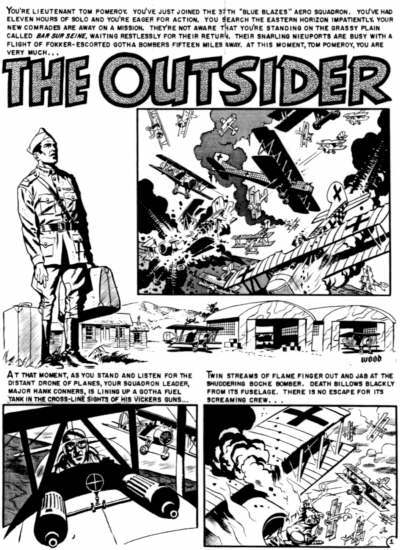
The Outsider

Yes, I'm not politic. I don't socialize with others. If I did have friends I suppose they would be academics and artists. I trained as a lawyer, but never practiced law. If I had practiced law, I would probably socialize with other lawyers. But that would be hell! If I were invited to lawyers' parties, I would refuse. I would just not fit in, I would not be a part of the society that lawyers form, and I would be out of place at such affairs. The society of lawyers would bore me.

I can just imagine. They would talk about their houses in the country, the schools their children go to, their trips in the summer -- all that. I wouldn't feel comfortable with them. I recognize this as an old childhood trait. I've never felt "in" anywhere -- not in school, not in college, not in law school, not working at law firms. And now I'm playing it out in relation to the world at large. I am an outsider everywhere I go.

I suppose if I have a central fantasy, mine would be that of an outsider looking into the bedroom: feeling excited and scared, getting aroused, trying to figure out what is going on, but not having to get involved, not having to risk anything. There are many ways of playing out this fantasy. I could have become a Peeping Tom, for one extreme possibility, but I became a professional outsider instead -- an observer who gets to know another person very intimately from outside but doesn't have to get involved with him. I'm very much a Jew -- another kind of outsider.

Do I want to be an "insider?" Yes and no. I have always felt a hunger for a certain kind of closeness that friends and membership in clubs, societies, and professional organizations confer, a certain kind of solidarity, for the warmth of belonging somewhere that was part of the mainstream. At the same time, even as a child, I never felt that I genuinely belonged. Growing up I felt both a certain disdain for an ordinary sense of belonging, and a hunger or nostalgia for it that has never entirely gone away.

Thursday, September 20, 2007

A Chaotic Order

My whole life was about to change at about age thirty: I was going to step into a hole and spend the coming years in the dark. Typical, I thought, for my life as I lived it then--in bewilderment, frowning at the futility and resenting the squandered time as it unrolled and flapped around me--seemed ragged and plotless: random, rancorous, out of my control, meandering from disorder to chaos, in the general direction of oblivion. In retrospect, from the vantage point of middle age--from the helpful heights and clear air that are part of aging's greatest consolations--I see that my life was in fact closely plotted and consequential, with the structural elaboration and subtle motifs of a Victorian novel, interwoven with grace notes, subplots, and coincidences that stretched credulity and yet were inevitable. This life of mine--perhaps all lives?--suffered from an excess of design: nothing was random, nothing wasted. The hole I'd stepped into was a magical thoroughfare that carried me to the future.

Though, as I say, at the time it all appeared to be an aimless monochrome of regret and shame, wrong turns and pointless effort. Whatever befell me, my mother's shrill cry was always: "It's your own goddamn fault!" That blame rang in my head for years.

Oddly, the clutter of my apartment reminds me of my relationship with my mother. More than any other place, the main room of my studio apartment, with its congested disorder, is symbolic of all my mother tried but failed to inculcate in me in all the years of my growing up. Vagrant pieces of furniture from different times and places are thrown together, partly out of financial necessity, and partly because of my eclectic taste. Oddly, these incongruous ingredients create a symmetry that another, more deliberately furnished apartment would lack. My apartment is an enchanted place--a place of orderly chaos--that carries me to the future.

My mother would go crazy if she were to see the piles of books and magazines against the wall and the assorted CDs and ceramic vases and plates and cups on the table and the curtainless window, which I refuse to dress. Does it really matter? My apartment window abuts an apartment building about twenty feet away whose nine-storey brick wall stands mute to the goings-on in my apartment.

When I was a child, my mother after surveying the clutter in my bedroom would lament, "I don't know if you really belong to me. Didn't I raise you to be orderly and organized?" Her tone was serious, but she repeated the same complaint to me for so many years that by adolescence it was almost a tender ritual. "Gary," she would say, "you are a grown-up boy now; act like one." Yet there was something in her tone that kept me young and fragile and obstinate, and still, when in memory I hear her voice, I know I never lived up to her expectations. I never did become the man she tried to will me into being.

Wednesday, September 19, 2007

Kyle XY: A Modern Kaspar Hauser

Kyle XY is an American drama television series about Kyle, a teenage boy who wakes up in the forest outside of Seattle, Washington with no memory of his life up until that point. The series follows Kyle as he tries to understand the mysteries of who he is, such as why he has no belly button or why he has no memory of being a child. Kyle has special abilities, both intellectual and physical. On one occasion he read the entire World Book Encyclopedia during the course of one day. Kyle is in fact a cloned human being. He has no memory of his past because for all intents and purposes he has no past. The company that created Kyle is determined to kill him to prevent a disclosure of the fact that he is a clone. His creators fear that Kyle's special abilities will give away his true nature in the outside world.

The show premiered June 26, 2006 on the ABC Family network; episodes are also broadcast on ABC and available for download from the iTunes Music Store.ABC Family has ordered 10 episodes for the first season, and another 13 episodes for the second season, set to air in 2007, but an exact air date has not yet been determined.

The fictional television drama Kyle XY has close parallels to the actual case of Kaspar Hauser.

The case of Kaspar Hauser was a cause celebre in his time, the early nineteenth century. Imprisoned in a dark cellar, he had been cut off from all human contact except for an occasional glimpse of his jailer (whom he called "the Man who was always there"). When Kaspar was turned loose he was discovered wandering in the streets of Nuremberg, Germany, at seventeen more a baby than a man.

Here are details of an eyewitness account: "He appeared neither to know or to suspect where he was. He betrayed neither fear, nor astonishment, nor confusion; he rather showed an almost brutish dullness . . . his tears and whimpering, while he was always pointing to his tottering feet [he seemed not to know how to walk correctly], and his awkward, and, at the same time, childish demeanor, soon excited the compassion of all present . . . his whole conduct . . . seemed to be that of a child scarcely two or three years old, with the body of a young man."

Kaspar had to be taught to speak and walk properly, to learn the difference between the organic and the inorganic. He showed an intense, passionate wish to learn and displayed unusual powers (he could distinguish colors in the dark, for example). Kaspar seemed asexual and incapable of anger; he showed no indignation at "the Man who was always there." It was as if some instinctual energy had been extinguished. When his teacher and protector, Anselm von Feuerbach, expressed surprise that Kaspar "should wish to return to that abominably bad man, Kaspar replied with mild indignation, 'Man not bad, man me no bad done.'" There proved no way of making up for the emotional deficits, and after a period of wonderful intellectual promise (the observers talked of genius) Kaspar, his mind unprepared emotionally to grasp how much he had been deprived of, gradually regressed into a kind of obsessive-compulsive automaton. His pathetic story (which led to romantic speculation that he was of royal blood) and the excitement of his education and subsequent murder were followed by thousands of readers in the newspapers of Europe. Von Feuerbach, who befriended Kaspar and helped care for him, wrote indignantly about Kaspar's imprisonment and "the cruel withholding from him of . . . all the means of mental development and culture -- the unnatural detention of a human soul in a state of irrational animality."

Even after his release at Nuremberg, Kaspar was subject to states of hypnosis and stuporous sleep.

Von Feuerbach writes: "Having been sunk during the whole of the earlier part of his life in animal sleep, Kaspar has passed through this extensive and beautiful part of it, without having lived through it. His existence was, during all this time, similar to that of a person really dead: in having slept through his youthful years, they have been passed by him, without his having had them in his possession; because he was rendered unable to become conscious of their existence. This chasm, which crime has torn in his life, cannot any more be filled up; that time, in which he omitted to live, can never be brought back, that it may be lived through; that juvenility, which fled while his soul was asleep, can never be overtaken. How long soever he may live, he must for ever remain a man without childhood, and boyhood, a monstrous being, who, contrary to the usual course of nature, only began to live in the middle of his life. Inasmuch as all the earlier part of his life was thus taken from him, he may be said to have been the subject of a partial soul-murder . . . the life of a human soul was mutilated at its commencement."

Kaspar Hauser was eventually stabbed to death in a public park by a mysterious stranger, thought to be his jailer, or an agent in the jailer's employ. It is believed that his jailer wanted the facts of Kaspar's childhood imprisonment to remain secret.

Tuesday, September 18, 2007

Working Behind the Scenes: A Dream

He dreamed he was back in his childhood in the little town of his birth. He was a child about seven years old, walking into the country with his father on the evening of a holiday. He was walking with his father past a tavern on the way to a graveyard; he was holding his father's hand and looking with dread at the tavern. A peculiar circumstance attracted his attention: there seemed to be some kind of festivity going on, there were crowds of gaily dressed townspeople, peasant women, their husbands, and riff-raff, mysterious riffraff of all sorts, all singing and all more or less drunk.

Hideously masked or painted out of all semblance of humanity, they had tramped out a strange limping dance round the square; round and again, singing as they went, round and round--faster and faster, so fast that it finally sounded like a stampede of wild horses, and all of a sudden, in the middle of it several voices cried out:

"Men to the left! Women to the right!" ". . . clear this out now!" They shouted again: "Get out!" "Right or left, or in any direction."

Two lines were forming. An elderly woman shouted something in German. I failed to understand.

"Rascher! Nochmals von vorn anfangen! . . . " A surge of attention, unspoken, identifiable only in a certain convergence of stillness, an inward tensing.

I had not had time to think, but already I felt the pressure of my father's hand: we were alone.
"Come along, come along!" said his father.

What was happening? What on earth were they doing? Who are the people working behind the scenes?

"Abba, Father, what are they doing? Why won't you look at me, why won't you explain what is happening?"

"They are drunk . . . They are brutal . . . It's not our business!" said his father.

I went on walking. My father held onto my hand. Behind me, an old man fell to the ground and was then beaten over the head. Through all my limbs a shudder ran.

Time was running out.

The boy put his arms round his father but he felt choked, choked.

His father said: "Look, we have reached the boundary-we must part now; you must not accompany me any further-go back!"

"What would happen if I followed?" asked the child, looking round at the horizon that was clear.

There was a silence.

At that instant his father paused to look: with a sudden recollection, or by an impulse, he shook his head and glanced at his son with deep, tragically knowing eyes and--and--walked on into the distance, the far distance--and at this point slowly vanished, a remote and isolated figure, a dark blur on the very edge of the horizon.

It came at last to this--

A minute later the square was empty, only the boy remained, alone and forsaken in the world a sole survivor and an empty shell.

Sunday, September 16, 2007

A Librarian on Capitol Hill

My local librarian, Brian Brown, used to work
in the deep recesses of the Library of Congress,
nothing so grand as the sea, merely
a library on Capitol Hill, barely
several acres in size, no bigger
in the scheme of things
than a soup spoon's bowl,
but it held him, it cradled him,
early in his career,
this place as vast as death,
small as life. It reduced him
to a speck in the universe.
The size of him, after all,
was vast and small.
It filled the spoon; it disappeared.

Thursday, September 13, 2007

Not So Much Pepper Here

I am sitting at a small desk, facing a wall in a small room--really a walk-in closet--in my apartment. My "view" encompasses a framed poster that I retrieved from the trash room in my apartment building, a poster that advertises an exhibit at The National Gallery of Art. To my left is a wall of shelves that houses a disordered array of books and papers. To my right is a chest of drawers that contains more books and papers and magazines. At my rear is an assortment of boxes that contain a forlorn archive, the accumulated detritus of my fifty-two years. It is in this place, this environment, that I compose my blog posts. On the desk sits a ten-year-old word processor that fortunately still performs its designated purpose.

I will tell you what I know about letting yourself write.

The first trick, the one I am practicing now, is to just start where you are. It's a luxury to be in the mood to write. It's a blessing but it's not a necessity. Writing is like breathing, it's possible to learn to do it well, but the point is to do it no matter what.

Writing is like breathing. I believe that. I believe we all come into life as writers. We are born with a gift for language and it comes to us within months as we begin to name our world. We all have a sense of ownership, a sense of satisfaction as we name the objects that we find. Words give us power.

As toddlers, first we grab and then we grab with words. Every word we learn is an acquisition, a bit of gold that makes us richer. We catch a new word and say it over and over, turning it like a rich nugget in the light. As children, we hoard and gloat over words. Words give ownership: we name our world and we claim it.

As children, we learn new words at an astonishing clip. Words give us leverage: "Me go with Mommy!" Or, "Mommy stay." Children are specific and direct. They don't beat around the bush. Their words are personal and powerful. They are filled with will and intent. They are filled with passion and purpose. Children trust the power of words.

If words give us power, when do we start to lose our power over words? When do we start to feel that some of us are "good" at language and even have a shot at being "writers" while the rest of us just happen to use it and don't dare consider ourselves in that league?

My guess is that for most of us school is where this sorting starts to happen. School is where we are told, "You're good with words . . . " The neat teacherly scrawl, diagonally written across the top right-hand corner of the top page of, say, a geography report on Mexico, "Well written."

Well written--what does that mean? In school it usually means clear, orderly thinking. Neat enough grammar. Lots of orderly facts. It may also mean things we are taught, like "topic sentences" and "transitions." Very often it does not mean words that sing off the page, innovative word combinations, paragraphs of great free associations and digressions--all the gifts a young poet or novelist might have and want to use but not find useful under the scholarly discipline of an academic paper.

What happens when writing of that kind shows up in school papers? Too frequently, it's another margin note, this time negative: "You stray from the topic a bit here" or "Stick to the point." It is a rare teacher who takes the time and care to praise the kind of writing that doesn't fit into an academic paradigm. It's as though scholastically we're on a pretty strict diet: "Not so much pepper here."

Thursday, September 06, 2007

September


The rain falls cool among the flowers.
Summer shivers quietly
On its way towards its end.

Golden leaf after leaf
Falls from the tall acacia.
Summer smiles, astonished, feeble,
In this dying dream of a garden.

For a long while, yet, in the roses,
She will linger on, yearning for peace,
And slowly
Close her weary eyes.

by Hermann Hesse

Wednesday, September 05, 2007

The Library


What's amazing to me about the library is it's a place where you go in you can take out any book you want they just give it to you and say bring it back when you're done.

It reminds me of like this pathetic friend that everbody had when they were a little kid who would let you borrow any of his stuff if you would just be his friend. That's what the library is. A government funded pathetic friend. And that's why everybody kind of bullies the library. I'll bring it back on time ... I'll bring it back late.... Oh, what are you going to do? Charge me a nickel?